


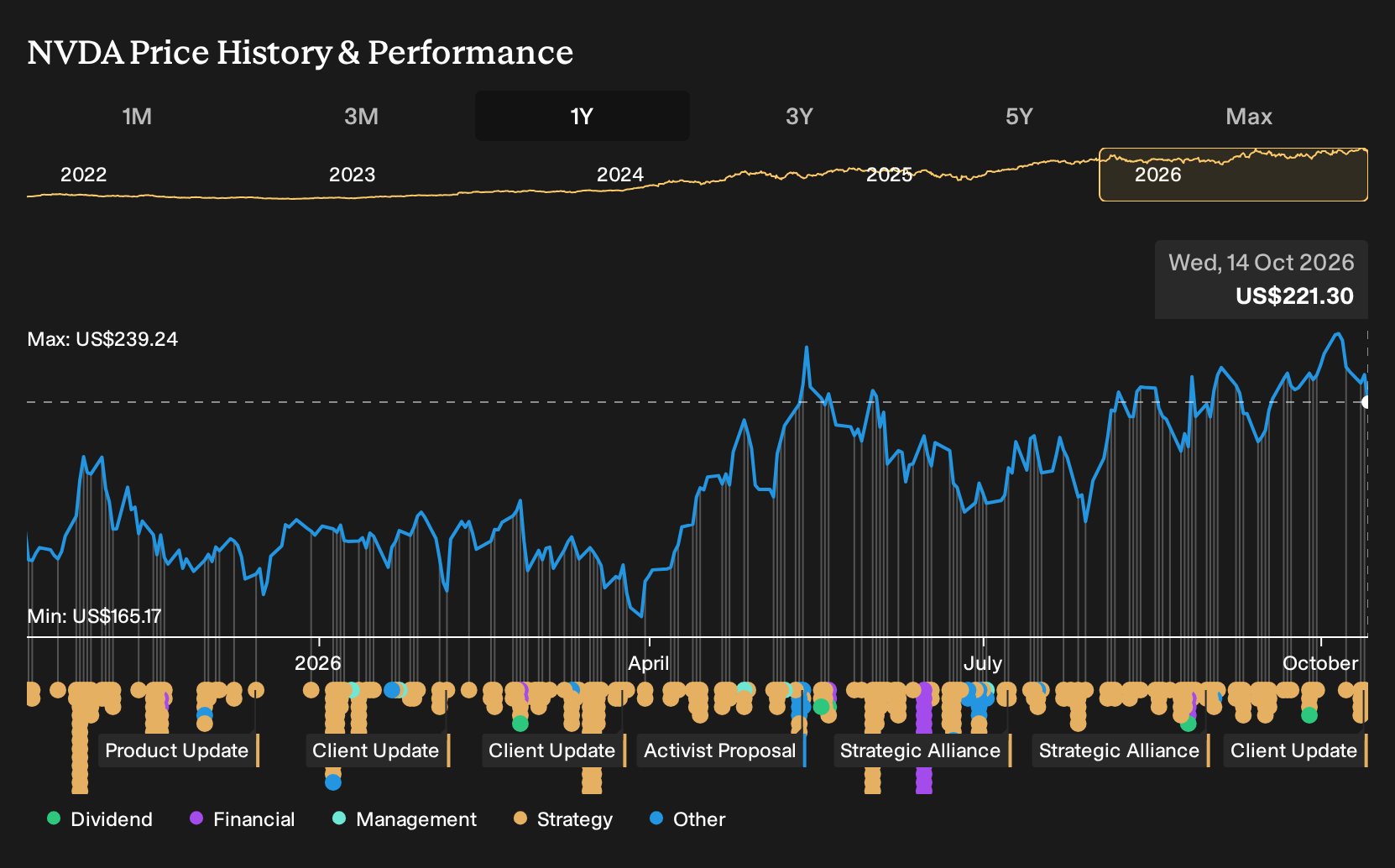
- NVIDIA faced fresh pressure as a sector wide selloff in semiconductor and AI stocks followed hotter than expected inflation data, which raised concerns about higher interest rates and the cost of funding AI data centers.
- The pullback highlights a key operational risk for NVIDIA, namely that AI infrastructure buildouts depend on cheap capital, so higher borrowing costs can weigh on customers’ ability to finance large GPU orders.
- We will look at how NVIDIA's investment narrative holds up when AI demand meets higher financing costs and sector wide volatility.
What Is NVIDIA's Investment Narrative?
NVIDIA’s investment story is about owning the picks and shovels of AI, not just single chips. The core belief is that hyperscalers, enterprises and governments keep leaning on its full stack, from GPUs and Vera Rubin platforms to CUDA-X software and networking, to run heavier AI and data workloads. That requires tight execution on supply, high capital intensity in partners’ data centers and pricing that reflects scarce capacity without choking off demand. Recent share price moves, with the stock down over 6% in a week, show how quickly sentiment can swing when funding costs for AI projects rise.
The latest partnerships point in a different direction. CUDA-X upgrades, cuPotential for atomic simulation and agentic AI projects with Honeywell, Danaher and LSEG all pull more critical workflows onto NVIDIA’s platform. The ChipAgents Build A Chip Bench collaboration goes even deeper, tying NVIDIA GPUs and software into how chips themselves are designed. These look incrementally positive for long term demand rather than immediate revenue catalysts, while near term risk still revolves around AI customers’ financing constraints, export controls and supply chain pressure in areas like high bandwidth memory.
Yet before treating this AI infrastructure story as fully de risked, it is worth pausing on ...
There's only one way to know the right time to buy, sell or hold NVIDIA. Head to Simply Wall St's company report for the latest analysis of NVIDIA's Fair Value.
Exploring Other Perspectives
One alternate NVIDIA story is all about margin risk rather than AI expansion. The most cautious analysts were already pencilling profit margins falling from 63.7% to 53.2% and earnings of about US$375.5b by 2029, then applying a much lower 17.7x P/E. That is a very different mood from the upbeat AI factory headlines you see today. These views were set before this week’s agentic design and CUDA-X news, so you may want to ask whether fresh alliances make that pessimistic path more or less likely, and explore both sets of assumptions yourself.
Explore 91 other NVIDIA fair value estimates, including one that suggests there may be as much as 7% downside from the current price.
Reach Your Own Conclusion
Disagree with this assessment? Extraordinary investment returns rarely come from following the herd, so consider relying on your own analysis and judgment.
- A great starting point for your NVIDIA research is our analysis highlighting 4 key rewards and 2 important warning signs that could impact your investment decision.
- See our latest analysis for NVIDIA. The report includes a comprehensive fundamental analysis summarized in a single visual, the Snowflake, making it easy to evaluate NVIDIA's overall financial health at a glance.
Looking For More Investment Ideas Beyond NVIDIA?
If the NVIDIA story has you thinking about portfolio balance and fresh opportunities, it can help to scan a wider field of companies that match the kind of risk and quality profile you want.
- For investors who care most about valuation and business quality, use the screener to focus on 32 high quality undervalued stocks that may align better with your return expectations and risk limits.
- If stability and financial strength matter more than headline growth, filter for a list of solid balance sheet and fundamentals (25 results) so you can concentrate on businesses with sturdier fundamentals behind their share prices.
- When you want something off the beaten track but still grounded in fundamentals, the screener can surface a 20 high quality undiscovered gems that might deserve a place on your watchlist next to NVIDIA.
This article by Simply Wall St is general in nature. We provide commentary based on historical data and analyst forecasts only using an unbiased methodology and our articles are not intended to be financial advice. It does not constitute a recommendation to buy or sell any stock, and does not take account of your objectives, or your financial situation. We aim to bring you long-term focused analysis driven by fundamental data. Note that our analysis may not factor in the latest price-sensitive company announcements or qualitative material. Simply Wall St has no position in any stocks mentioned.
Have feedback on this article? Concerned about the content? Get in touch with us directly. Alternatively, email editorial-team@simplywallst.com