


At a time when demand for epidemic prevention materials is normalized and medical consumables valuations are returning to cash flow and channel capacity, medical-grade mask manufacturer Top Leader Universal (Top Leader Universal) is entering the capital market. Recently, Ricoh International submitted an F-1 prospectus for the first time to the US Securities and Exchange Commission (SEC) to apply for listing on the OTCQB market. The plan is to issue 2.5 million shares at US$1.5 per share, and it is proposed to raise approximately US$3.75 million.
It is worth noting that Ricoh International is trying to tell not only the story of masks, but also the entire chain from raw material procurement, clean room production, packaging quality inspection to five types of terminal distribution, and extends to multi-brand matrices such as TL Gloves, TL Clean, TL Beauty, and Calipro. Can this model actually form a collaborative premium, or is it just a matter of business collage? We will break it down one by one below.
Performance growth was slightly weak, and operating cash flow bucked the trend
According to the prospectus, Ricoh International uses Hong Kong as its operating base. The brand TL Mask focuses on medical-grade masks. It has an ISO Class 8 clean room, over 23 production lines, and has obtained ASTM Level 3, EN14683 IIR and CE certifications, with a filtration efficiency of over 99%. These qualifications constitute a “compliant ticket” to hospitals, pharmacies, and European export markets, but certification barriers are not equivalent to pricing rights. For low-value medical consumables companies, what the capital market is more concerned about is whether production capacity can be converted into continuous revenue, whether channels can bring repurchases, and whether profits can maintain resilience in raw material fluctuations and cost investment.
Through its 2024 and 2025 income statements and cash flow statements, we can clearly see that under the apparent stagnation of revenue growth, the company is facing downward pressure on gross margin.
Ricoh International's revenue for 2024 and 2025 was US$3.713,200 million and US$3.72.2 million, respectively, a slight increase of 0.24% over the previous year. With more than 23 production lines and production capacity endorsements from ISO Class 8 clean rooms, revenue growth is almost zero, which directly reflects that its core mask business has reached the ceiling of demand. The dividends of epidemic prevention materials brought about by the epidemic have completely declined, and the industry has entered the stock game stage, lacking the explosive power of the second growth curve.
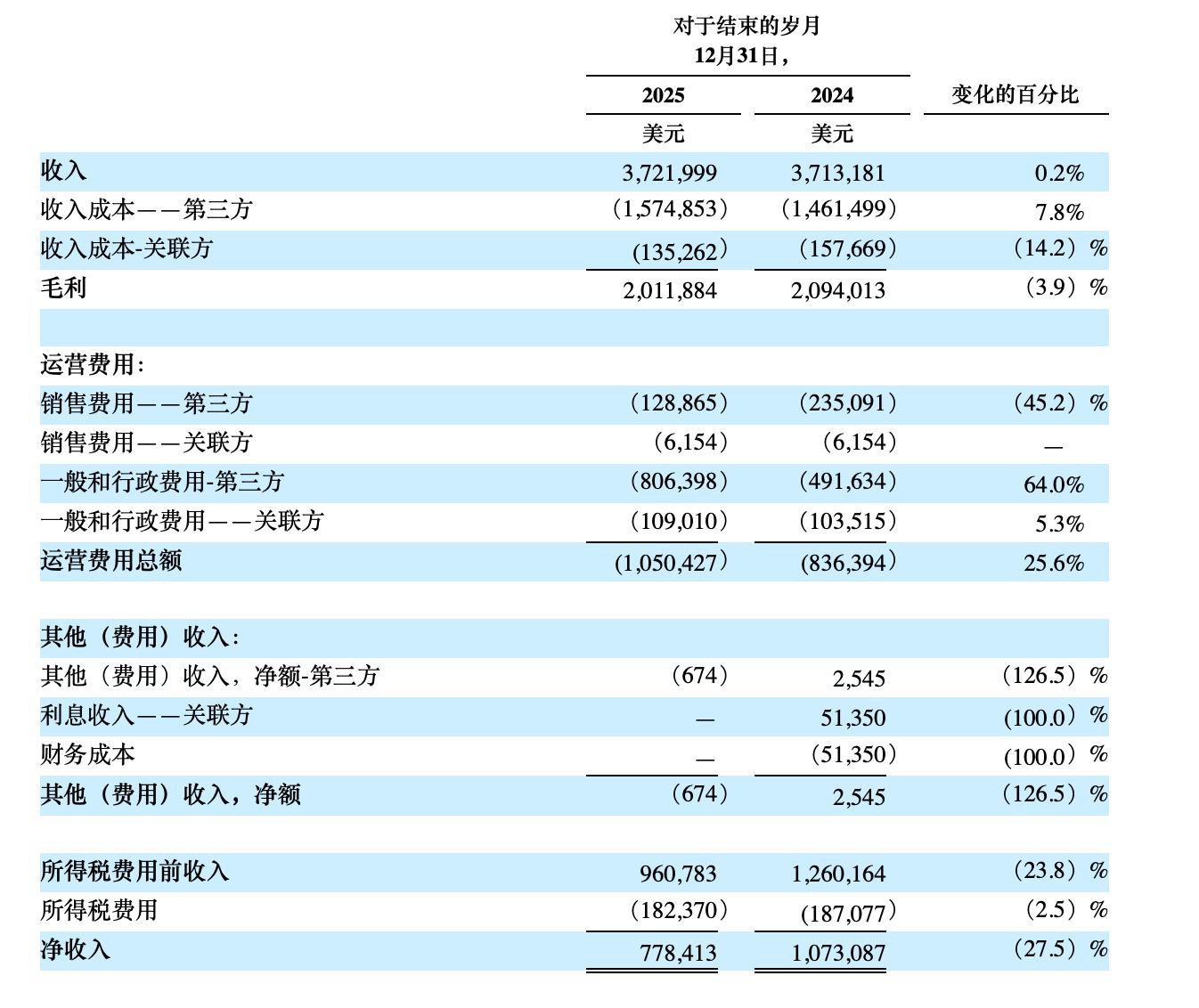
Even more serious is the pressure on its profitability. The company's gross profit fell from US$2,094 million in 2024 to US$20.19 million in 2025, a decrease of 3.9%; gross margin fell from 56.4% to 54.1%. The core reason for the decline in gross profit is the rise in revenue costs: third party revenue costs increased 7.8% year over year, and although related party costs fell 14.2%, they were unable to hedge against overall cost increases. In a situation where there is limited room for price increases for terminal products, fluctuations in raw material prices and marginal changes in capacity utilization continue to squeeze profit margins.
Of note is the structural change in operating expenses. In 2025, the company's sales expenses (third party) fell sharply by 45.2% to $128,900, while general and administrative expenses (third party) surged 64.0% to $806.4 million. It forms a “drop of one liter” scissor difference. In the end, total operating expenses surged 25.6% year on year in 2025, which directly led to a 23.8% year-on-year decline in revenue before income tax, and the net profit plummeted from US$1.073,300 to US$778,400, a drop of 27.5%.
However, compared to the bleak income statement, the cash flow statement showed a different picture. In 2025, the net cash provided by the company's operating activities reached US$745,500, a significant increase of 74.8% from US$426,300 in 2024. Against the backdrop of a sharp decline in net profit, operating cash flow bucked the trend. This usually means that changes in working capital (inventory, accounts receivable, accounts payable) have released cash.
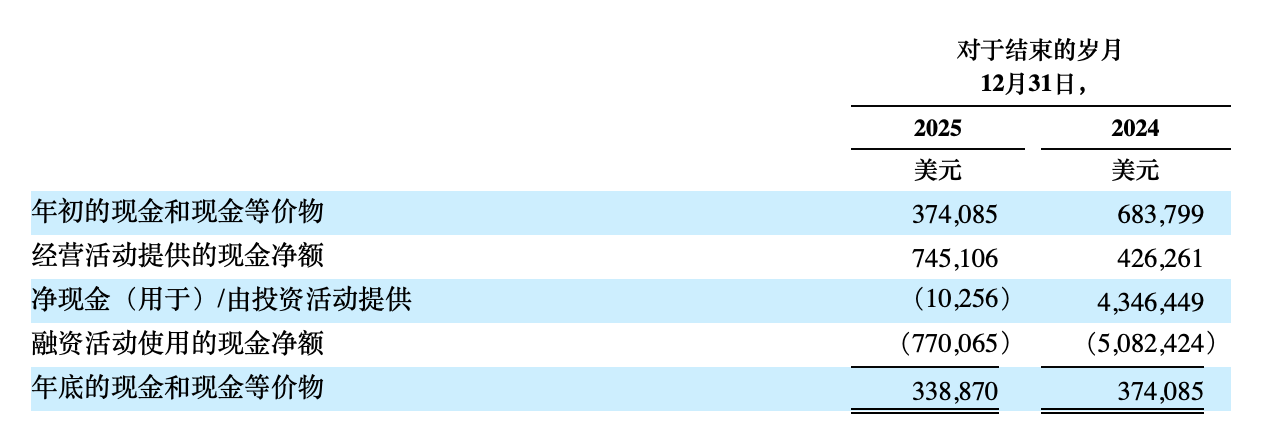
In summary, Ricoh International's zero revenue growth and cliff-style decline in net profit indicate that its core mask business has lost its high growth engine and the improvement in operating cash flow does not seem to be a restoration of endogenous profitability. Today, when the overall valuation of the medical consumables sector is recovering, and the market favors steady cash flow and high-growth deterministic assets, Ricoh International may face pressure if it is unable to provide a viable path to break through revenue bottlenecks.
Can the battle to break through the second growth curve with a “closed loop of the whole chain” work?
In order to find a second growth curve, Ricoh International began telling a growth logic story centered on the “full chain closed loop”.
Is this closed-loop logic a “moat” that supports high valuations, or is it a “blind box” that distracts energy?
Judging from financial data, Ricoh International's revenue base is still stable. In 2025, the sales revenue of homemade mask products reached US$3.5623 million, an increase of 3.1% over the previous year, accounting for 95.7% of total revenue. This slight increase may seem banal, but against the backdrop of the normalization of global demand for masks and serious overcapacity in the industry, it is not easy to stabilize the basic market with strict qualifications such as ISO Class 8 clean room certification and ASTM Level 3 and EN14683 IIR. This shows that its “medical grade” positioning has strong customer stickiness in B-side hospitals and pharmacy channels.
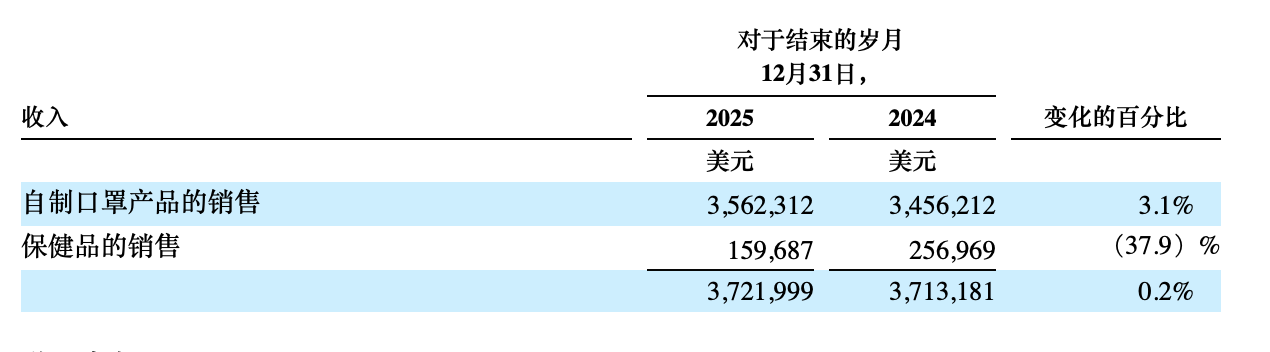
However, the highly anticipated second growth curve — health product sales — experienced a sharp drop in 2025. Revenue plummeted 37.9% from $257,700 the previous year to $159,700, accounting for less than 5%. This structure of “a slight increase in main business and a stalling of side businesses” poses Ricoh International's current concerns. In the prospectus, the company clearly proposed “transferring more resources to the nutritional products market” with the aim of making up for the decline in mask sales expectations through product diversification. However, judging from performance, this strategic transformation does not seem to have been a success.
It is worth mentioning that on the manufacturing side, Ricoh International's strategic plan shows strong industrial genes. The company plans to further increase its daily production capacity from the current 150,000 masks by purchasing new mask production machines and upgrading existing automation components. In the field of low-value medical consumables, homogenization competition is fierce, and there is extremely limited room for price increases for terminal products. The core competitiveness of enterprises lies in cost control. The better production speed, higher accuracy and reliability brought by the new machine, combined with the replacement of manual monitoring stations with automated components, will directly reduce unit production costs and improve operational efficiency. At the same time, the expansion of production capacity allows it to calmly handle larger order volumes during peak demand periods, which is essential for accepting large orders from overseas OEMs and expanding the international market. It can be said that the closed loop on the manufacturing side has established a bottom-line defense of “exchanging volume for price and efficiency to protect profit”.
However, after all, diversification on the product side is the most imaginative part of the closed loop of Ricoh International's entire chain. The company plans to develop enhanced functional masks for different face types and different industry environments (such as extending wearing comfort), and use the TL Gloves (gloves), TL Clean (disinfection), TL Beauty (skincare) and Calipro (health products) brand matrices to extend the product line from a single medical protection to the field of health consumption. If this synergy works, the company's market positioning will be upgraded from a “multi-purpose mask supplier” to a “comprehensive healthcare provider”, thereby breaking the ceiling of the mask market and realising the restructuring of the valuation logic. However, it should be noted that the marketing style of health products and skincare products with stronger consumer properties is completely different from B-side collection and pharmacy distribution of medical consumables, which severely tests the company's ability to operate the brand.
Taken together, Ricoh International's “full chain closed loop” strategy is an active defense and active breakthrough of its current business difficulties. However, the capital market's gaze has always been cautious. At the end of the day, a strategic narrative must be translated into financial performance. Currently, if Ricoh International wants to take a thrilling leap through an IPO, it must prove to investors that its full closed loop can bring positive operating cash flow, not just blind expansion of the commercial landscape.