


After artificial intelligence (AI), Elon Musk's SpaceX (SPCX) is seeking to upend another established industry. On October 8, when the company announced that it had acquired 14 MHz of paired nationwide 800 MHz low-band spectrum from Grain Management for $8 billion, it sent shares of the existing carriers on a downward spiral.
After the announcement, AT&T (T) and Verizon (VZ) shares ended almost 10% lower the next day; SpaceX's partner, T-Mobile (TMUS), saw the sharpest drop, about 13%. Moreover, in T-Mobile's case, the bitter irony was that it had just sold that exact 800 MHz block to Grain Management on August 11, 2026, for $2.9 billion in cash plus 600 MHz licenses. On the other hand, Grain gained $5 billion in just a couple of months.
Pivotal Reckoning
Now, boutique institutional research firm Pivotal Research has joined the Starlink Mobile bandwagon. Starlink Mobile is SpaceX’s cellular division and direct-to-smartphone satellite network.
Lead analyst at the firm, Jeffrey Wlodarczak, in a recent research report, expected Starlink Mobile to add about 160 million subscribers by 2036. This would comprise 110 million international subscribers and 50 million subscribers from the US, giving a 13% market share in the latter, potentially. Delving further, Pivotal forecasts Starlink Mobile to become EBITDA-positive by 2030 and generate EBITDA of $3.5 billion in 2032 and $15 billion by 2036. Citing strategic benefits, Pivotal posits that Starlink Mobile could complement SpaceX's other businesses such as Cybercab and Optimus, among others. Some risks were also highlighted, chief among them being the $900 billion in additional financing expected to be required to build the infrastructure for Starlink Mobile, along with regulatory hurdles.
Overall, Pivotal reiterated its “Buy” rating on the stock and increased its price target for SPCX stock to $230 from $220, indicating a potential upside of about 47% from current levels.
But what could be the reason, or possibly reasons, for Pivotal's bullishness about Starlink Mobile?
Strong Signals With Some Resistance
SpaceX is entering the wireless telecommunications sector with a distinctive structural advantage grounded in vertical integration, owned spectrum, and an operational orbital constellation. The company currently runs approximately 650 first-generation Direct to Cell satellites that can provide text messaging, emergency services, and limited application data to standard smartphones. This capability is supported by federal approval secured in October 2026 to launch up to 15,000 next-generation V2 satellites.
Notably, a critical development is that SpaceX no longer depends on leasing spectrum from partner carriers. Through a $17 billion purchase of EchoStar’s (ECHO) 2 GHz mid-band spectrum and an $8 billion transaction for Grain Management’s nationwide 800 MHz low-band spectrum, the company now controls nearly 80 MHz of valuable United States cellular frequencies. Combined with its existing base of more than 12 million Starlink broadband subscribers worldwide and a network of terrestrial gateway stations, SpaceX already has the infrastructure, backhaul capacity, and distribution pathways needed to expand a national wireless offering.
Moreover, to compete with established players such as AT&T, Verizon, and T-Mobile, SpaceX is pursuing a hybrid orbital and terrestrial approach rather than functioning solely as a satellite backup service. By pairing its 2 GHz mid-band spectrum for high-capacity performance with 800 MHz low-band frequencies that penetrate buildings and vehicles, Starlink Mobile intends to deliver continuous indoor and outdoor 5G connectivity.
Further, SpaceX plans to integrate cellular micro radios, or femtocells, into millions of residential and commercial Starlink terminals. This strategy would create a distributed terrestrial small cell network across communities without incurring lease costs from cell tower REITs.
Finally, SpaceX’s core competitive edge stems from ownership of its own launch vehicles, which can be deployed and upgraded at relatively low incremental cost. This structure allows the company to avoid the heavy legacy debt loads, unionized field maintenance workforces, and physical retail networks that constrain the major traditional carriers.
That said, expanding into dense urban markets is likely to present challenges for Starlink Mobile. Conventional terrestrial operators address urban capacity constraints through intensive spatial reuse, deploying large numbers of macro towers and small cells in proximity so that the same frequencies can be reused repeatedly. Achieving comparable density from satellites would involve substantial expense. Additionally, SpaceX’s total spectrum holdings of roughly 79 MHz remain considerably smaller than the hundreds of megahertz of mid-band and millimeter-wave spectrum controlled by Verizon and T-Mobile.
SpaceX Q2 Recap
SpaceX has achieved substantial revenue expansion over recent years, with totals climbing from $10.4 billion in 2023 to $18.7 billion in 2025. The company recorded net income of $791 million in 2024 before reporting a net loss of $4.9 billion the following year. Operating cash flow strengthened during this timeframe, advancing to $6.8 billion in 2025 from $4.5 billion in 2023. SpaceX closed 2025 with a robust cash balance of $24.7 billion and minimal short-term debt, which helps address liquidity risks.
During the second quarter of 2026, SpaceX generated revenue of $7.8 billion, reflecting a 92% year-over-year increase. Net losses improved to $541 million from a $1 billion loss in the same period a year earlier. At the end of the quarter, the company held $93.5 billion in cash and cash equivalents.
Capital spending has increased substantially over the past three years, rising from $4.4 billion in 2023 to $20.7 billion in 2025. Investments related to artificial intelligence have grown especially quickly, beginning at $463 million in 2023 as the smallest category among space, connectivity, and artificial intelligence before expanding to $12.7 billion in 2025. This evolution shows how SpaceX, which originally concentrated on space operations and connectivity offerings, is now establishing artificial intelligence as a foundational element for future growth. Artificial intelligence capital expenditures alone reached $15.8 billion in the second quarter of 2026.
Reviewing the second quarter revenue mix, connectivity continued to lead with $4.29 billion. The artificial intelligence segment produced $2.56 billion, while the space segment added $962 million.
From a valuation standpoint, SPCX stock remains significantly elevated relative to peers. Its forward P/S and P/CF at 49.01 and 78.26, respectively, are above the sector medians of 1.11 and 7.40, respectively.
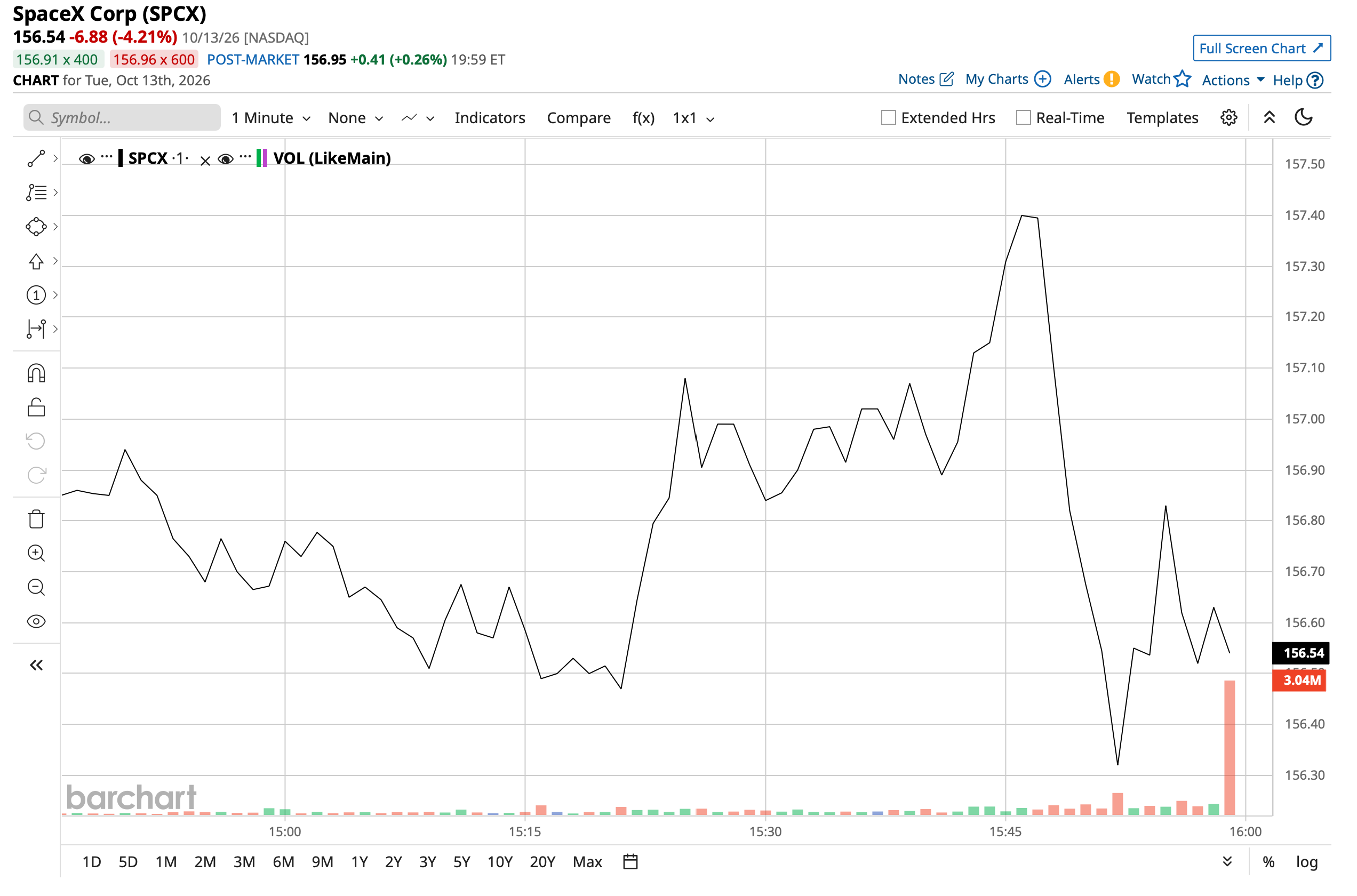
SPCX stock is down 2.7% since its IPO, and the company's market cap currently stands at $2.1 trillion.
Analyst Opinion
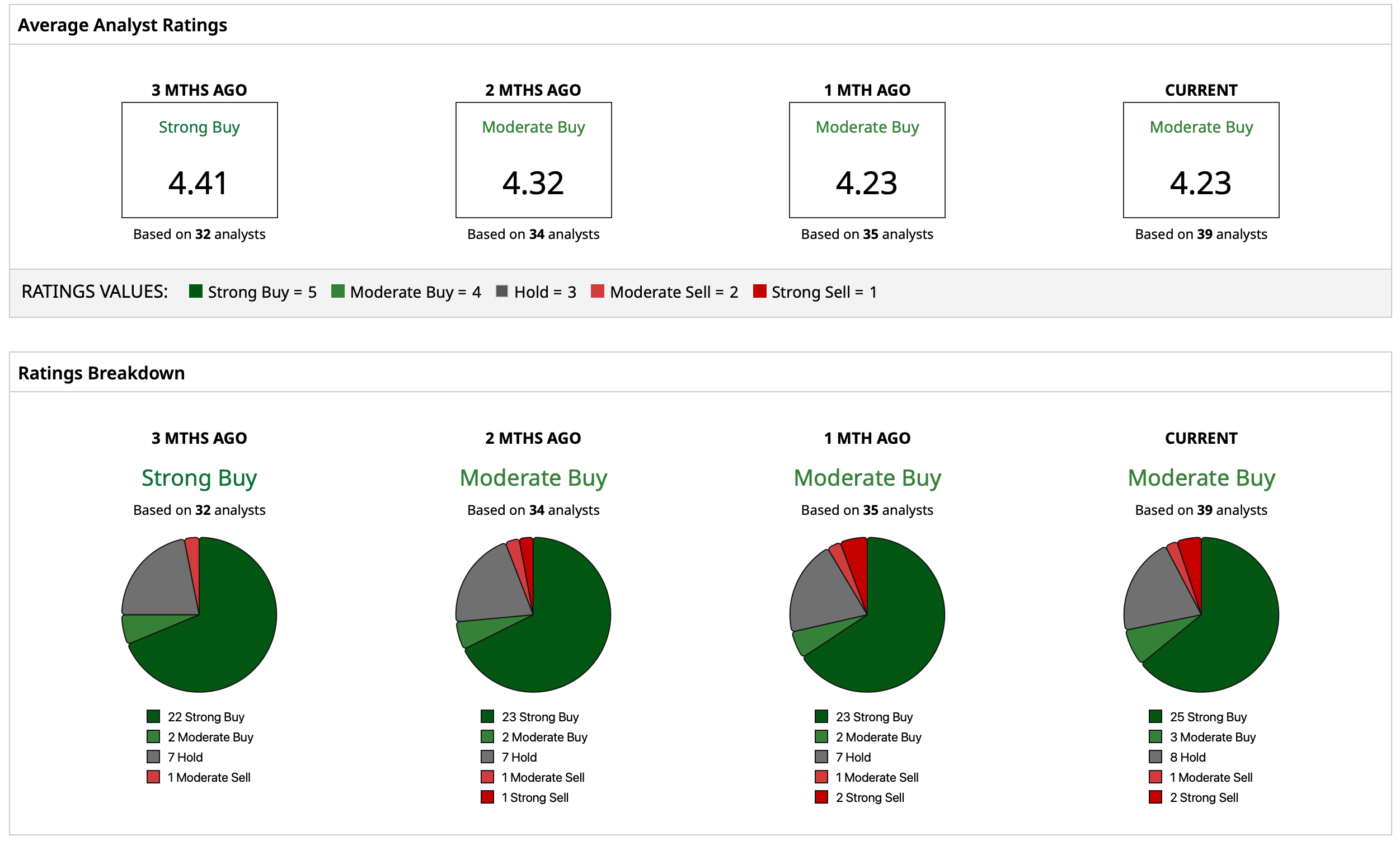
Considering all this, analysts have deemed SPCX stock to be a “Moderate Buy.” The mean target price of $224.86 denotes a potential upside of 43.6% from current levels. Out of he 39 analysts covering SPCX stock, 25 have a “Strong Buy” rating, three have a “Moderate Buy” rating, eight have a “Hold” rating, one has a “Moderate Sell” rating, and two analysts have a “Strong Sell” rating.
On the date of publication, Pathikrit Bose did not have (either directly or indirectly) positions in any of the securities mentioned in this article. All information and data in this article is solely for informational purposes. For more information please view the Barchart Disclosure Policy here.