


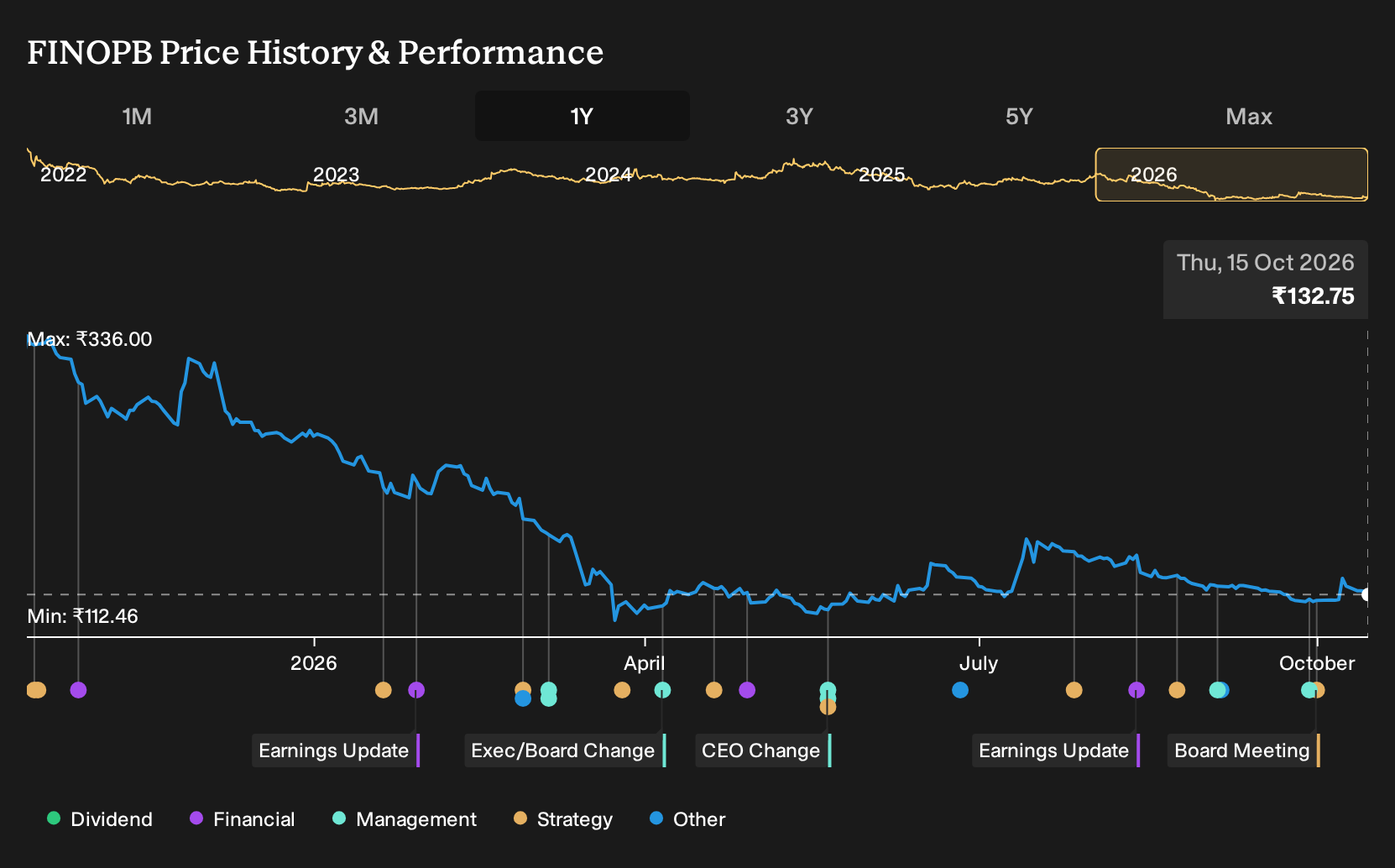
If you had looked at Fino Payments Bank on 15 October 2025 and decided to skip it after reading the split between bullish digital optimism and cautious views on regulation and legacy cash services, the next year would have felt very different from holding on. Investors who held Fino Payments Bank over the past year are down 59.8%, including dividends. What early warning in those published expectations about digital migration, regulation, or fees deserved closer attention?
The easy part of this move is behind Fino Payments Bank. Zero in on 197 high quality undervalued stocks for companies trading below our estimates.
The Two Stories Investors Had To Choose Between On Fino Payments Bank
The shares cost ₹336 at the start of the period, and anyone looking at Fino Payments Bank then had to decide which story about its future felt more realistic.
The bullish narrative pointed to a Fair Value of ₹390. That price would only make sense if rapid digital adoption, rising on-us transactions, and deeper rural reach lifted digital revenue to well above 25% of total and supported higher earnings and margins.
The more cautious view set Fair Value at ₹300, assuming slower revenue expansion, rising compliance and technology costs under tighter RBI oversight, and pressure on legacy remittance and fee income as customers shifted toward self-service digital payments and UPI.
What The Results Changed For The Fino Payments Bank Story
The clearest new fact was the Q1 2027 result. Fino Payments Bank reported revenue of ₹2,715.4m and a net loss of ₹137.2m, which pulled net margin down to -5.1%. That outcome challenged the optimistic case that expected stronger profitability from digital adoption and sat closer to the cautious view that tighter RBI oversight and higher costs could weigh on earnings.
The hinge assumption here was earnings quality, not just digital buzz. When you look at another stock with a big digital narrative, check whether net margin and absolute profit are actually moving in the direction the upbeat story expects once new tech and compliance spending hit the income statement.
What Fino Payments Bank's Price Drop Really Reflects Today
Today Fino Payments Bank trades at ₹133, with the story now hinging less on digital promise and more on basic earnings power. Over the past year, the share price move outpaced the shift in top line, while the key operational shock came from profitability.
Revenue moved from ₹4,250.9m in Q1 2026 to ₹2,715.4m in Q1 2027, and profit swung from ₹177.6m to a loss of ₹137.2m as net margin fell from 4.2% to -5.1%. The open question is how much future margin repair the current valuation quietly assumes, which the valuation CTA can help you test.
We value every stock in the world, every day. See what our valuation says Fino Payments Bank is worth now.
One Step Beyond Fino Payments Bank
The Fino Payments Bank story highlights digital banking trade offs. You saw what happens when technology spending meets tight regulation.
Take that same hunger for branch free finance and look elsewhere. Some lenders are built from the start around a phone only relationship.
One of them runs everything through a single app, from everyday spending to investing and insurance. It tries to remove almost all physical friction.
That kind of model focuses on very low running costs and deeper data on customer habits. If those features hold, its role in digital finance could diverge from Fino Payments Bank.
It is written up in full, assumptions and all. → Explore the Narrative that puts this company 54% above its price
This article by Simply Wall St is general in nature. We provide commentary based on historical data and analyst forecasts only using an unbiased methodology and our articles are not intended to be financial advice. It does not constitute a recommendation to buy or sell any stock, and does not take account of your objectives, or your financial situation. We aim to bring you long-term focused analysis driven by fundamental data. Note that our analysis may not factor in the latest price-sensitive company announcements or qualitative material. Simply Wall St has no position in any stocks mentioned.
Have feedback on this article? Concerned about the content? Get in touch with us directly. Alternatively, email editorial-team@simplywallst.com