


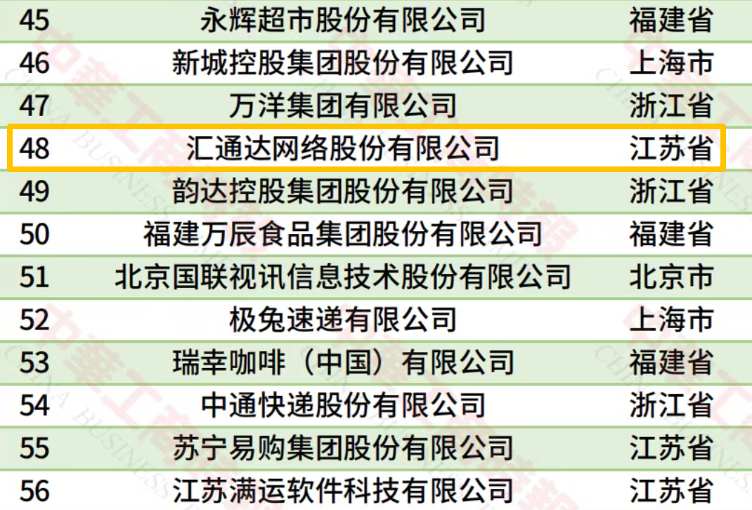
Recently, the All-China Federation of Industry and Commerce released the “2026 Top 500 Chinese Private Enterprises” list in Tianjin, and Huitongda Network (09878) once again ranked among them. This is the 8th year in a row that the company has been on this list. At the same time, it also ranks among the top 100 private service enterprises in China, ranking 48th in the top 100 service industry with revenue of 52.3 billion yuan.
A list records the scale of operations in a certain year. The one recorded for eight consecutive years is not just the scale.
The retail circuit has not been calm for the past eight years: the product structure and consumer market trends are rapidly shifting to high-frequency FMCG products, the retail industry is also gradually dividing into vector snacks and hard discount supermarkets, and technological tools are moving from basic informatization to AI-driven. The cards are being reshuffled every round of changes, and there is no shortage of ups and downs in the industry.
On the retail circuit of “leading the way for three to five years”, not only does Huitongda stand firm at the “table”, but also continue to find new growth. What does Huitongda rely on?
Going back to the strategic choice of foreign exchange access, the starting point was not to chase the cusp, but to actively sink into a “difficult and correct” sinking market. Today, this network covers 21 provinces and 26,000 townships, serving more than 250,000 member stores. According to the Zhitong Finance App, the scale itself is not a moat. What is really scarce is the business scenario that has settled down around this group of township husband and wife stores — products can be replaced, tools can be iterated, but once “who to serve and in what scenarios” has been repeatedly verified, it forms an anti-cycle chassis. This also explains that in e-commerce, the community, mass sales... “Let Me Go”, Huitongda's position in the industry continues to stabilize.
If the revenue figures show Huitongda's scale value and industry position, then the ability of the following three layers to be reused over and over again is the chassis that supports the continuous stable operation and iterative upgrades of this network.
The first is the ability to operate an end-to-end supply chain. The company's categories have migrated from the early “top three” products to today's high-frequency quick consumption of snacks, convenience, etc., but the full-link ability to deliver products from the factory to the terminal store has not changed. New categories can be connected to the existing network to obtain Huitongda's mature channel operation efficiency — this is the direct reason why Huitongda's category upgrades faster than peers.
The second is customer service capabilities. The digital foundation of sinking merchants is weak, and the launch of the system does not mean that it can actually be used. Huitongda's offline team covering the county area undertakes promotion, training and operation, so that every upgrade is implemented into the actual operation of the store. Because of this, its promotion costs and customer retention are superior to a pure online model.
The third is technical ability. From e-commerce in the sinking market to the industrial Internet to AI technology, the technology stack was replaced in three rounds, and the users and scenarios accumulated in the first two layers provided a ready-made entry point for each round of technology. Technology can be purchased, but it is not possible to carry the user scenarios and underlying data accumulation of the technology.
The three layers of ability are superimposed, the chassis remains unchanged, and the ability is gradually increasing - this is the essence of the cross-cycle.
As the retail industry enters a new cycle jointly defined by smart supply chains and AI, the value of these three levels of competency has become more clear. The implementation of AI in the sinking market faces three different thresholds from the urban market.
The first threshold is the scene. Most of the corpus of the GM Big Model is taken from standardized supermarkets in cities. Unstandardized retail sales rarely enter training sets; actual management itself is a scarce resource. The multi-format store network covered by Huitongda, as well as daily business operations such as purchasing, sales, product selection, and promotion, provided conditions for the model to be repeatedly calibrated in actual operation. Companies without scenarios can only export tools; companies with scenarios can directly deliver results.
The second threshold is a closed loop of data. The Huitongda system operates three types of customer groups: member stores, chain stores, and e-commerce merchants: the product selection and operation experience accumulated by member stores are reused in chain stores. The high-frequency transaction feedback model of chain stores is used, and the e-commerce scenario complements the online sample. Scenario output data, data optimization models, and model return scenarios, and closed-loop efficiency is gradually improving. Even if competitors make models that are quite capable, they lack the scenarios and data to continuously calibrate them.
The third threshold is delivery: the digital foundation of sinking merchants determines that AI tools cannot only be distributed online; deployment and continuous use rely on offline services. Huitongda used the county operation team to complete promotion, training and operation, so that the AI business has service attributes rather than traffic attributes, and user renewal and retention are more predictable. This is a natural extension of user service capabilities in the new cycle.
The eight-year list measures the scale of operations, and the chassis formed by the superposition of users, scenarios, and capabilities measures sustainability. This is the scarcest source of cross-cycle investment value.
Huitongda has integrated more than 250,000 township husband and wife stores into the digital management network, forming a positive cycle between commercial “being needed” and “being needed” by society. The thicker the chassis, the higher the certainty of return. As the penetration of smart supply chains and AI applications represented by snacks+convenience accelerates in the sinking market, the superposition of capabilities on this chassis is expected to be realized more quickly as operating results and shareholder returns.