


The Zhitong Finance App learned that a top fund manager focusing on the Korean market said that when the market rebounds, South Korean AI hardware components stocks with good profit prospects are likely to surpass the memory chip giants.
Lee Wang-seop, head of equity investment department and fund manager at Korea Asia Asset Management, said in an interview this week that as the AI boom cycle continues to spill out, capacitor manufacturers and AI substrate producers will benefit next year. He is also optimistic about renewable energy and energy storage suppliers, and he anticipates that demand for data center services will continue to exist.
Among the major stocks of the 748 billion won (about 558 million US dollars) fund he manages, they include capacitor manufacturer Samsung Electric and lithium battery developer Samsung SDI.
Lee Wang-seop said, “We have expanded our exposure to other areas of the AI value chain other than semiconductors.” The Hana Korea IT Fund it manages has a return of 77% since this year, outperforming similar funds by 99%. “We are focusing on the intersection of companies in areas where profit growth has outperformed the Korea Composite Stock Price Index (Kospi) and where profit expectations have also been raised.”
As the South Korean stock market relies heavily on Samsung Electronics and SK Hynix, investors scrambled to withdraw their previously increased AI holdings, dragging the benchmark index Kospi down into a bear market on Thursday. Lee Wang-seop's strategy highlights that fund managers are reallocating positions outside of these two giants to capture AI-related gains rather than risk missing out on the rebound in other parts of the supply chain.
The fund manager expects that when the market rebounds, the performance of semiconductor materials, components and equipment stocks will surpass that of large-market memory chip manufacturers. He added that in many fields, including energy storage suppliers, the net profit growth rate is expected to outperform Kospi next year.
“We have just now entered a stage where the price of ordinary packaging substrates and multilayer ceramic capacitors (MLCCs) has also begun to rise sharply,” said Lee Wang-seop, who manages the “Korea Asia IT Korea Securities Parent Fund.” “It may not last as long and as large as a memory chip, but such a cycle is expected to start as well. That's why I like this section the most.”
The semiconductor industry experienced a ripple effect of pricing — AI demand first started with high-end products such as high-bandwidth memory (HBM), and once these supply tightened and prices increased, the boom spilled over to everyday chips and components such as ordinary DRAM and NAND. Similar developments may also be taking place in the field of packaged substrates, where price increases first occurred in high-end products.
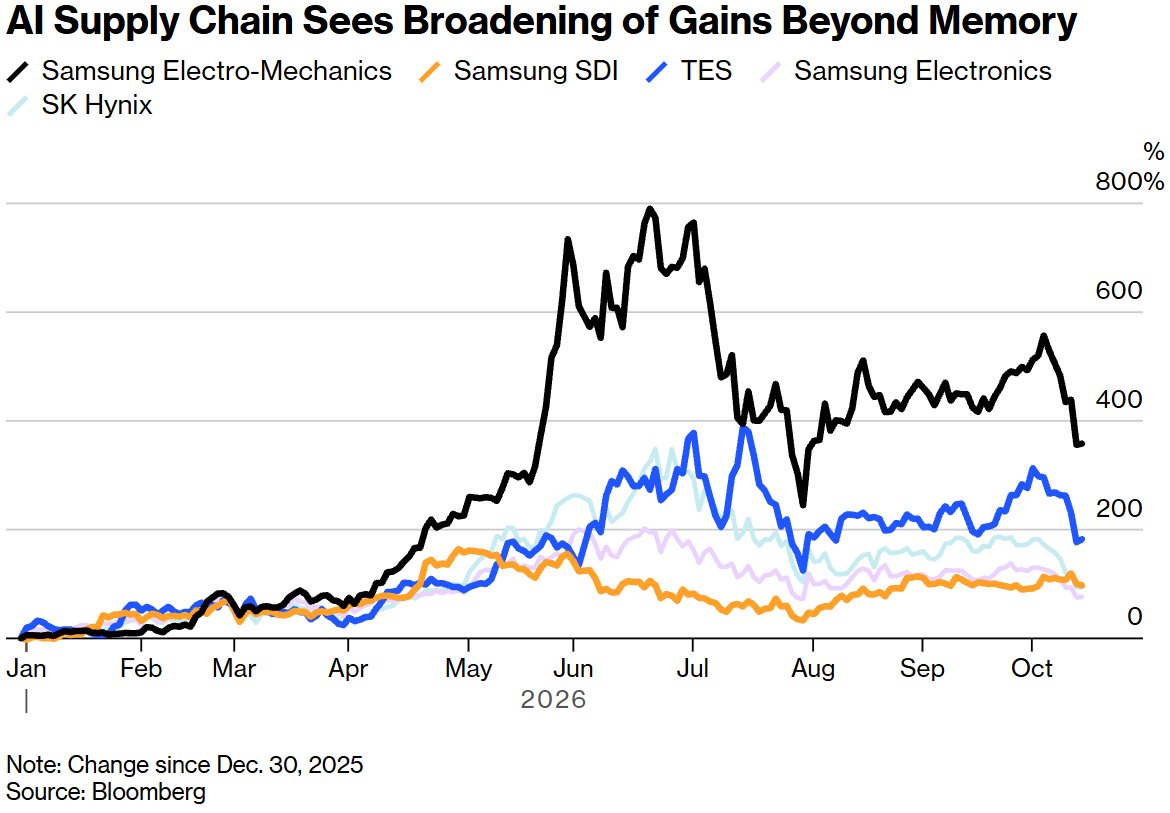
The benefits of the AI supply chain have expanded beyond storage
Samsung Electric is one of the world's leaders in the field of AI substrates and MLCCs. Its stock price has more than tripled this year, far surpassing memory chip manufacturers. Samsung SDI shares have also roughly doubled.
Despite the recent sell-off, funds focused on South Korea are still expected to have a good harvest year this year, with Kospi's cumulative increase of about 35%. Lee Wang-seop said that its fund outperformed the benchmark index, largely due to the early layout of front-end chip equipment manufacturers such as TES Co. (TES Co.).
Progressive Earnings
Korea Asia's fund still slightly exceeds Samsung Electronics and SK Hynix to focus on the huge influence of these two companies on the market. However, he said investors must deal with the following uncertainties: whether AI investment can remain resilient in the face of continued inflation, rising borrowing costs, and increased competition among Chinese chipmakers.
He is closely monitoring South Korean chipmakers' profit expectations for 2027. The market's views on this outlook are divided, and if analysts raise their forecasts, there is potential upside. Another indicator he is concerned about is whether foreign investors will continue to sell Korean stocks after SK Hynix completes its share repurchase plan.
“A rebound of this magnitude in the past will be difficult for Korean memory chip makers to replicate,” he said. “We'll see that there are sectors where stock returns will surpass semiconductors.”