


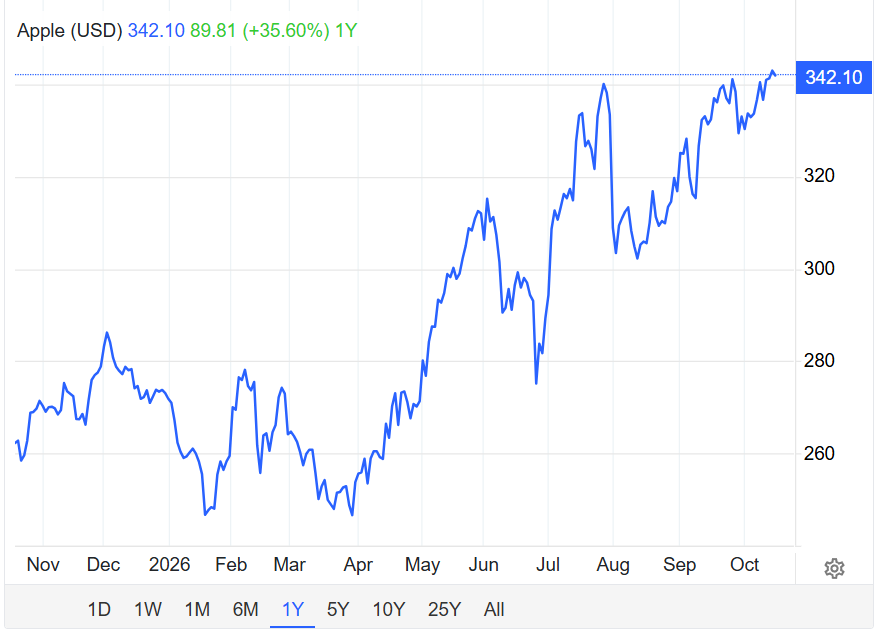
The Zhitong Finance App learned that US stocks and Apple (AAPL.US) stock prices closed up 0.5% to 342.96 US dollars on Wednesday, and the market capitalization successfully surpassed 5 trillion US dollars. This is the first time in Apple's history that it has reached this historic threshold at a closing price. Previously, the company had hit this threshold six times in the intraday period but failed to maintain it, including a fall after the intraday price once surged to about $5.036 trillion on July 28 this year. Although the stock price declined somewhat on Thursday, this did not prevent Apple from being the second company in the world to reach this market capitalization milestone after Nvidia (NVDA.US).
This historic moment comes at a special moment: Tim Cook officially stepped down as CEO on August 31, 2026, and handed over the scepter to John Turnus, senior vice president of hardware engineering. During Cook's 15-year tenure, Apple's market value expanded 13 times, and annual iPhone sales nearly quadrupled. The service business jumped from 10 billion US dollars to more than 100 billion US dollars in annual revenue. Together, Apple Watch and AirPods generated more than 30 billion US dollars in annual revenue, and returned more than 1 trillion US dollars to shareholders through stock repurchases and dividends. These numbers formed a frame of reference that Tenus could not avoid when he took over.
However, the $5 trillion price offered by the capital market when Cook came to an end was not a simple tribute to the past, but a vote of confidence in Apple's future narrative.
Behind this optimism, there are four clear main lines of support — the strong product cycle of the iPhone series, the pioneering development of the iPhone Duo folding screen model, the strategic expansion of the smart home ecosystem, and the premium of the “light AI” capital allocation strategy being repriced in the current macro environment.
iPhone 17/18: Super product cycle realized, pricing rights withstood the test
Apple is making major adjustments to the pace of iPhone releases that have continued for more than ten years. At the 2026 fall press conference, only the iPhone 18 Pro, iPhone 18 Pro Max, and the first folding screen iPhone Duo were introduced, but the standard iPhone 18, which has always been popular, was not unveiled.
This arrangement stems from Apple's precise calculations in supply chain management. There are two considerations behind the delay: the first hurdle is 2nm chip production capacity. The A20 Pro chip in the Pro series uses TSM.US (TSM.US) 2nm manufacturing process, and initial wafer output and yield are tight. Apple is clearly more willing to prioritize scarce chip production capacity, assembly lines, and testing resources to the more profitable Pro series and folding screen models. The second hurdle is more realistic — the pressure on memory costs. The cumulative increase in DRAM and NAND spot prices over the past two quarters was more than 300%. For products with millions of shipments such as iPhones, the increase of a single component by a few dollars is multiplied by huge profit erosion. Delaying the release of the standard edition is tantamount to staggering the centralized preparation time and leaving room for procurement negotiations and supply chain switching.
Despite this, the strong performance of the iPhone 17 series underpins this strategy. According to Counterpoint Research data, global wholesale revenue in the first sales year of the iPhone 17 series surpassed 170 billion US dollars, an increase of 11% over the same period of the iPhone 16 series, and set a record high in the annual revenue of the first iPhone of all generations. Among them, the basic iPhone 17's first-year revenue reached 1.3 times that of its predecessor, making it the smartphone model with the highest global shipment volume in the first half of 2026; the iPhone 17 Pro and Pro Max followed, and the entry-level iPhone 17e also performed well.
By region, China has become the biggest engine driving the revenue growth of the iPhone 17 series. The wholesale revenue of this series in the Chinese market increased 35% compared to the iPhone 16 series, contributing nearly 24% of global revenue. The growth was mainly driven by the consumption upgrade of basic models. Japan, the Middle East and Africa, and other markets in Asia and the Pacific also achieved steady growth, hedging the slow growth rate of mature markets in North America and Europe.
In the context of an industry where the price of memory chips has risen sharply due to a surge in demand for data centers, Apple also chose to transfer cost pressure to terminals and raise prices for older models rather than cut prices according to convention. However, this has not affected consumers' desire to switch flights. Since the first round of price increases, Apple's stock price has increased by about 25%. Bank of America analyst Wamsey Mohan pointed out that investors believe that Apple users are willing to pay higher prices, that is, under pressure from convenient profit margins, Apple can still maintain or even increase overall profit through higher stand-alone revenue.
Counterpoint senior researcher Hilpie Jain further added a structural factor: as Android manufacturers raised prices one after another under pressure from storage costs, the price gap between Android flagships and iPhones gradually narrowed, and Apple's relatively stable pricing instead constituted a competitive advantage.
iPhone Duo: The “ultimate definition” logic for those who arrive late for folding screens
The release of Apple's first folding screen phone, the iPhone Duo, was the most high-profile product event at the 2026 fall press conference. It was also the first major product decision that Tenus led after taking office.
This model uses a book-style folding scheme, equipped with a 7.6-inch inner screen and a 5.4-inch outer screen. The internal and external screens maintain a uniform display ratio, and are equipped with an under-screen front camera. The fuselage frame is made of aerospace-grade aluminum, and the hinge is a custom variable torque structure composed of more than 100 components. When unfolded, it is Apple's thinnest iPhone to date. In terms of core configuration, the iPhone Duo is equipped with an A20 Pro processor and a self-developed C2 baseband chip. The latter increases network speed by 50% and reduces power consumption by 15% compared to the previous generation.
The market's expectations for this product are quite positive. Counterpoint Research estimates that the iPhone Duo will sell about 6 million units in 2026, while TrendForce predicts shipments of about 5 million units. Both organizations believe that Apple can use this to win about 25% of the global folding screen market. This means that although Apple entered the folding screen circuit much later than rivals such as Samsung, it is expected to occupy a quarter of this market segment in its first year.
In an exclusive interview, Tenus gave a candid explanation for Apple's “late arrival.” He bluntly said that some early-generation folding phones gave people the feeling of “cheap texture and poor experience,” and emphasized that Apple would not rush to launch “compromising semi-finished products.” This statement reflects the engineering philosophy that Tenus upholds: rather than endure late questioning, it is better to wait until the durability, lightness, and system-level interaction of the hinges are polished to an industrial level before they are officially introduced to the market.
The effectiveness of this strategy is fundamentally dependent on whether the folding screen can evolve from a “high-end toy” to a form of productivity for high-frequency use. Tenus was clearly aware of this proposition. The iPhone Duo was specially adapted for large folding screens — the main screen dock was changed to a vertical layout, the control component can be moved to the area where the thumb can be reached, and it can be used as a calendar, alarm clock, or desktop speaker in the half-folded state.
Smart Home: From HomeView to Ecological Closed Loop Systematic Expansion
If the iPhone Duo is an extension of Apple in the form of a mobile terminal, then HomeView released on October 13 marks Apple's official systematic attack on the home scene.
HomeView is a smart home hub equipped with a 7-inch Liquid Retina display. It can be placed on a desktop or wall, equipped with next-generation Siri based on Apple Intelligence, and can recognize up to 6 family members. Its operating system incorporates design elements from iOS, watchOS, and tvOS. By default, it displays a clock and photo slideshow, and supports widgets, FaceTime video calls, calendar, notes, music playback, and HomeKit device control. At the same time, Apple also launched the second-generation HomePod Mini and the new Apple TV 4K with a faster chip, and collaborated with LG Electronics and Schneider Electric to launch smart home accessories.
Apple's layout logic in the smart home field is not just about adding a few hardware products. Its core intention is to build a complete closed loop of family interaction: using HomeView as a unified entry point, using Siri AI to solve the control experience, using Matter Protocol to achieve cross-platform compatibility, and third party cooperation to resolve category coverage. By connecting the four links, Apple is trying to integrate HomePod, Apple TV, HomeKit devices, future security cameras, sensors, etc. into an ecosystem centered on Siri.
The capital market gave positive feedback on this strategy. On the day HomeView was released, Apple's US stock rose more than 2% in the intraday period, breaking through $5 trillion in market capitalization; since then, the stock price continued to rise for two trading days, and finally reached a historic closing of $5 trillion on Wednesday.
“Light AI” Strategy: The Scarcity Premium for Not Participating in the Arms Race
The most counterintuitive and most thought-provoking support in Apple's $5 trillion market capitalization is its “restraint” in AI infrastructure.
When the four tech giants Alphabet (GOOGL.US), Amazon (AMZN.US), Microsoft (MSFT.US), and Meta (META.US) had a combined capital expenditure plan of over $700 billion in 2026, with the vast majority invested in AI infrastructure, Apple's capital expenditure for the full year of fiscal year 2025 was only $12.7 billion. The capital expenditure for fixed asset purchases in the first three quarters of fiscal year 2026 was $6.799 billion, down 28.2% year over year. In other words, the world's largest consumer technology company's AI infrastructure investment is less than 2% of the total investment of its four major competitors.
This seemingly “backward” attitude has been repriced as a scarce “safe-haven attribute” in the current market environment. Apple's AI capital expenditure accounts for only 2.5% of predicted revenue, far lower than the ratio of cloud vendors about 39%. Apple's AI strategy is essentially a “terminal-first” approach: cloud computing-intensive AI strategies will transform large amounts of revenue into huge capital expenses on chips and data centers, reducing profits and free cash flow; while Apple's device-side model uses Google's cloud infrastructure and AI capabilities to meet demand through leasing computing power, etc., thereby reducing upfront capital expenses and maintaining strong cash flow and profit resilience.
In an interview, Tenus responded to criticism from the outside world about Apple turning to Google Gemini to build a basic model for next-generation AI: “We don't need to do every aspect of the product ourselves. We're doing things that really make a difference.” This statement clearly defines Apple's AI boundaries: it does not seek to compete head-on with US tech giants on cutting-edge models, but instead embeds AI capabilities into the devices users use on a daily basis, using ecological integration rather than computing power as its core competitiveness.
Regarding the new Siri, Tenus said, “Everything in your life is on this phone... With Siri AI, you can use all this information to do things, learn things, and solve problems that no one else can.” This discussion reveals the core logic of Apple's AI strategy—its real differentiating advantage lies not in the size of the model's parameters, but in the unique personal data and usage scenarios on the device side.
However, this strategy is not without risk. Some analysts warned that as the focus of AI competition shifts from the model layer to the proxy framework and ecological orchestration layer, the logic of relying on third-party models and switching the best options at any time will face a fundamental challenge — Apple that is not deeply involved in agent layer construction may be marginalized in the second half of AI.
Financial Reports Continue to Exceed Expectations: Positive Feedback Cycle between Fundamentals and Valuation
The continued rise in Apple's market value must ultimately be supported by financial data. Judging from the performance of the last two fiscal quarters, this support is solid.
In the second quarter of fiscal year 2026 (as of March 28), Apple achieved total revenue of US$111.18 billion, up 17% year on year, far exceeding Wall Street analysts' previous forecast of US$109.66 billion; after dilution, earnings per share were 2.01 US dollars, an increase of 22% year over year. Service revenue increased from US$26.645 billion to US$30.976 billion, reaching another record high. The iPhone business also set a revenue record in the quarter, driven by strong demand for the iPhone 17 series.
In the third fiscal quarter (ending June 27), Apple continued its strong momentum. Total revenue reached US$109.42 billion, up 16% year over year, exceeding LSEG's average analysts' expectations of US$108.65 billion, setting a new revenue record for the June quarter in Apple's history. Net profit of US$29.79 billion, up 27% year over year; earnings per share were US$2.02, exceeding market expectations of US$1.89. Among them, iPhone sales revenue reached $54.25 billion, up 22% year over year. Apple's chief financial officer Kevin Parek pointed out that the quarter's operating cash flow exceeded 28 billion US dollars, and the active equipment installation base reached record highs in all major product categories and geographical regions.
It is worth noting that Apple's stock price currently has a premium compared to the S&P 500 as a whole, yet the company's revenue growth rate is below the average level of this index. Analysts believe that this premium reflects the market's pricing of the Apple stock's “safe asset” attributes — business certainty, cash flow stability, and discipline in capital allocation, which is difficult to replicate in an environment of high macroeconomic uncertainty.