


The Zhitong Finance App learned that after many years of supply shortages, global coffee supply has finally begun to increase. The question, however, is how much of this new coffee will actually enter the exchange warehouses that support the entire industry's price system.
The Arabica coffee market has been extremely volatile this year, in large part because stocks of coffee beans that can be used to meet the delivery obligations of expiring futures contracts have been severely depleted. Exchange-certified stocks have fallen to their lowest level since 1999, driving coffee prices close to this year's high, close to $3.50 per pound.
For the price trend to stabilize, this inventory must be replenished. Otherwise, even if global supply conditions improve, coffee roasters and even end consumers may face the impact of large price fluctuations.
The supply of coffee beans on the market should be quite adequate. Driven by Brazil, the world's largest coffee producer, which is likely to usher in record harvests, the market generally anticipates that 2026-2027 will experience the largest oversupply of coffee in many years. However, traders and analysts are uncertain whether current futures prices can provide sufficient incentives for coffee beans to enter exchange-managed warehouses rather than private inventories.
This difference is critical because exchange warehouses are a backup guarantee for the coffee industry. Exchange warehouses can absorb coffee beans when there is little interest from other buyers; when supply is scarce, they can also provide ready-to-use stock reserves. Coffee roasters previously used a large amount of this reserve, and are now actively purchasing coffee beans at higher prices in the spot market, thereby blocking the supply that may have flowed into exchange warehouses.
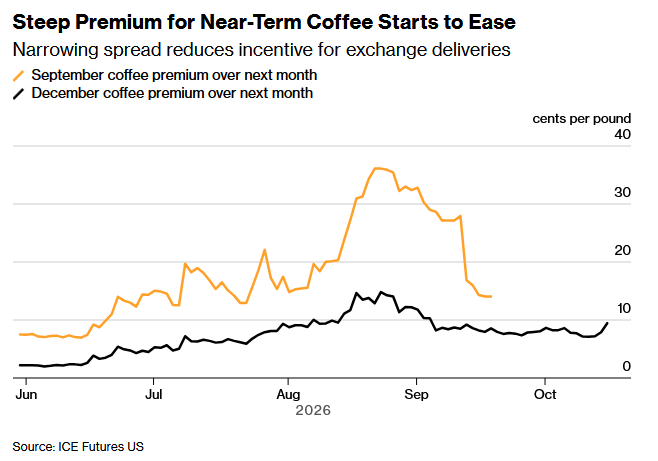
The spread between recent deliveries and forward deliveries has narrowed, reducing the incentive to deliver to exchanges
Judy Gaines, president of J. Ganes Consulting and a senior commodity analyst, said that when delivering coffee early is higher than the premium that can be obtained by delaying delivery, delivering coffee to an exchange is “a definite choice.” “The calculation results changed, and suddenly it was no longer profitable to deliver that much coffee to the exchange,” she said.
Oliver Broadster, senior manager of Expana Coffee Analysis, said that the upcoming oversupply means that coffee prices are at risk of falling sharply, which also means that the exchange should have become an attractive storage destination for some coffee beans.
Some coffee beans have already begun entering exchange warehouses. In September, more Brazilian coffee entered certified stocks than in any of the previous 18 months. However, tens of thousands of bags of coffee beans suddenly poured into the market, causing futures prices to plummet, and the arrival rate of coffee has slowed since then.
In the same month, about 72% of Brazilian coffee arrived batches passed the exchange's quality inspection. This ratio was higher than expected and in line with previous years. This has also put pressure on prices, as previous heavy rainfall has raised market concerns, and investors are worried that coffee crops may suffer extensive damage. Broadster said, “This is a huge harvest. As a result, compared to last year, Brazil still has a large number of high-quality coffee beans.”
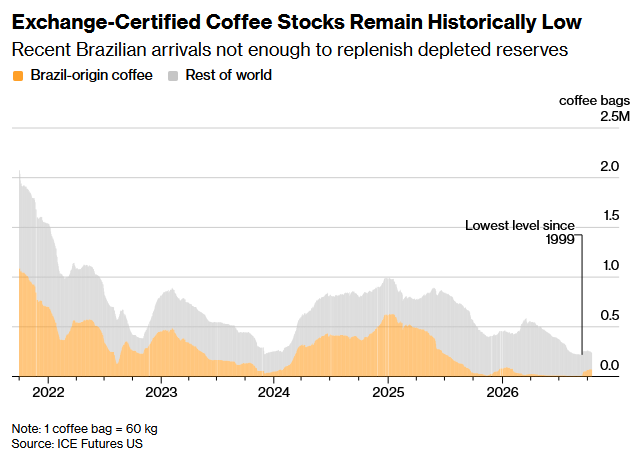
Exchange-certified coffee stocks are still at historically low levels
Despite an increase in the arrival volume of Brazilian coffee, there are still many obstacles to restoring exchange inventories to a level sufficient to stabilize the market. One of them is that producers lack motivation to deliver as soon as possible.
Since coffee prices hit record highs in previous quarters, Brazilian producers have plenty of cash on hand, so they can hold coffee beans longer than usual and wait for higher offers.
Marcelo Morella, an analyst at Archer Consulting based in Brazil, said that the quality of Brazilian coffee beans that are expected to meet the quality standards of the Intercontinental Exchange (ICE) is also sufficient to allow them to obtain a “real premium” in some markets, and this premium may exceed the price that the exchange can offer.
Thomas Araujo, a senior trader at StoneX, said that coffee beans produced in popular production areas such as Colombia can also receive higher premiums, which makes delivering coffee beans to exchanges in the near future no longer the most profitable option.
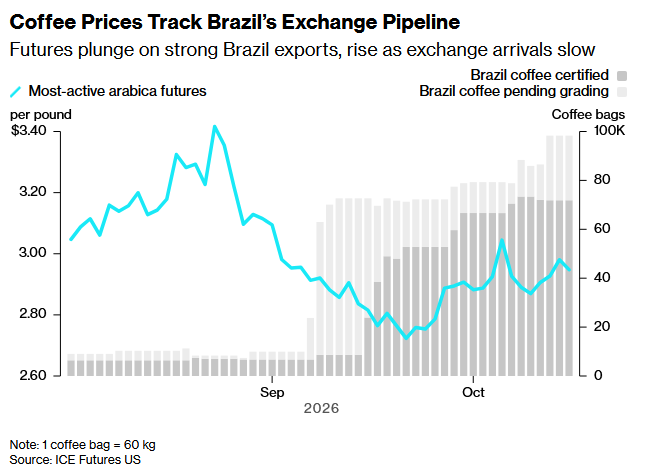
The coffee price trend is closely related to the supply channel of Brazilian coffee entering the exchange
Araujo anticipates that 50,000 to 70,000 bags of Brazilian coffee beans may enter the exchange in October. These coffee beans will have enough time to complete quality certification and be used to fulfill the delivery obligations of the December futures contract. Up to now, there are about 14,000 bags of Brazilian coffee beans awaiting quality inspection in ICE-approved warehouses, an increase of about 14,000 bags over the end of September.
However, this number is still lower than the market forecast a few weeks ago. At the time, futures prices were still at a higher level.
Furthermore, the Brazilian currency appreciated sharply this month due to the election results. If the dollar revenue received by exporters does not increase at the same time, this may further weaken farmers' willingness to sell coffee beans.
Tiago Cazzarini, a coffee broker based in Brazil, said, “Increased inventory on exchanges means that the supply of coffee has become abundant to a certain extent, and this usually reduces the price difference between contracts in different delivery months. But inventories must grow significantly, otherwise the impact will be minimal.”
After years of supply shortages and record price increases, the increase in private inventories is still good news for coffee roasters and consumers. However, if exchange inventories do not recover significantly, futures prices may continue to fluctuate. Prices may need to rise further to attract more coffee beans to be delivered, and this may force traders with short futures positions to buy back futures contracts, thereby further amplifying the gains.
“There is a possibility that some players in the market will be squeezed by bears,” Gaines said.
Eventually, this could spread to the price of a latte. The futures price is an important pricing benchmark for many coffee roasters when purchasing coffee beans. The final cost is usually based on the futures price plus or deduction of premiums or discounts associated with the quality of the coffee beans. There was a historic spike in coffee costs two years ago, and consumers are still suffering the effects. JM Smucker Co., the parent company of the Folgers (Folgers) brand, has also kept futures prices high as one of the reasons for delaying the price reduction plan.