


Norwegian Cruise Line Holdings Ltd. (NCLH), with a market capitalization of approximately $6.8 billion, is a global cruise company operating Norwegian Cruise Line, Oceania Cruises, and Regent Seven Seas Cruises. Based in Miami, Florida, the company offers diverse vacation experiences, from contemporary cruises to luxury voyages, serving destinations worldwide through its fleet of ships.
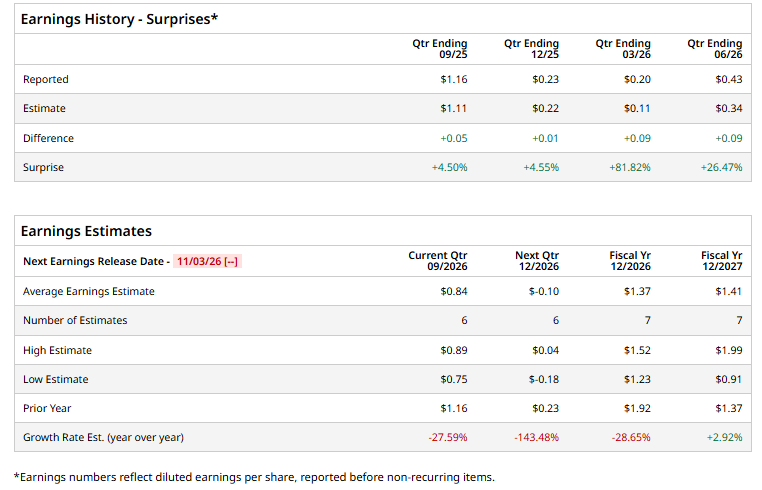
NCLH is set to report its Q3 earnings on Thursday, October 29, 2026, before the market opens. Ahead of the release, analysts expect the company to report diluted EPS of 84 cents, down 27.6% from $1.16 in the year-ago quarter. However, NCLH has surpassed Wall Street’s EPS estimates in each of the past four quarters, highlighting its consistent earnings performance.
For fiscal 2026, analysts expect the company to report EPS of $1.37, down 28.7% from $1.92 in fiscal 2025. However, EPS is projected to increase 2.9% year over year to $1.41 in fiscal 2027.
NCLH stock has plunged 34.7% over the past 52 weeks, underperforming both the S&P 500 Index ($SPX), which gained 16.1%, and the State Street Consumer Discretionary Select Sector SPDR ETF (XLY), which fell 3.4% over the same period.
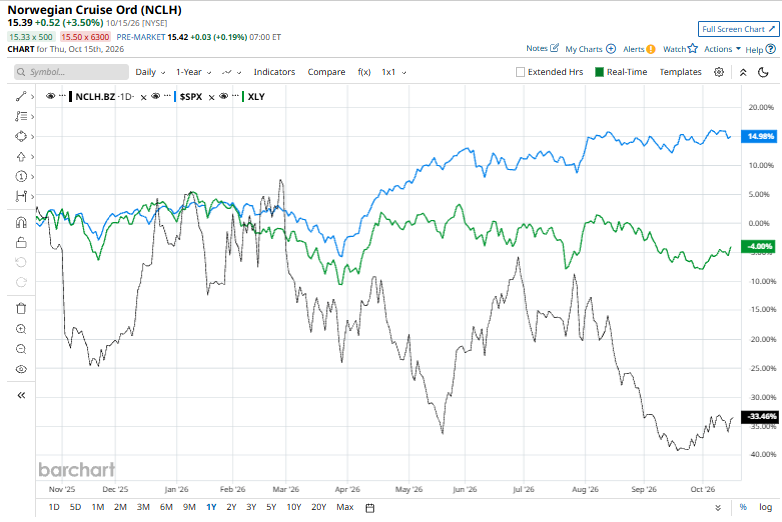
Norwegian Cruise Line has lagged the broader market over the past year amid concerns about weak demand growth, persistent cash burn, and high debt levels. Passenger cruise days grew at an average annual rate of 4.8% over the past two years, pointing to relatively modest volume growth that could constrain pricing power and profitability. Meanwhile, the company’s free cash flow margin stood at negative 11.7% over the past 12 months, while its $15.03 billion in debt far exceeded its $218.1 million in cash, raising concerns about financial flexibility and potential shareholder dilution.
Adding to these concerns, on Sept. 30, Norwegian Cruise Line announced that its subsidiary, NCL Corporation, increased its senior notes offering from $750 million to $950 million, with an 8.8% interest rate and a 2031 maturity. The proceeds, combined with cash on hand, will be used to redeem existing notes due in 2028 and repay borrowings under revolving credit and export credit-backed financing facilities. Although the refinancing helps manage near-term debt obligations and extends some maturities, the higher interest rate compared with the 6.1% notes being redeemed could increase borrowing costs.
Analysts remain moderately bullish on NCLH, with the stock carrying a consensus “Moderate Buy” rating. Of the 26 analysts covering the stock, eight recommend a “Strong Buy,” 17 rate it a “Hold,” and one recommends a “Strong Sell.” Meanwhile, the average price target of $18.94 implies potential upside of 23.1% from the current share price.
On the date of publication, Kritika Sarmah did not have (either directly or indirectly) positions in any of the securities mentioned in this article. All information and data in this article is solely for informational purposes. For more information please view the Barchart Disclosure Policy here.