The Zhitong Finance App learned that on October 16, the World Gold Council released the “2026 China Gold Jewellery Retail Market Insights”. Against the backdrop of the transformation of old and new kinetic energy in the Chinese economy and the accumulation of positive signs of economic recovery, the jewellery market has also entered a stage of adjustment. In the first half of 2026, China's demand for gold jewelry fell 30% year on year, but consumption increased 5% year on year to 144 billion yuan, making the second-highest consumption scale in history in the first half of the year, showing the characteristic of “volume reduction without price reduction”. Under the high price of gold, the way consumers buy money has changed, but their interest in buying gold has not diminished. With the high price of gold, what is more worth discussing than “consumers still buy it or not” is why and how they buy it.
I bought less gold jewelry, but I spent no less money
The high price of gold changed the way consumers bought gold, but it did not change their interest in gold. In the first half of 2026, China's gold jewellery demand fell 30% year on year, but consumption increased 5% year over year to 144 billion yuan, making the second-highest jewellery consumption in history in the first half of the year.
This shows that in a situation where the budget is relatively stable, although consumers choose to buy gold jewelry with a lower weight, their enthusiasm for gold jewelry has not diminished, which in turn boosts overall consumption.
Gold jewellery spending remains high
Gold jewellery tonnage demand and consumption
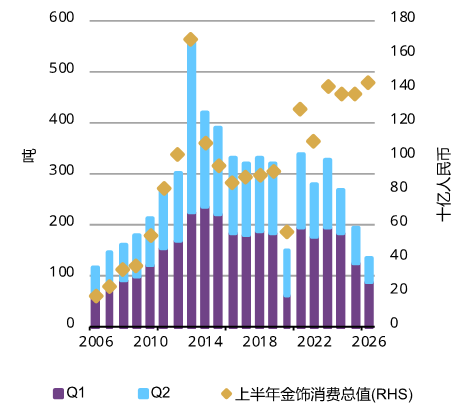
At the current stage of China's economic transformation, combined with gold value-added tax reform, gold investment demand and jewellery consumer demand are more divided. It is not surprising that investment demand is stronger than jewellery consumption.
Gold jewellery consumption ranks first in the jewellery market
Gold jewellery remains the core revenue source for domestic retailers.
The industry continues to innovate and iterate and launch gold jewelry products with novel designs. Chinese consumers' preferences and consumption investment in gold jewelry are still stable.
However, due to the high price of gold and the transmission of cost pressure brought about by the gold value-added tax reform to downstream consumers, the dominant position of the gold jewellery market weakened slightly.
The impact of the gold value-added tax reform on the physical gold investment business of jewelry retailers, mainly non-members of the Gold Exchange, is most obvious. The new value-added tax policy implemented in November 2025 stipulates that gold investment products sold through non-member channels of the Shanghai Gold Exchange will increase the tax burden by about 13%. The vast majority of domestic jewelry retailers use the franchise model and are non-members. As a result, many merchants have reduced or even stopped their gold bar sales business.
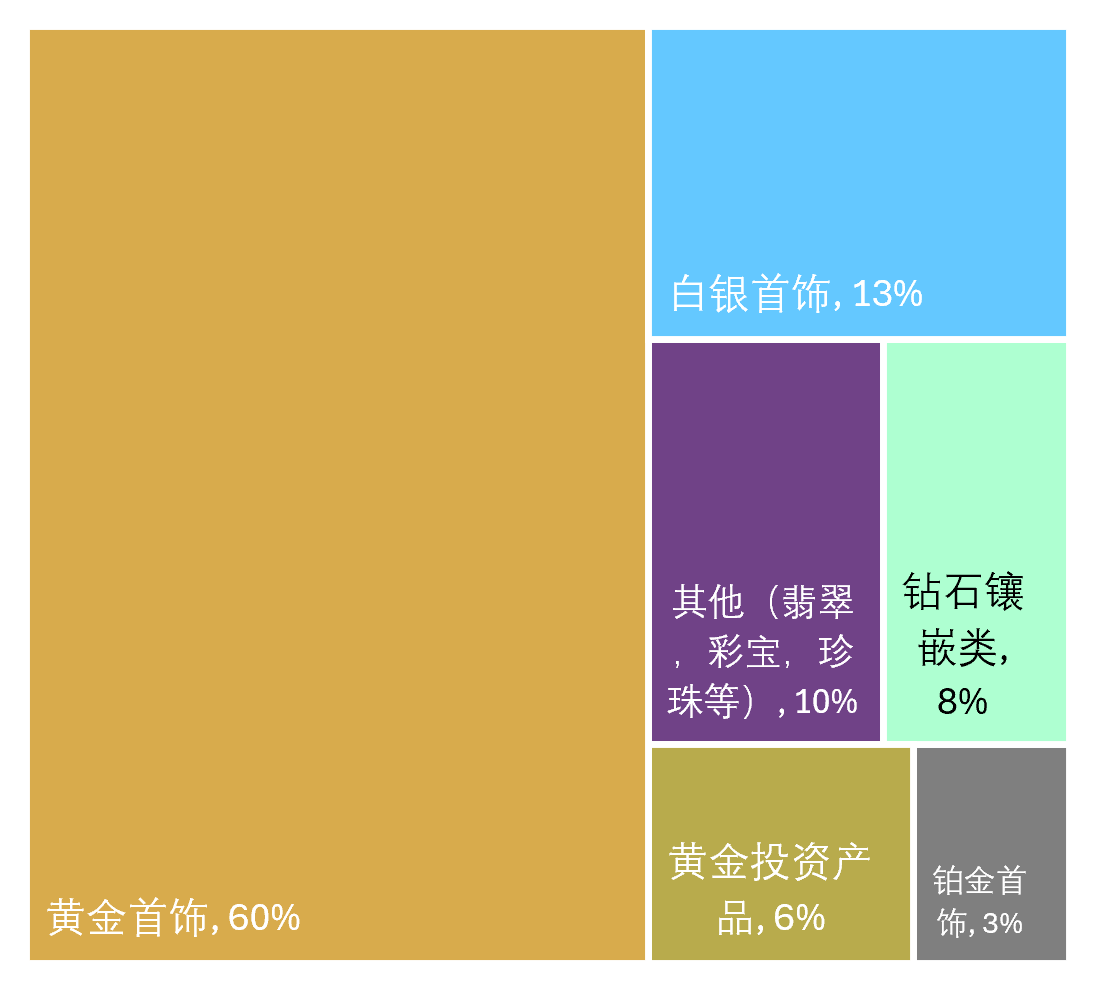
In addition, one chart is worth paying attention to: in the first half of 2026, silverware contributed 13% to revenue, and silverware products have now become an important component of retailers' revenue.
In 2026, gold will still occupy the first place in the jewelry market
Revenue contribution of various categories of Chinese jewellery retailers in the first half of 2026 (amount)
More “happy with yourself”: Gold is moving from a “major event in life” to “everyday life”
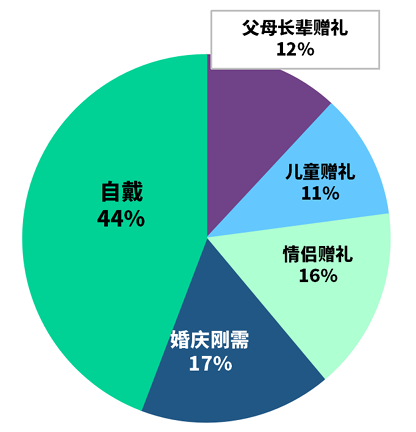
The dominant role of “self-wearing” driven consumption in jewellery consumption continues to increase, higher than traditional wedding scenarios.
Research shows that consumption in the “self-wearing” scenario is still the primary driving force for domestic jewellery consumption. 44% of retailers reported that customers buy gold jewelry for the purpose of pleasuring themselves.
This deepening trend is the most important structural change in the Chinese jewellery market: jewellery consumption shifts from being driven by traditional ceremonial scenarios to being driven by emotions. Today, gold jewelry is increasingly being used as an optional consumer item that highlights lifestyle, rather than just an item of ceremonial value.
This shift also explains why demand for jewellery in China continues to increase in cyclical characteristics: demand for gifts and purchases in weddings and other traditional settings is relatively stable; while consumption driven by “self-wear” is closely related to personal emotions, self-expression, consumer confidence, and income expectations. This means that, especially after the implementation of the value-added tax reform, consumers will comprehensively weigh the value preservation properties of gold as well as the individuality and emotional expression value carried by the jewelry when purchasing gold jewelry.
“Self-wearable” -driven consumption continues to drive jewellery purchases
Percentage of retailers who believe that each consumption scenario is the key to revenue in the first half of 2026 (%)
More refined: Gold jewelry is becoming “lighter” but the design and craftsmanship are more “heavy”
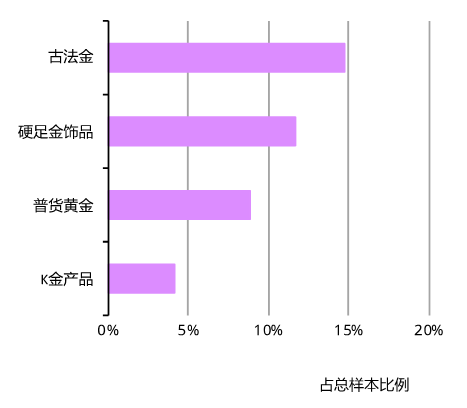
Looking closely at the performance of various categories, ancient gold and hard pure gold are still the product categories with the strongest resistance to falling, supporting the overall revenue of the store.
In 2026, ancient French gold and hard pure gold outperformed other gold categories for the fourth year in a row. Research shows that small pieces of gold jewellery with exquisite design, light weight, and strong sense of style or strong cultural elements have become the core revenue pillar of jewelers. Despite rising costs, consumers still prefer 24K pure gold, preferring products that balance cost performance, aesthetic design, and the value preservation properties of gold. Therefore, retailers focusing on these categories can better mitigate the impact of high gold prices and weakening non-essential consumption.
At the same time, the Chinese jewellery market is characterized by polarization:
On the one hand, light and heavy antique French gold and hard pure gold products are welcomed by the market due to their higher cost performance ratio.
On the other hand, high-grade handmade ancient gold jewelry is still popular among high-net-worth consumers.
This market segmentation may be another driving factor for ancient gold jewelry to outperform other categories.
Ancient gold and hard pure gold categories performed better than other categories
Percentage of retailers that achieved year-on-year sales growth in the first half of 2026 (%)
Most retailers plan to expand the layout of light, heavy, and high-margin products.
Faced with high gold prices and pressure from the macroeconomic environment, retailers continue to adjust product strategies, and cost performance is still a core consideration. Over 40% of retailers plan to increase the proportion of products under 5 grams in stock; 47% plan to expand the supply of products in the 5-10 gram range. Overall, the share of retailers that prefer light to heavy products under 10 grams is a significant increase from the level of 60% in 2025, highlighting the industry's continued transformation to lightweight. This shows that weight reduction has evolved from a temporary measure in response to market changes to a structured product strategy.
It's worth noting that most retailers don't just create lightweight, low-cost products. 62% of retailers plan to add high-cost products. These products usually have higher margin and focus more on design and process. The rest of the merchants are prioritizing expanding low-labor products to speed up product turnover, but they need to sacrifice part of their profits. This strategic differentiation once again confirms the previous view that the polarized characteristics of the market are becoming more and more obvious.
Younger: Young people haven't left gold but are just redefining gold consumption
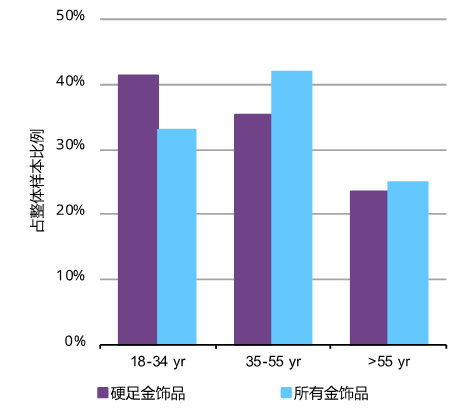
The customer base for hard pure gold consumers is noticeably younger.
Research shows that the average age of hard and pure gold buyers is lower than the overall gold jewellery consumer group. Hard and pure gold is affordable, stylish in design, and can also be creatively matched with enamel, diamonds, and other materials. It is very suitable for young consumers who pursue self-expression and value practicality for everyday wear.
Notably, people aged 18-34 are still a core pillar of jewellery consumption. This also reflects a major trend among young people. Accenture's “China Consumer Insights 2026” points out that Gen Z consumers are increasingly dividing their spending and emotional needs into two separate “accounts”: one for satisfying emotional value, and the other for long-term asset security.
The overall consumer group of hard pure gold tends to be younger
Question: What is the age range of customers according to the gold jewelry category?
Industry confidence is still strong: there has been deceleration and differentiation, but there has been no “U-turn”
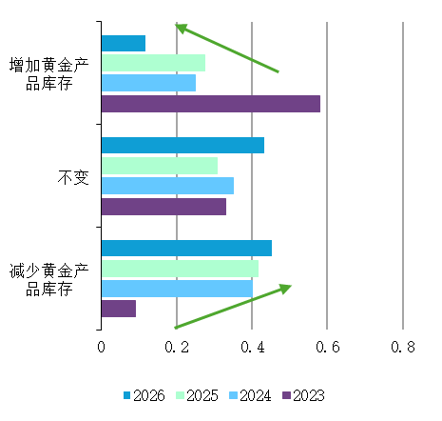
A significant percentage of merchants maintained their original inventory levels, which was similar to the proportion of retailers that removed inventory, indicating that the industry was making careful adjustments rather than a complete decline.
Retailers are shrinking their inventory of gold products. Continued high gold prices are driving up capital costs, compounded by a slowdown in product tonnage turnover, which has prompted many retailers to close their stores, delay expansion plans, or shrink their market size. 45% of the retailers surveyed said they plan to reduce gold product inventory in the future. This is the third year in a row, and the proportion of retailers planning to reduce inventory is higher than that of merchants planning to increase inventory.
However, it is worth noting that over 40% of retailers chose to keep their gold inventory unchanged. The share gap between “maintaining inventory” and “removing inventory” groups is small, and the situation in the industry is far from declining. In our opinion, this signals more of a “prudent adjustment” than a “full retreat.”
Some retailers cut inventory
However, there is still a similar percentage of merchants who keep their inventory unchanged
Q: How will future plans adjust the size of the gold product inventory?
Compared to other jewelry categories, retailers have more positive confidence in gold.
Market confidence is more important than gold itself. Especially now, many retailers are shrinking their business, and weak consumer demand has further amplified the industry's concerns about the future market.
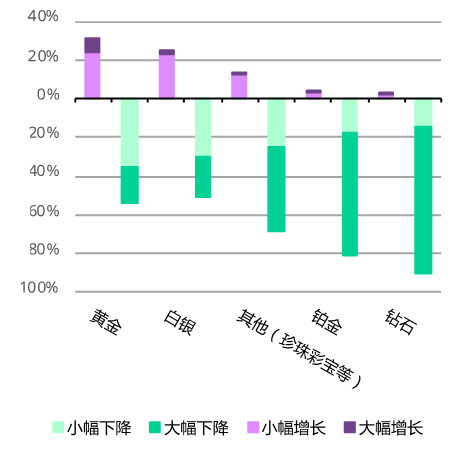
Thankfully, more than one-third of retailers still believe that sales of gold products are expected to pick up. This ratio is the highest among all jewelry categories, but it has declined somewhat compared to previous surveys. Notably, retailers' positive expectations for silverware came in second place.
Retailers' confidence in various gold categories is basically in line with recent sales performance: Gufa Gold accounts for the highest share of optimistic expectations, with over one-third of respondents optimistic about its sales prospects, followed by hard pure gold.
Research results show that market recovery will show structural characteristics, and growth will be driven by differentiated categories that balance emotional value, self-expression, and cost performance.
Retailers are still optimistic about gold jewelry
Percentage of retailers surveyed who agree with various opinions
Demand may have been delayed, but it hasn't disappeared
More than 60% of retailers believe that consumers are just delaying purchases rather than abandoning them, and demand will return.
Retailers' confidence in the jewellery market is also reflected in their interpretation of recent weakening consumption. Over 60% of retailers believe that in the face of this rare surge in gold prices, a large number of consumers have only postponed their purchases and have not given up on their purchases. Retailers expect this part of the demand will return after consumers adjust price expectations and adapt to the current level of gold prices.
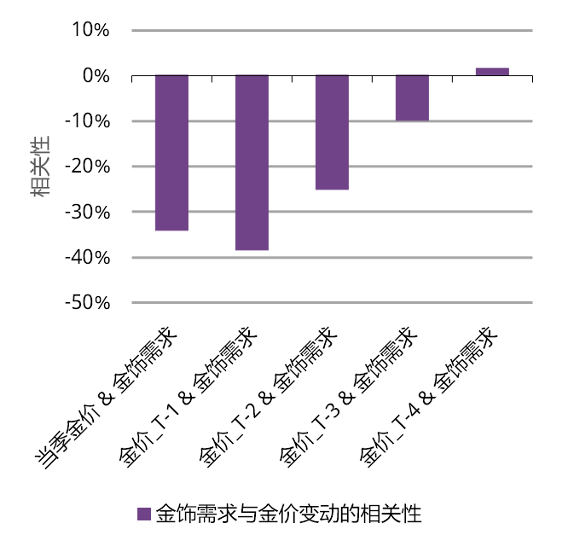
This view is our conclusion from our analysis that jewellery demand is lagging behind in response to gold prices. The study found that a sharp rise in gold prices will significantly dampen demand during the season, and consumers will suspend purchases, reduce their purchasing weight, or switch to lower priced products. However, as consumers readjust their budgets and price expectations, this pressure will gradually subside.
In the long run, the continued rise in gold prices will even form support, strengthen the inherent value preservation properties of gold, and encourage consumers to anticipate that the price of gold will continue to rise and purchase in advance.
The impact of gold prices on Chinese jewellery demand will gradually subside over time
Correlation between quarterly gold price changes and jewellery demand under different lag periods