


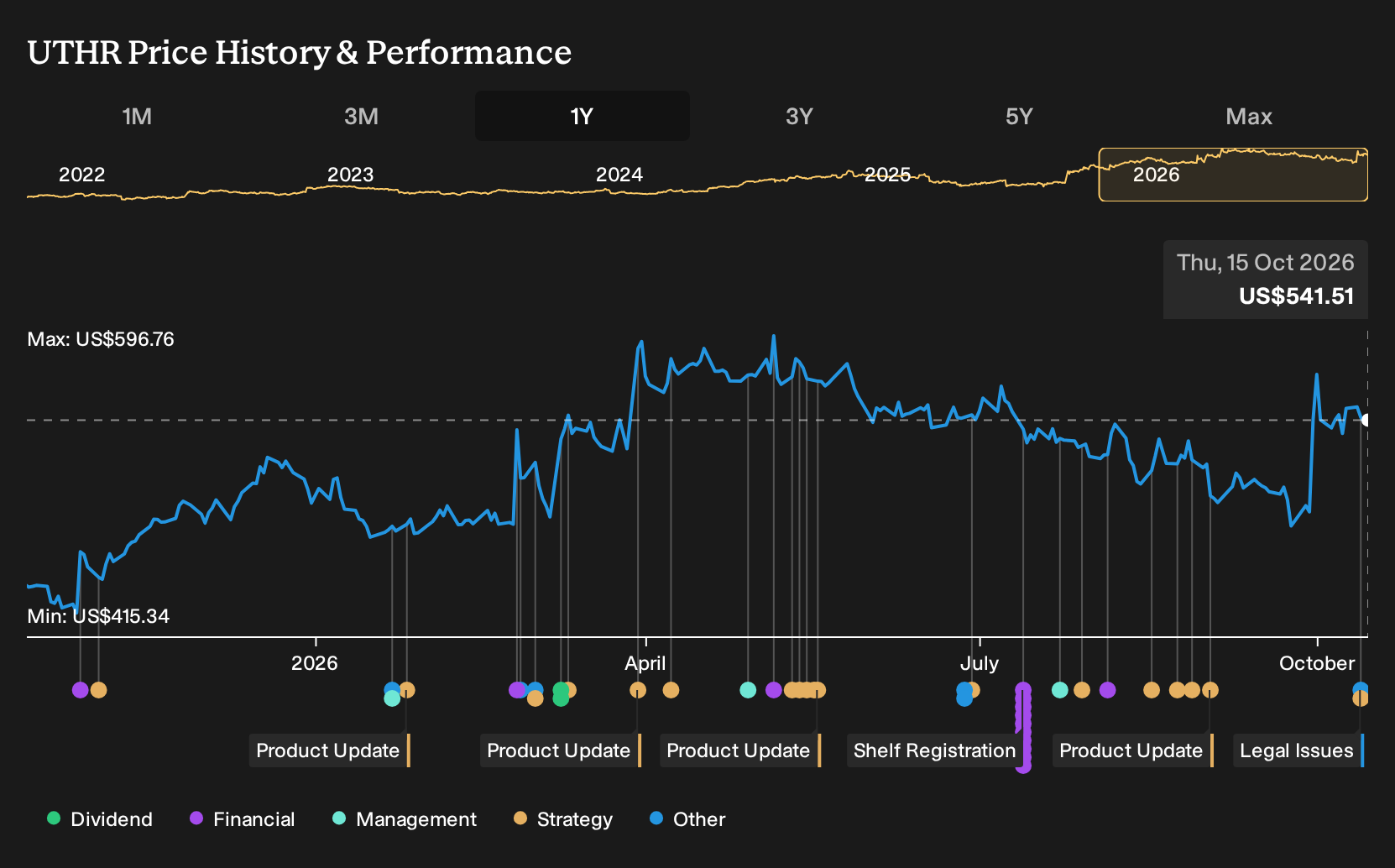
If you had bought United Therapeutics on 15 October 2025 and simply held on, the outcome might surprise you. Holding United Therapeutics over the past year would have returned 25.1%, including dividends. That result now sits against a split backdrop investors once argued over, from bullish Phase III optimism and organ technology ambitions to worries about patent cliffs and pricing pressure. If you were weighing that choice then, which of those competing stories would have carried more weight for you?
The move put United Therapeutics in the middle of this trade. Scan 34 healthcare AI stocks for other companies exposed to it.
The Argument You Would Have Been Weighing Up On United Therapeutics
The shares cost US$432 at the start of the period, and United Therapeutics sat between two very different stories investors were debating.
On the optimistic side, one camp saw a Fair Value of US$467. This was a notional price based on assumptions that TETON Phase III trial readouts for Tyvaso in idiopathic pulmonary fibrosis would open a new multi billion dollar market and support revenue growth of 6.7% with profit margins at 40.2% and a future P/E of 17.8x.
The cautious view pointed to a Fair Value of US$295. This was rooted in concerns that heavy reliance on Tyvaso and Remodulin left the business exposed to patent expirations and faster biosimilar entry, with the risk that significant spending on organ manufacturing and xenotransplantation might not translate into commercially viable products.
What The Evidence Did To The United Therapeutics Debate
United Therapeutics secured FDA acceptance of a supplemental filing for nebulized Tyvaso in idiopathic pulmonary fibrosis and an NDA for ralinepag, which backed the optimistic thesis about new indications. Reported Q2 2026 revenue of US$783.3 million was lower than Q2 2025, while net income rose to US$333 million and net margin widened to 42.5%. The evidence cut both ways.
The useful takeaway for other stocks is simple. When a bullish story hangs on new uses for an existing drug, track two things with each result season: the regulatory steps on those indications, and whether profit margins actually move in the direction that story assumes.
What United Therapeutics' Price Now Asks You To Believe
United Therapeutics now trades at US$542. The selected Narrative’s Fair Value sits below that level and frames today’s quote as already baking in a generous read on late stage pulmonary drugs and organ platforms.
The Narrative keeps circling one hinge question: Are you comfortable assuming pulmonary fibrosis rollouts offset pressure in pulmonary hypertension while higher selling costs and organ spend stay manageable?
"Although United Therapeutics now has highly statistically significant Phase 3 data in idiopathic pulmonary fibrosis and a supplemental application under FDA review, the recent revenue decline of 1.9% year over year and withdrawal of 2026 growth guidance signal that execution risk in converting pulmonary fibrosis trial success into durable revenue growth is higher than the current long-term revenue targets imply."
That disagreement has a full argument behind it. → Uncover the lower Fair Value this Narrative argues for
Looking Beyond United Therapeutics
Studying United Therapeutics naturally raises one question. Where else are similar medical needs being tackled from a different angle?
Pulmonary hypertension treatments sit within a broader effort to address difficult diseases. Another healthcare group focuses on cancer, immune disorders and brain conditions.
Rather than relying on a single drug, it spreads effort across many therapies. Ongoing spending on research and acquisitions continually refreshes that development pipeline.
Surgeons and cardiologists are central for this business, not only prescribing doctors. New tools for heart procedures, surgery and eye care expand its opportunity set.
If United Therapeutics is a focused bet on one therapy area, this other business offers a broader route into similar medical demand.
That argument has a Narrative and a number behind it. → See the company one Narrative values 26% above its price
This article by Simply Wall St is general in nature. We provide commentary based on historical data and analyst forecasts only using an unbiased methodology and our articles are not intended to be financial advice. It does not constitute a recommendation to buy or sell any stock, and does not take account of your objectives, or your financial situation. We aim to bring you long-term focused analysis driven by fundamental data. Note that our analysis may not factor in the latest price-sensitive company announcements or qualitative material. Simply Wall St has no position in any stocks mentioned.
Have feedback on this article? Concerned about the content? Get in touch with us directly. Alternatively, email editorial-team@simplywallst.com