


Tesla (TSLA) built its reputation with electric vehicles (EVs). But its core business has been struggling for a while with pricing pressure, competition, and questions about automotive profitability. The pressure even weighed on Tesla shares, which once wore the top growth stock crown.
Now, even a long-promised Roadster reveal on Oct. 15 may not be enough to change the stock’s trajectory. The bigger opportunity lies in what Tesla can build beyond electric cars with its robotaxis, humanoid robots, AI software, and energy storage businesses. The challenge, however, is whether Tesla can turn Musk’s bold ambitions into businesses that generate lasting profits.
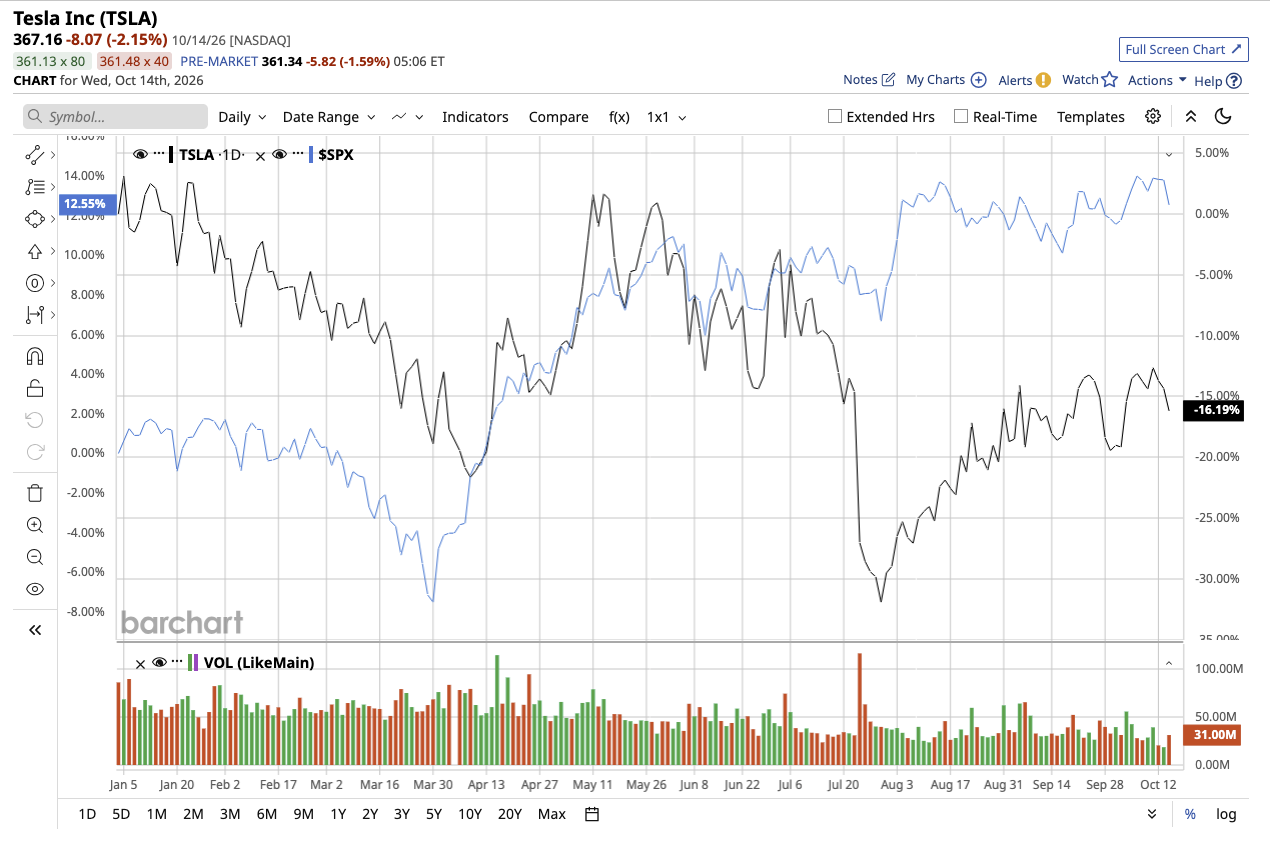
Dan Ives, one of Tesla’s longtime bullish analysts, has now lowered his price target from $600 to $500 after leaving Wedbush for Yorkville Ives, highlighting how even an optimistic view of Tesla’s AI and robotics future comes with changing expectations. Tesla shares have stumbled 16% year-to-date, making it the worst performer among the Magnificent Seven. A $500 target price suggests the stock could gain 36% from current levels.
What would it take for Tesla stock to reach $500?
The Roadster Is a Showcase, Not a New Growth Engine
Tesla’s next-generation Roadster was unveiled on Oct. 15, although it was first introduced in 2017, with production originally planned for 2020. However, that didn’t happen. Musk has previously discussed targets including acceleration from zero to 60 mph in under two seconds (it said yesterday it can do it under 1 second), a range exceeding 600 miles and a top speed of roughly 250 mph. He has also floated the possibility of SpaceX-related (SPCX) cold-gas thrusters, which it delivered on to make the vehicle leap and flip.
Even if the Roadster has lived up to its performance claims, a lasting boost to Tesla stock would require concrete production and delivery plans and not just another spectacular show.
Tesla Needs More Than Its Automotive Business
The pressure to find more growth engines becomes clearer when you look at Tesla’s core automotive business performance. In the second quarter, management said automotive gross margin excluding regulatory credits declined from 19.2% to 16.3% sequentially. This does not mean Tesla’s car business has become irrelevant. Total automotive revenue grew 23% to $20.5 billion. However, deliveries in the third quarter fell 2% to 486,532. Its adjusted earnings also fell 18% year over year (YOY) to $0.33 per share, while GAAP gross margin fell from 21.1% to 16.8% sequentially.
Therefore, investors can no longer rely on automotive growth alone to justify the stock’s valuation while competition and margin pressures persist. This is where robotaxis, Full Self-Driving subscriptions, Optimus, and energy storage enter the picture.
Its Energy storage, services, and other revenues are still growing, compensating for the weakness in the automotive business. Energy storage revenue jumped 13% while services and other revenue increased by 50% YOY in the second quarter. Energy storage may offer a different growth path, particularly as electricity demand increases and data centers require more power infrastructure.
Robotaxis, AI Software, and Optimus: Tesla’s Next Act Goes Beyond Cars
Tesla’s robotaxi ambitions include building a transportation service around Tesla’s vehicles. However, expanding a robotaxi fleet profitably will require vehicles, maintenance, charging infrastructure, insurance, ongoing software development, regulatory approvals, and customer adoption. Its Full Self-Driving (FSD) subscriptions offer another potential revenue stream. In Q2, Tesla reported nearly 1.5 million paid FSD customers worldwide, with 55% having purchased the software upfront and 45% subscribing.
Then there is Optimus, Tesla’s humanoid robot program, which could eventually take the company into manufacturing and other physical-work applications. Musk has acknowledged that scaling the robots will be difficult because of the new components and supply-chain requirements involved. Tesla is also yet to prove that Optimus can perform useful tasks reliably and be manufactured at scale. Until that happens, Optimus remains just a speculative long-term opportunity.
Can Tesla Stock Reach $500?
Tesla has a much bigger vision than electric cars, but that vision doesn't yet reflect in its financial performance or justify its sky-high valuation. Currently, TSLA stock is trading at 169x forward 2027 earnings, which are expected to increase by 24%. Meanwhile, capital expenditures more than doubled sequentially, and free cash flow came in at negative $1 billion in the quarter, with the company expecting capital expenditure to exceed $25 billion in 2026. The Roadster unveiling could generate excitement, but a halo car alone is unlikely to transform Tesla’s financial outlook.
Dan Ives’ move from a $600 target to $500 is a reminder that even bullish analysts can revise their expectations. For Tesla stock to justify the most optimistic forecasts, the company will need to turn robotaxis, FSD subscriptions, Optimus, and energy storage into scalable, profitable businesses and not just bold claims of what they might become.
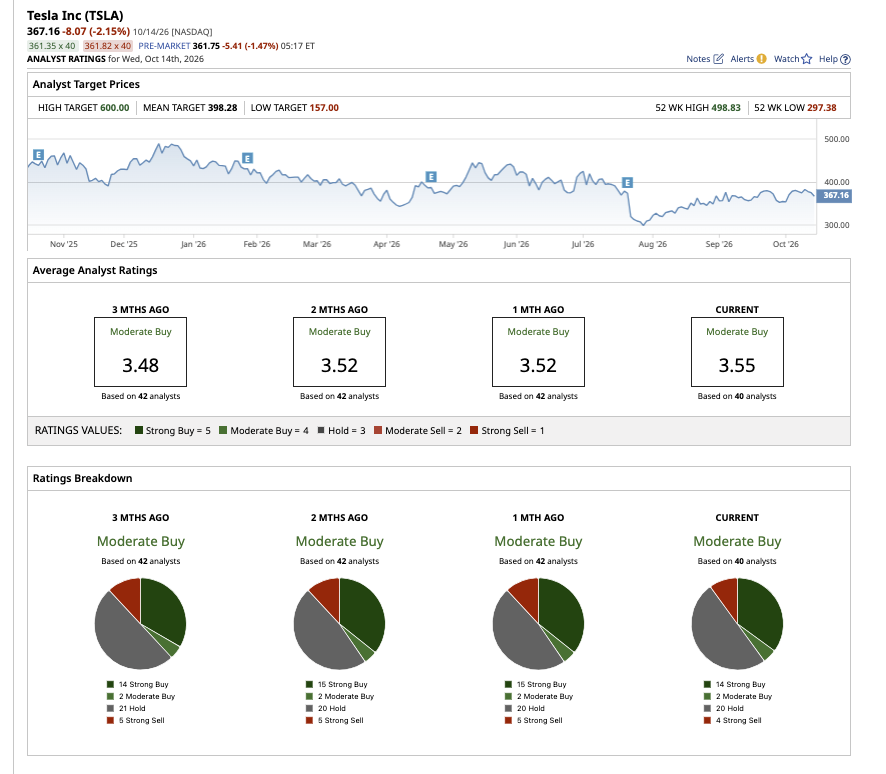
On Wall Street, TSLA stock holds a consensus “Moderate Buy” rating overall. Of the 40 analysts covering the stock, 14 recommend it as a “Strong Buy,” two rate it a “Moderate Buy,” 20 rate it a “Hold,” and four rate it a “Strong Sell.”
On the date of publication, Sushree Mohanty did not have (either directly or indirectly) positions in any of the securities mentioned in this article. All information and data in this article is solely for informational purposes. For more information please view the Barchart Disclosure Policy here.