


Apple (AAPL) has given investors plenty of reasons to smile lately, and Wall Street seems to have misplaced its chill. The iPhone maker’s shares recently hit a record high, pushing its market capitalization past the $5 trillion mark at Wednesday’s close. That makes Apple only the second company ever to cross the milestone, following Nvidia (NVDA). Not bad for a company that was briefly flirting with the same valuation back in July but couldn't quite stick the landing.
Apple’s market cap crossed $4 trillion in October 2025, and its shares have climbed roughly 40% over the past year, outperforming several of its fellow Magnificent Seven stocks. Strong iPhone demand, a booming Services business, renewed product excitement, and a more fleshed-out AI strategy have helped fuel the rally. Apparently, reports of Apple falling behind in the AI race were a little premature.
The milestone also comes just over a month after John Ternus took over as CEO from Tim Cook, marking a new chapter for the tech giant. With the prospect of a foldable iPhone and further AI upgrades adding to the excitement, investors have plenty to keep an eye on.
But with AAPL already up 27% this year and its market cap sitting fairly comfortably in the $5 trillion club, the question is whether the stock still has room to run or whether investors are getting a little too carried away. So how should investors approach the tech stock at these lofty levels?
About Apple Stock
Based in Cupertino, California, Apple has come a long way from its humble beginnings as a computer maker. These days, whether it’s an iPhone in your pocket, a Mac on your desk, or an iPad on the couch, chances are Apple has found its way into everyday life.
And the company is not just about selling the next shiny gadget. Its Services business, which includes the App Store, iCloud, Apple Music, and Apple Pay, gives customers more reasons to stick around while bringing in a steady stream of revenue.
Apple is still adding to its lineup, too. On Oct. 13, 2026, it unveiled its fourth-generation Apple TV 4K, featuring the A19 chip, Siri AI, and built-in far-field microphones. With its powerful brand and loyal customer base, Apple clearly knows how to keep people coming back for more.
AAPL stock has had a few bumps in 2026, but investors who stayed patient have had plenty to smile about. The year started with uncertainty around interest rates, geopolitical tensions, and Wall Street’s relentless obsession with artificial intelligence (AI), keeping Big Tech on its toes. Apple shares initially struggled to find their footing but gradually gained momentum.
Earlier in October, AAPL came under pressure after reports suggested Apple had asked suppliers to cut October component orders for the iPhone 18 Pro and Pro Max by roughly 15% to 20% from initial estimates. Higher prices, reportedly up $100 to $1,199 and $1,299, respectively, may be cooling demand. A broader memory and storage chip shortage, fueled by AI data center demand, is not helping matters either. Still, Deepwater Asset Management’s Gene Munster offered a less gloomy take—delivery lead times for the iPhone 18 Pro had fallen 31%, while those for the Pro Max increased 1%. Combined, they were roughly in line with last year’s iPhone 17 Pro lineup. So, the demand picture is not exactly falling apart.
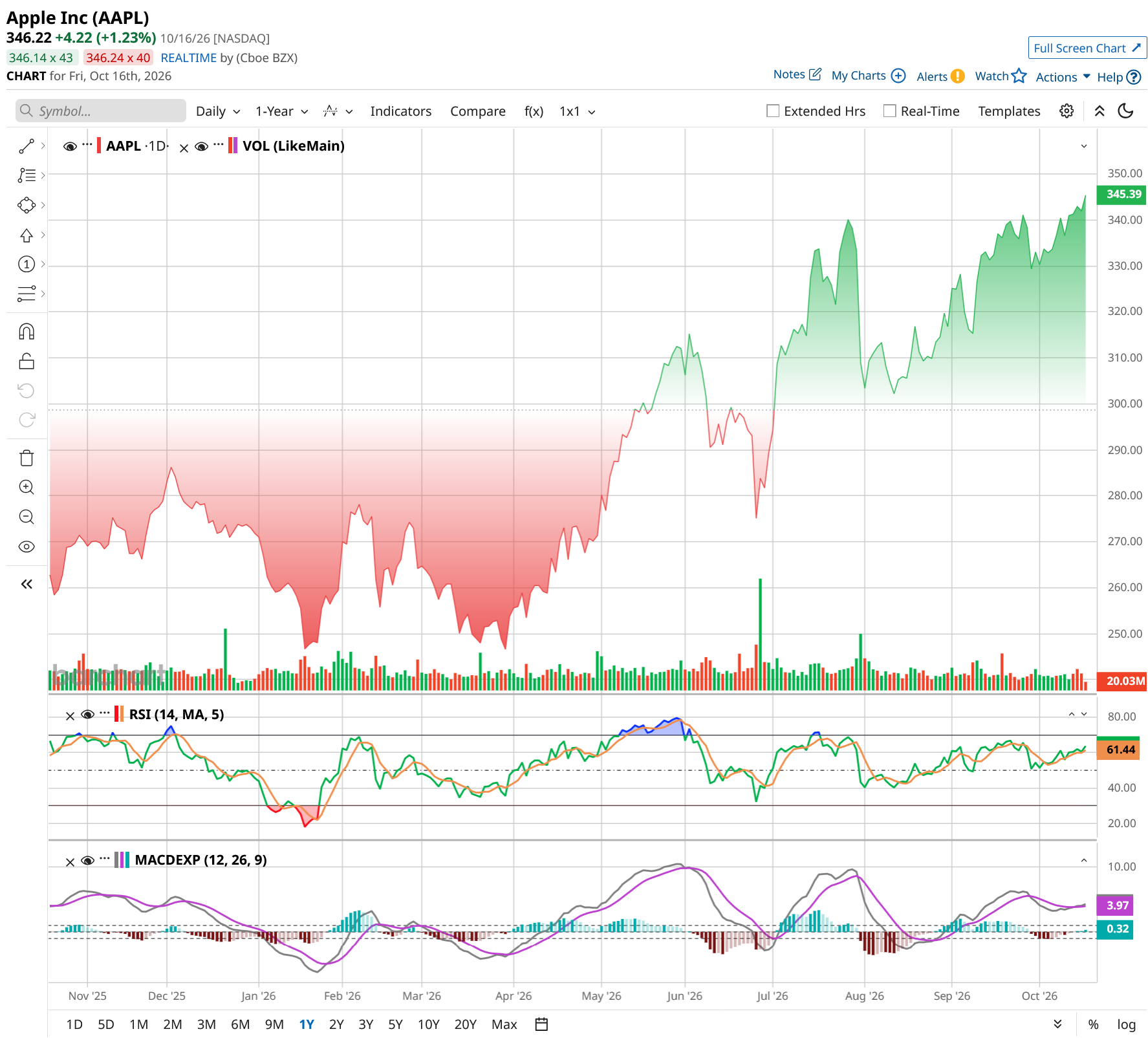
In fact, Apple’s shares hit an all-time high of $348.15 on Oct. 13, buoyed by excitement around its new smart home lineup unveiled at its “Welcome Home” event. Although now down by just 0.8% from that peak, over the past six months, the stock has climbed 31%. Not too shabby for a company that has faced its fair share of AI skepticism.
The technical picture, however, suggests investors shouldn’t get too carried away. Apple’s 14-day RSI sits around 60, indicating positive momentum without entering the traditional overbought zone above 70. But there’s a small wrinkle—the MACD line has slipped below its signal line, while the negative histogram indicates bearish momentum is gaining ground relative to the signal line. The longer-term picture looks encouraging, but the rally could be losing some steam in the short term. With AAPL hovering near record territory, a little caution wouldn’t hurt.
Apple stock may be wearing a $5 trillion crown, but investors are not exactly getting a discount at the checkout. Trading at around 38.83 times forward adjusted earnings and 10.47 times sales, AAPL commands a premium to its historical averages and several mega-cap tech peers. Clearly, Wall Street is willing to pay extra for Apple’s loyal customer base, sticky ecosystem, and impressive cash-generating power.
Still, shareholders have a few perks to enjoy. Apple has increased its dividend for 13 consecutive years, and its roughly 12% payout ratio leaves plenty of room for future hikes. Adding in billions in stock buybacks, Apple continues to give investors reasons to stick around.
What’s Fueling Apple’s $5 Trillion Run?
Apple did not stumble into the $5 trillion club accidentally. Strong iPhone sales throughout 2026 have given its shares a serious boost, thanks to a renewed upgrade cycle and growing excitement around its latest devices. And just when investors started wondering whether Apple had missed the AI party, the company began getting its act together.
Remember when delayed Apple Intelligence features had Wall Street questioning its AI credentials? Those concerns have not disappeared entirely, but Apple’s partnership with Alphabet's (GOOG) (GOOGL) Google to incorporate its AI models and updates to Siri AI eased some worries. Siri AI is still in beta, so the victory lap can wait.
Meanwhile, anticipation surrounding the iPhone Duo foldable, a touchscreen MacBook, and revamped iPads has added fresh excitement. Combine that with Apple’s lucrative Services business, loyal customer base, and disciplined AI spending, and investors have plenty of reasons to keep buying into the story.
A Snapshot of Q3's Results
Apple’s Q3 financials were impressive, and the tech giant generated revenue of $109.4 billion, up 16.4% year-over-year (YoY) and ahead of Wall Street’s expectations. Adjusted earnings amounted to $1.91 per share, while reported EPS climbed 28.7% annually to $2.02. The company also notched June-quarter revenue records for the iPhone, Mac, and Services, while its installed base surpassed 2.5 billion active devices. Apparently, getting people into the Apple ecosystem is one thing, and getting them to leave is quite another.
The iPhone remained the star of the show, with revenue jumping 22% YoY to $54.3 billion. The iPhone 17 lineup delivered record June-quarter sales across every geographic segment. Mac revenue also surged 28.7% to $10.4 billion, helped by demand for the MacBook Neo and MacBook Pro. Supply constraints limited some sales, but customer interest remained strong.
Meanwhile, Services revenue rose 12% to a record $30.7 billion, with paid subscriptions topping 1.5 billion. From the App Store and AppleCare to iCloud and entertainment, this business continues to provide Apple with a valuable stream of recurring revenue. Not everything was picture-perfect, though. iPad revenue slipped 6% to $6.2 billion, while Wearables, Home, and Accessories revenue increased 6.5% to $7.9 billion.
Apple’s financial position remains equally impressive. It ended the quarter with $147 billion in cash and marketable securities against $84 billion in debt. Record operating cash flow of $34.4 billion helped fund $33 billion in shareholder returns through dividends and stock buybacks. That’s a considerable amount of cash finding its way back to investors.
Looking ahead, management expects fiscal Q4 revenue to grow 9% to 11% YoY, with iPhone sales rising in the mid-teens and Services maintaining a growth pace similar to Q3. However, currency headwinds could trim growth by 2.5 percentage points, while tighter supply and higher memory costs may pressure margins. Existing inventory, lower costs elsewhere, and a favorable product mix could help soften the blow.
Wall Street remains optimistic, projecting Q4 revenue of around $113.6 billion and EPS of $1.99, up 7.6% YoY. For fiscal 2026, analysts expect EPS of $8.75, up 17.3%, followed by another 9% annual increase to $9.54 in fiscal 2027.
Apple is scheduled to report its Q4 results on Monday, Nov. 2, 2026. With expectations running high, the next report will need to show that Apple’s growth story has more substance than just an expensive stock chart.
What Do Analysts Expect for AAPL Stock?
JPMorgan analyst Samik Chatterjee remains bullish on AAPL stock, reiterating his “Overweight” rating and raising his price target to $360 from $340. He believes demand for the iPhone 18 Pro and Pro Max remains resilient, while recent supplier order cuts reflect Apple’s changing launch schedule rather than weakening demand.
With the standard iPhone 18 models expected next spring, Apple could ship fewer iPhones this December quarter but benefit from higher average selling prices, particularly with the iPhone Duo foldable launching soon. JPMorgan trimmed near-term estimates but expressed greater confidence in sustainable iPhone growth over fiscal years 2027 and 2028.
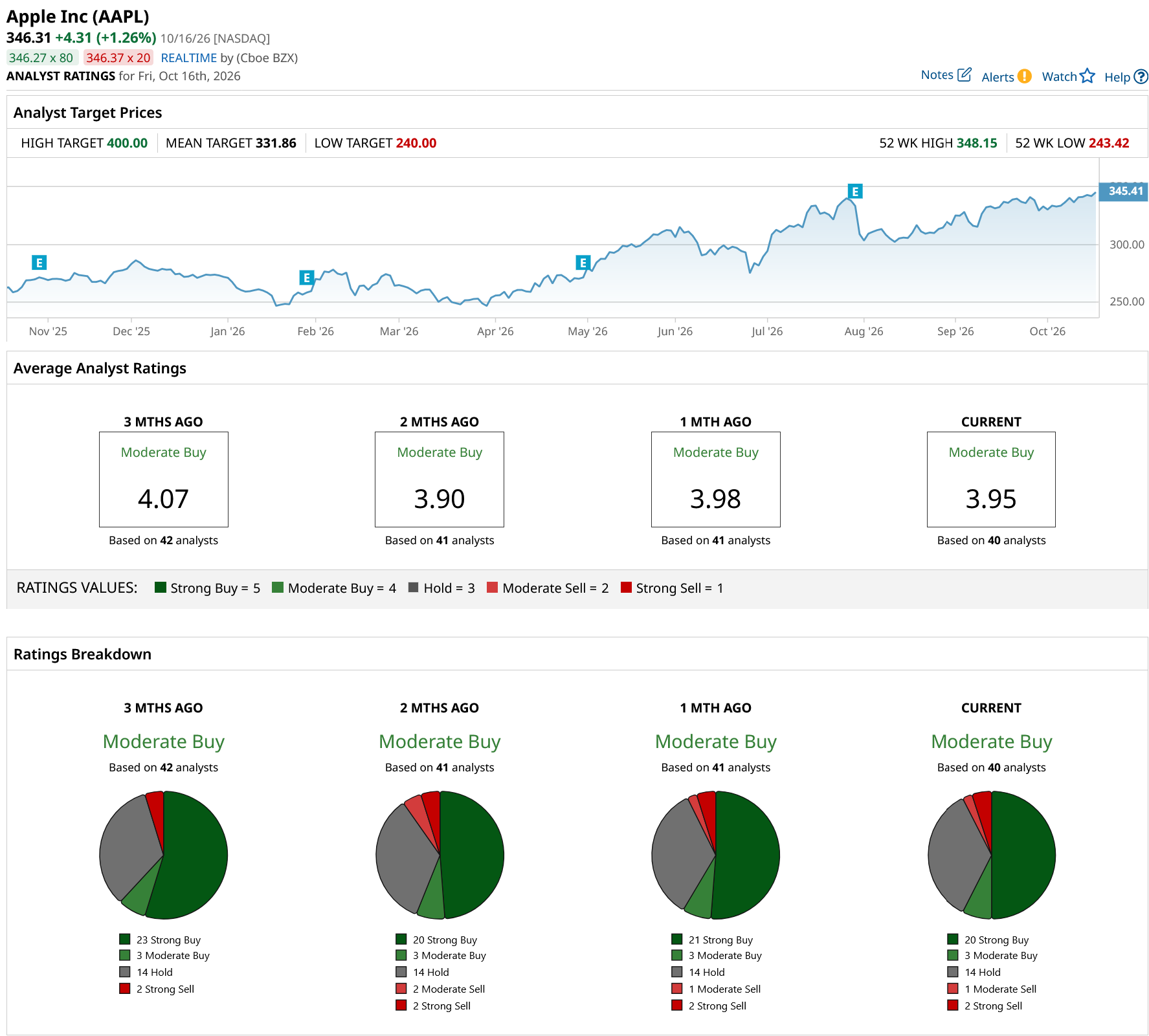
AAPL stock carries a consensus “Moderate Buy” rating, reflecting a mix of optimism and caution on Wall Street. Among the 40 analysts covering the stock, 20 have issued a “Strong Buy” recommendation, while three rate it a “Moderate Buy.” Meanwhile, 14 analysts are playing it safe with a “Hold” rating. On the bearish side, one analyst recommends a “Moderate Sell,” while the remaining two are outright skeptical, advising a “Strong Sell” rating.
AAPL stock is already trading above Wall Street’s average price target of $331.86, suggesting the market has gotten a little ahead of analysts’ expectations. But the bulls are not waving the white flag just yet. The Street-high target of $400, raised by analyst Dan Ives, leaves room for another potential 16% rally, meaning some analysts still believe the tech giant has more tricks up its sleeve.
On the date of publication, Sristi Suman Jayaswal did not have (either directly or indirectly) positions in any of the securities mentioned in this article. All information and data in this article is solely for informational purposes. For more information please view the Barchart Disclosure Policy here.