


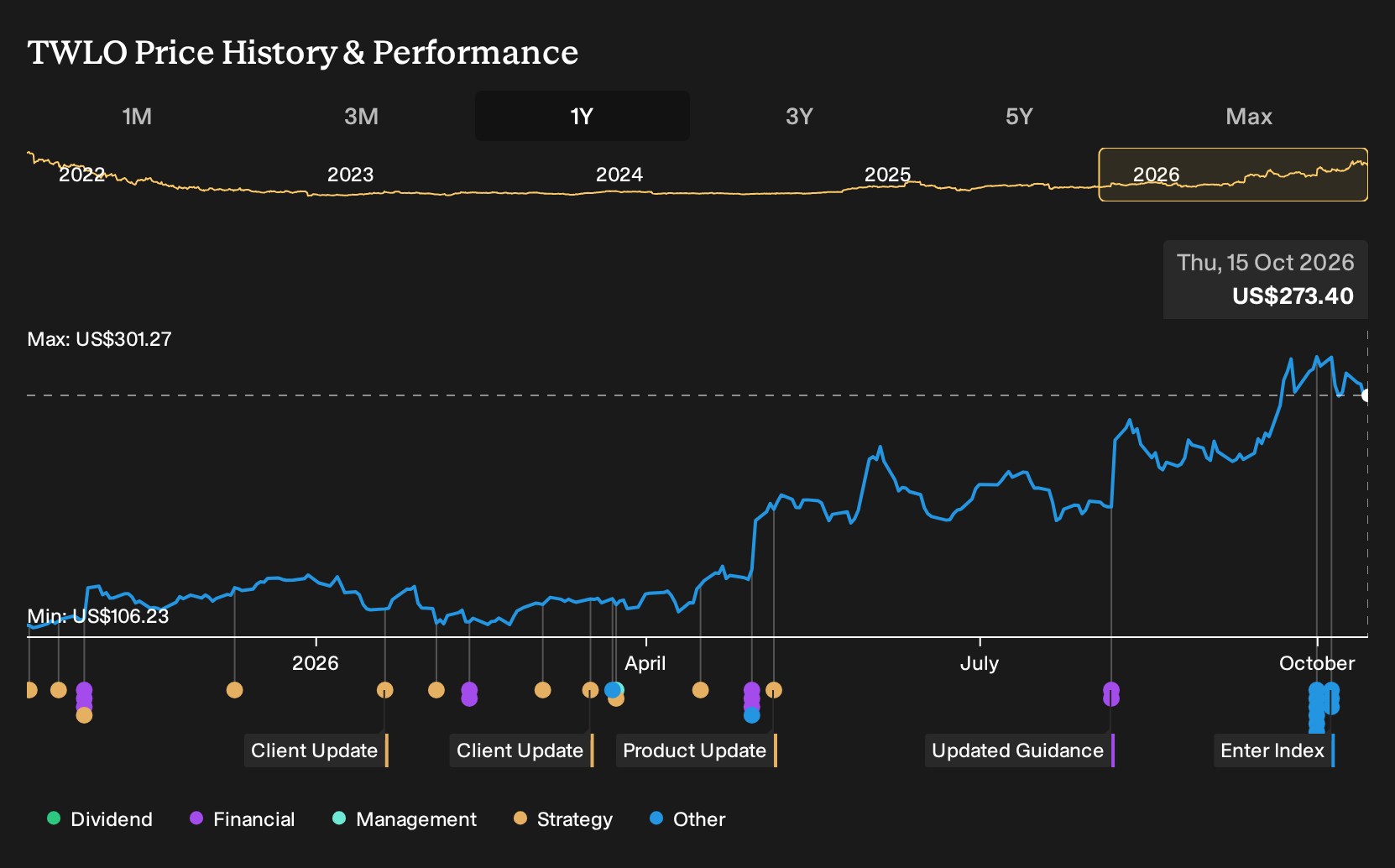
If you had been weighing Twilio on 15 October 2025, recent analyst upgrades and concern about compliance costs were already pulling your attention in opposite directions. For Twilio shareholders, the return over the past year was 157.4%, including dividends. If that kind of move would have changed your financial year, the real puzzle is what you would have focused on back then: AI-driven upside or the risk that regulation and competition would keep choking profitability.
Narratives are how investors here put a case on the record, with explicit assumptions about revenue, margins and the multiple. Those assumptions imply an estimated Fair Value.
This theme extends beyond Twilio. See which of 55 AI infrastructure stocks may still merit a closer look.
The Two Twilio Stories Investors Had To Compare
The shares cost US$108 at the start of the period, so any view on Twilio needed a clear sense of what might justify paying more or less than that.
The bullish Narrative pinned Fair Value at US$131, 21% above the start price. That case leaned on AI powered communications and global expansion, with assumptions that revenue could grow 7.9% a year and profit margins might reach 7.6% within about three years.
The bearish view set Fair Value at US$85.91, 20% below the start price. That scenario treated rising compliance demands and Big Tech rivalry as central risks, with revenue growth assumptions of 7.5% and profit margins rising to 5.5% over a similar timeframe.
What The Results Did To The Twilio Thesis
Twilio’s Q2 2026 report showed revenue of US$1.5b and net income of US$1.1b compared with US$1.2b and US$22.4m in Q2 2025, with net margin moving from 1.8% to 71.2%. That outcome leaned toward the bullish case on growth and profitability, although the unusually high margin left the cautious view on sustainability unresolved.
The key lesson is simple. When a story depends on margins getting better, you track net margin and absolute profit in each filing and assess whether the move looks repeatable or one off before updating your own fair value range.
What Twilio's Run Now Asks You To Believe
Twilio now trades at US$273 after a 157.4% gain over the past year. The selected Narrative’s Fair Value sits below the current price, which frames today’s level as generous for a business balancing AI upside with pressure on margins and customer retention.
The same Narrative argues that a buyer today has to assume Twilio can keep turning AI driven engagement tools and data integration into durable, higher quality recurring usage despite regulatory, pricing and competitive strains.
"Intensifying regulation, localization demands, and new technology alternatives threaten Twilio's margins, growth rate, and overall global expansion capability. Stronger competition and CPaaS commoditization are set to pressure prices, margins, and Twilio's ability to retain enterprise customers for recurring revenue."
The price and this Narrative do not agree. → Uncover what this Narrative says Twilio is actually worth
Find Your Own Contrarian Opportunity
By the time a rally makes headlines, you are reading about returns someone else has already earned. Why not go straight to the source and look for your own contrarian opportunity? These three companies trade below our estimated value.
- Company 1 - 50% below our estimate - uses an app-led store network to test frequent drink launches and promotions.
- Company 2 - 38% below our estimate - scales device trade-in, refurbishment, and resale as policy support and consumer acceptance expand.
- Company 3 - 35% below our estimate - reshapes its deposit mix and branch footprint through acquisitions and digital banking upgrades.
Three companies from the same screener. Open every one of the 33 undervalued companies on it →
This article by Simply Wall St is general in nature. We provide commentary based on historical data and analyst forecasts only using an unbiased methodology and our articles are not intended to be financial advice. It does not constitute a recommendation to buy or sell any stock, and does not take account of your objectives, or your financial situation. We aim to bring you long-term focused analysis driven by fundamental data. Note that our analysis may not factor in the latest price-sensitive company announcements or qualitative material. Simply Wall St has no position in any stocks mentioned.
Have feedback on this article? Concerned about the content? Get in touch with us directly. Alternatively, email editorial-team@simplywallst.com