


MALAYSIAN banks are under pressure from two directions – with fierce competition for deposits threatening interest margins while elevated bond yields weigh on investment portfolios.
This combination raises concerns over lenders’ profitability as funding costs increase and existing bond holdings become vulnerable to valuation losses.
Compounding the challenge, persistently high yields could make it more expensive for banks to raise fresh funding or refinance maturing debt, adding yet more strain on earnings.
The implications are particularly significant as higher government bond yields do not necessarily translate into stronger lending returns, especially with Bank Negara Malaysia (BNM) keeping its benchmark interest rate unchanged.
Banks could therefore find themselves paying more to secure funding while earning little additional income from existing loan portfolios.
Elevated yields are also challenging the investment appeal of banking stocks as investors reassess whether their dividend returns sufficiently compensate for the risks of holding equities of banks.
The deterioration in investor sentiment is already evident, although some analysts believe the selloff has been excessive.
Shares of Malayan Banking Bhd (Maybank), Malaysia’s largest listed bank, have fallen nearly 20% from their year-to-date peak in February, wiping out almost RM29bil in market capitalisation from that peak, as of Oct 14.
Public Bank Bhd’s shares have declined 10% from their August peak, while CIMB Group Holdings Bhd is down 15% from its January high.
The weakness extends beyond Malaysia.
Major Wall Street banking stocks, including JPMorgan Chase & Co, Bank of America Corp and Citigroup Inc, are also thrashed amid rising Treasury yields and concerns over inflation and government debt.
Across the Causeway, Singapore’s major lenders, DBS Group Holdings Ltd, Oversea-Chinese Banking Corp Ltd and United Overseas Bank Ltd, suffered declines in early October amid analyst downgrades and concerns over surging long-term bond yields.
Adding to market jitters, the International Monetary Fund (IMF) warned earlier this week of a potential “sharp rise in sovereign bond yields”.
“High public debt and rollover risks remain unresolved, increasing the chances that a rise in yields could occur in a disorderly manner, despite stable bond market liquidity and the recent unwinding of some leveraged trades,” the IMF said in its latest Global Financial Stability Report.
The fund urged governments to reduce deficits and debt levels, warning that delays would make fiscal adjustments more difficult, according to Reuters.
Malaysia has just announced its largest-ever budget for 2027, with the fiscal position expected to remain in deficit for the 30th consecutive year.
Nevertheless, annual new borrowings have declined from RM100bil in 2021 to RM75.6bil in 2025, while the fiscal deficit is projected to narrow to 3.3% of gross domestic product in 2027.
One immediate challenge confronting Malaysian banks is intensifying competition for deposits. Banks rely heavily on current accounts, savings accounts and fixed deposits to finance lending operations, with profitability depending substantially on the difference between interest earned and funding costs.
However, Malaysians increasingly have alternative destinations for their savings, including the Employees Provident Fund (EPF) and investments such as gold.
In 2023, the government raised the annual voluntary EPF contribution ceiling from RM60,000 to RM100,000, allowing members to channel more savings into the retirement fund.
The appeal is compelling. EPF dividends of around 6% or higher have historically exceeded fixed deposit rates offered by commercial banks.
Adding to its attractiveness is greater withdrawal flexibility for members with substantial retirement savings.
EPF members under the age of 55 can withdraw savings exceeding RM1.1mil in 2026, although the threshold will increase to RM1.2mil in 2027 and RM1.3mil in 2028.
While withdrawal restrictions remain, potentially superior returns and greater flexibility could intensify competition for household savings.
Official data shows voluntary EPF contributions reached RM14.15bil in the first half of 2026 (1H26), which is a 21.1% increase from the same period last year.
Meanwhile, the number of formal sector members making above-statutory contributions through i-Topup rose 13.9% year-on-year to nearly 204,450.
To retain deposits, banks may have to offer more competitive fixed deposit rates or higher returns to depositors.
Hong Leong Investment Bank Research has cautioned that renewed deposit competition could emerge from November as banks position themselves for year-end targets.
Consequently, it sees limited scope for meaningful recovery in net interest margins during the fourth quarter of 2026 (4Q26), with more visible improvement potentially delayed until early 2027.
The difficulty is compounded when government bond yields rise without a corresponding increase in BNM’s overnight policy rate (OPR).
Higher Malaysian Government Securities (MGS) yields do not automatically translate into higher interest rates on existing floating rate loans.
Instead, lending returns could remain relatively unchanged while deposit competition pushes funding costs higher.
Citi acknowledges that rising deposit rates could compress banks’ net interest margins, although it believes much of this risk has already been reflected in the share prices of local banks.
Change in yields
Beyond deposit competition, Malaysian banks face another challenge from their substantial holdings of government securities, including MGS and Government Investment Issues.
These securities generate relatively predictable income but remain vulnerable to changes in market yields.
When investors demand higher yields, prices of existing fixed rate securities decline, potentially leaving banks with valuation losses.
MBSB Research cautions that rising yields could create short-term pressure on investment portfolios, even though higher reinvestment returns may eventually benefit banks.
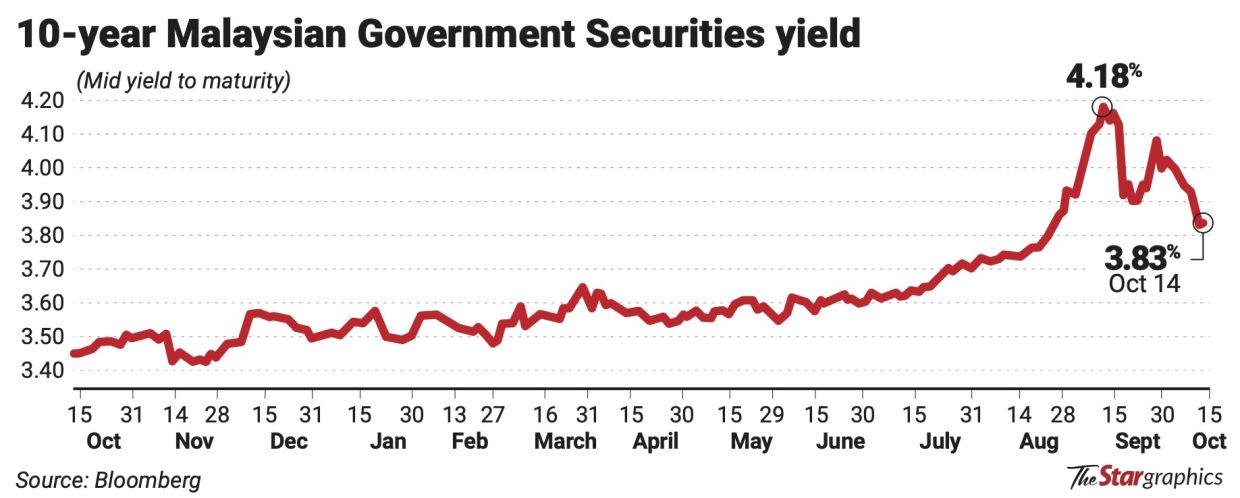
It notes that the previous increase in the 10-year MGS yield exceeding 4% was driven primarily by global repricing rather than domestic fundamentals, potentially increasing Treasury income volatility.
However, yields have been easing in recent weeks, with the 10-year MGS moving to the 3.8% level.
The actual financial impact from higher yields depends on the size, duration and accounting classification of banks’ investment portfolios.
Under the Malaysian Financial Reporting Standards 9, banks classify their bond holdings into three categories: amortised cost, fair value through other comprehensive income (FVOCI), and fair value through profit or loss (FVTPL).
Bonds classified as FVTPL are typically held for trading purposes, allowing banks to profit from movements in market prices.
These securities are marked to market, meaning any increase or decrease in their value is immediately reflected in the bank’s reported profit or loss.
Meanwhile, bonds classified as FVOCI are generally held to generate interest income while giving banks the flexibility to sell them, particularly to manage liquidity needs.
These securities are also marked to market, but unrealised valuation gains or losses are generally recognised in other comprehensive income rather than directly affecting reported profit. These losses can nevertheless erode shareholders’ equity and potentially affect regulatory capital.
Bonds held at amortised cost are generally intended to be held to collect contractual interest and principal payments, rather than actively traded. They are not subject to routine fair value adjustments, although credit impairment requirements still apply.
These distinctions matter because banks could report relatively stable earnings even as their securities portfolios suffer valuation losses.
RHB Research estimates that a 100-basis-point increase in bond yields could generate approximately RM8bil in mark-to-market losses across Malaysian banking groups.
After incorporating mitigating factors, it estimates that the sector’s aggregate Common Equity Tier 1 (CET1) capital ratio could decline by approximately 46 basis points.
Under the same scenario, Maybank’s group capital ratio could decline by 57 basis points, compared with 52 basis points for CIMB.
Bank Islam Malaysia Bhd and Alliance Bank Malaysia Bhd are also identified as relatively sensitive, while Public Bank is considered more insulated.
However, Citi believes investors have overestimated the damage from higher bond yields, prompting it to upgrade the Malaysian banking sector to a “buy” rating.
It argues that banks are more resilient than perceived, partly because derivative hedges can offset valuation losses on FVTPL securities.
Citing previous periods of rising yields, Citi notes that derivative gains generally exceeded FVTPL losses, with CIMB recording particularly strong gains.
Citi also estimates that the impact on CET1 ratios would vary substantially, with RHB Bank Bhd facing the largest potential reduction of around 80 basis points, compared with approximately 50 basis points for Maybank and just 10 basis points for Public Bank.
BIMB Securities Research similarly expects the impact of higher yields to remain manageable.
It noted that FVTPL securities account for only 13.1% of banks’ investment holdings, limiting the direct earnings impact of valuation losses.
However, CIMB, AMMB Holdings Bhd and Maybank are relatively more exposed, with FVTPL securities representing 28.6%, 22% and 21.9% of their respective investment portfolios.
For FVOCI holdings, MBSB Bhd has the highest exposure at 79.4%, followed by Alliance Bank at 69% and RHB Bank at 60.2%.
BIMB Securities Research expects valuation pressures in the 3Q26 to ease towards year-end as the 10-year MGS yield moderates to between 3.75% and 3.9%, potentially allowing banks to recover some unrealised losses.
The OPR factor
A key question is whether the recent surge in bond yields represents a temporary adjustment or the beginning of a prolonged period of elevated borrowing costs.
BIMB Securities Research analyst Kelvin Ong tells StarBiz 7 that Malaysian government bond yields have already retreated towards historical norms.
He notes that the 10-year MGS yield has generally traded about 100 basis points above the OPR over the longer term.
With the OPR at 2.75% and the 10-year MGS yield around 3.8%, he believes the market has largely returned to that relationship.
BIMB Securities Research does not expect BNM to raise the OPR in either 2026 or 2027.
However, iFast Capital analyst Kevin Khaw Khai Sheng remains cautious about declaring an end to the elevated yield environment. “The easing in MGS yields is positive, particularly following Budget 2027’s fiscal consolidation measures.”
He expects longer-term risk premiums to remain elevated amid persistent macroeconomic uncertainty.
Khaw highlights domestic political uncertainty, including the possibility of an early general election, alongside potential inflationary pressures from the proposed minimum wage increase to RM2,000 in June 2027, higher personal tax relief and expanded cash assistance.
These developments could prompt investors to demand higher premiums for holding longer-dated government bonds, resulting in a steeper yield curve.
His house view anticipates an unchanged OPR throughout 2026, although risks are tilted towards a rate increase in 2027.
Against this backdrop, Khaw prefers Malaysian fixed income securities with maturities of three to five years to balance income opportunities against interest rate volatility.
Opportunity amid the selloff
Despite the near-term headwinds, the banking sector’s fundamentals remain relatively sound, according to several analysts.
Rising yields do not necessarily signal financial distress, although even adequately capitalised banks can experience pressure on earnings, shareholders’ equity and regulatory capital.
Banks also face potentially higher refinancing costs when outstanding bonds and sukuk mature.
For example, refinancing RM1bil of debt at 5% instead of 4% would increase annual financing expenses by RM10mil.
The actual impact depends on the timing of maturities, instrument types and credit spreads demanded by investors.
Nevertheless, the recent share price correction could present an opportunity for long-term investors.
Tradeview Capital chief executive officer Ng Zhu Hann believes banking stocks have become increasingly attractive following their steep declines, particularly given their dividend yields.
“Banking stocks will always be a good portfolio asset to hold. The question is always the timing of entry.”
However, he cautioned that investors must contend with near-term valuation pressures on bond holdings, slower economic and loan growth, and margin compression from higher funding costs.
For investors, the question is whether these risks warrant the steep declines already seen in banking stocks.
With analysts divided over the outlook for bond yields but increasingly recognising the sector’s resilience, the coming quarterly results could prove crucial in determining whether the recent selloff represents an opportunity or whether further earnings pressure lies ahead.