


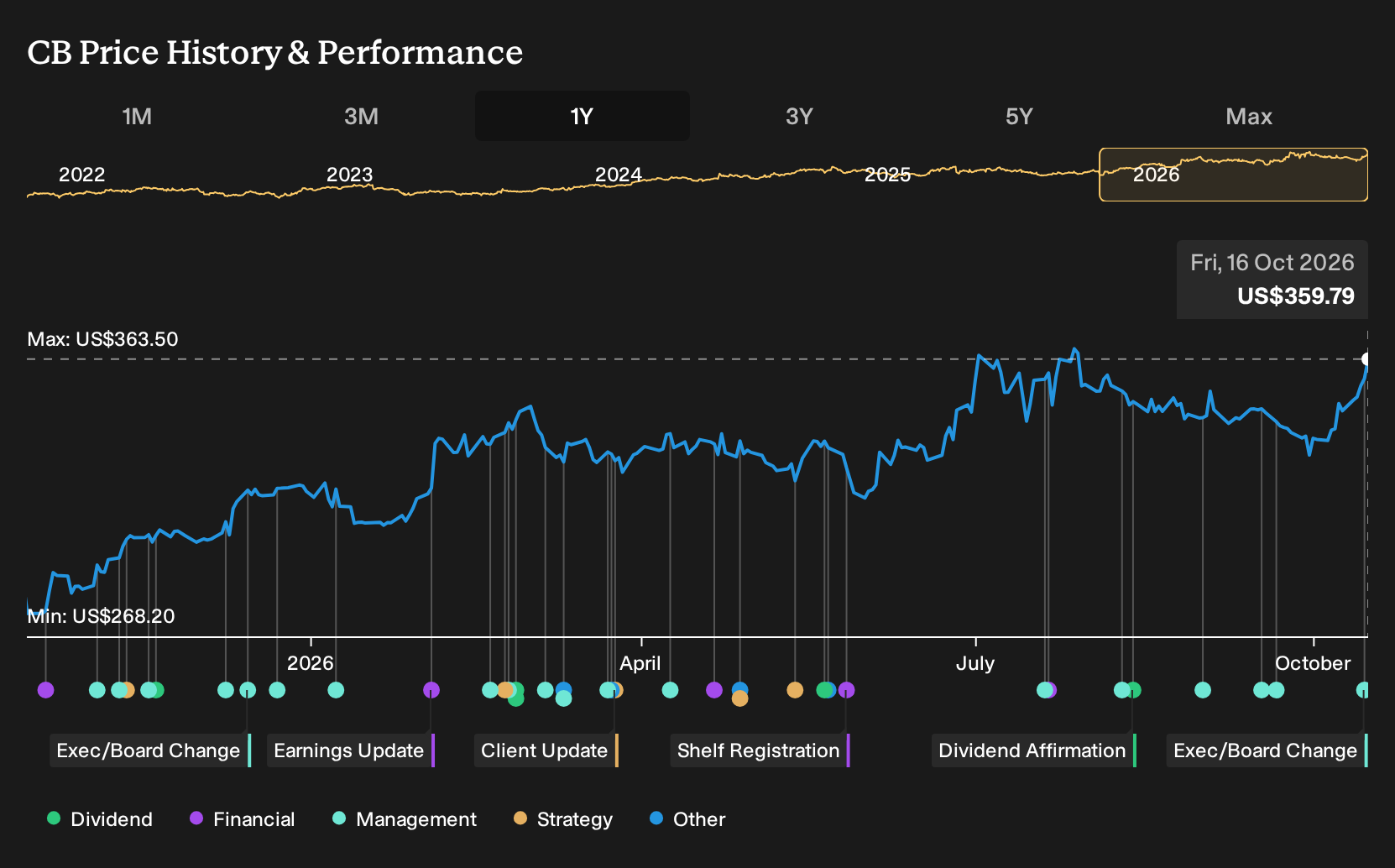
If you only glanced at Chubb’s headlines over the past year, the mix of record earnings, catastrophe concerns and war risk exposure might have looked more like a warning label rather than an invitation. Investors who held Chubb over the past year are up 35.8%, including dividends. If you had been deciding on 16 October 2025, with analysts split between upside and downside, what would you have focused on to judge that kind of payoff was even possible?
If the move has made Chubb harder to judge, start where the gap is still open and scan 33 high quality undervalued stocks.
The Two Chubb Stories Investors Had To Choose Between
The shares cost US$268 at the start of the period, and the argument was whether Chubb was quietly cheap or already full value.
The bullish narrative pointed to a Fair Value of US$300, a rough guide to what that storyline implied, built on international expansion, digital distribution and disciplined underwriting that kept combined ratios tight.
The bearish view put Fair Value at US$247 and leaned on assumptions of revenue growth at 2.5% and a future P/E of 11.6x, with competition and catastrophe risk weighing on sentiment.
What The Evidence Did To The Chubb Debate
Chubb’s Q2 2026 update backed the bullish focus on underwriting quality, with a P&C combined ratio in the low 80s and strong core operating income across Q1 and Q2. The Q2 figures also reminded investors of the bear case. Revenue rose from US$14.9b to US$15.8b, while net income slipped and net margin moved from 19.9% to 18.0%, so the evidence cut both ways.
The key assumption investors were really betting on was margin resilience, not just premium growth. When you look at another insurer, check whether higher revenue is backed by stable or stronger profitability, especially net margin and combined ratio, before trusting any fair value story.
What Chubb’s Price Seems To Be Saying Now
Chubb trades at US$360 today, well above the US$268 starting point of last year, so expectations have clearly shifted. The business picture looks more mixed. Revenue in Q2 2026 was US$15.8b versus US$14.9b a year earlier, while net income excluding extra items was US$2.9b versus US$3.0b.
The key question now is whether a lower net margin of 18.0% versus 19.9% supports this richer price. The valuation screener can help you test how much margin strength is already assumed.
A past return records what the market decided, not what Chubb is worth. Uncover where our valuation lands today.
Looking Past Chubb For Clues
Once you have pulled Chubb apart, one question lingers. Where else are similar pressures and opportunities playing out?
Large insurers everywhere are wrestling with the same core problem. They need better underwriting economics, not just more premium volume.
Another global player is pushing hard on AI across marketing, pricing and claims. The focus is lowering unit costs and keeping combined ratios in check.
It is also leaning into health cover and investment products to steady earnings. If that mix works, your mental model for Chubb may need a second reference point.
That argument has a Narrative and a number behind it. → See the company one Narrative values 35% above its price
This article by Simply Wall St is general in nature. We provide commentary based on historical data and analyst forecasts only using an unbiased methodology and our articles are not intended to be financial advice. It does not constitute a recommendation to buy or sell any stock, and does not take account of your objectives, or your financial situation. We aim to bring you long-term focused analysis driven by fundamental data. Note that our analysis may not factor in the latest price-sensitive company announcements or qualitative material. Simply Wall St has no position in any stocks mentioned.
Have feedback on this article? Concerned about the content? Get in touch with us directly. Alternatively, email editorial-team@simplywallst.com