


- Selective Insurance Group has appointed Vaibhav Kalia as Executive Vice President and Chief Investment Officer, formalizing the role he held on an interim basis since June 2026 and placing him in charge of the insurer's investment portfolio and benefit plan assets.
- Kalia's fixed income and risk management background, including prior roles at BlackRock and HSBC, directly links investment decisions to Selective Insurance Group's underwriting and earnings ambitions. The portfolio is now overseen by an executive steeped in quantitative risk analysis.
- We will now look at how Selective Insurance Group's new permanent CIO could reshape its investment narrative.
Selective Insurance Group Investment Narrative Recap
To own Selective Insurance Group, you need to believe the insurer can keep underwriting discipline tight while casualty severity and social inflation stay elevated. The near term swing factor is whether rate actions and re underwriting in Standard Commercial Lines can stabilize combined ratios without putting too much pressure on premium volume and agency relationships.
The biggest operational risk remains adverse loss development in general liability and commercial auto, where assumptions around 9% casualty trends and 10% commercial auto severity keep volatility on the table. Mr. Kalia's permanent CIO appointment looks important, but not transformational for those core underwriting challenges or the near term earnings catalyst.
The most relevant update here is the confirmation of Vaibhav Kalia as permanent CIO, because analysts expect net investment income of about US$480m in 2026 to be a key earnings driver. With an A plus rated fixed income portfolio and growing benefit plan oversight, investment execution sits alongside underwriting as a main earnings lever.
For you as a shareholder, the link between Selective Insurance Group's investment returns and casualty reserving risk is critical. If investment income tracks guidance while Standard Commercial Lines premiums remain under pressure from tighter underwriting, the portfolio can still influence overall ROE and cushion some volatility, although it does not remove the core casualty trend risk.
What The 2029 Consensus Implies For Selective Insurance Group
Analysts are essentially asking you to underwrite a slow top line, higher margin story for Selective Insurance Group. Revenue is expected to stay broadly flat over the next three years, while profit margins are projected to move from 8.9% today to 10.4% by 2029. That mix relies heavily on tighter underwriting, casualty reserve discipline and a larger lift from investment income rather than aggressive premium expansion.
The earnings bridge gives you a clearer anchor. Consensus points to profit of US$575.2 million by 2029, compared with US$488.4 million today. That is an increase of about US$86.8 million, or roughly 18%, over the period. Earnings per share of US$9.40 assumes a modest reduction in the share count of 1.39% a year, so part of that step up comes from buybacks as well as better margins, not just higher absolute profit dollars.
On the revenue side, the 2029 framework is simple but demanding in its own way. Analysts are effectively pencilling in around US$5.5b of revenue with very little assumed annual growth between now and then. The narrative does not lean on outsized premium expansion to make the math work. Instead it leans on expense control, improved loss ratios and Selective Insurance Group turning more of every premium dollar and investment dollar into net income.
Valuation expectations layer on another set of assumptions you need to be comfortable with. The analyst group is using those 2029 earnings of US$575.2 million and revenues of US$5.5b as the anchor and applying a P/E of 12.5x to arrive at a consensus price target of US$101.86. That multiple is higher than the current 10.4x P/E for Selective Insurance Group and above the stated 10.7x for the wider US insurance sector. This means the thesis is not just about hitting the numbers. It also assumes the market would be willing to pay a richer earnings multiple once the profit mix and perceived risk profile improve.
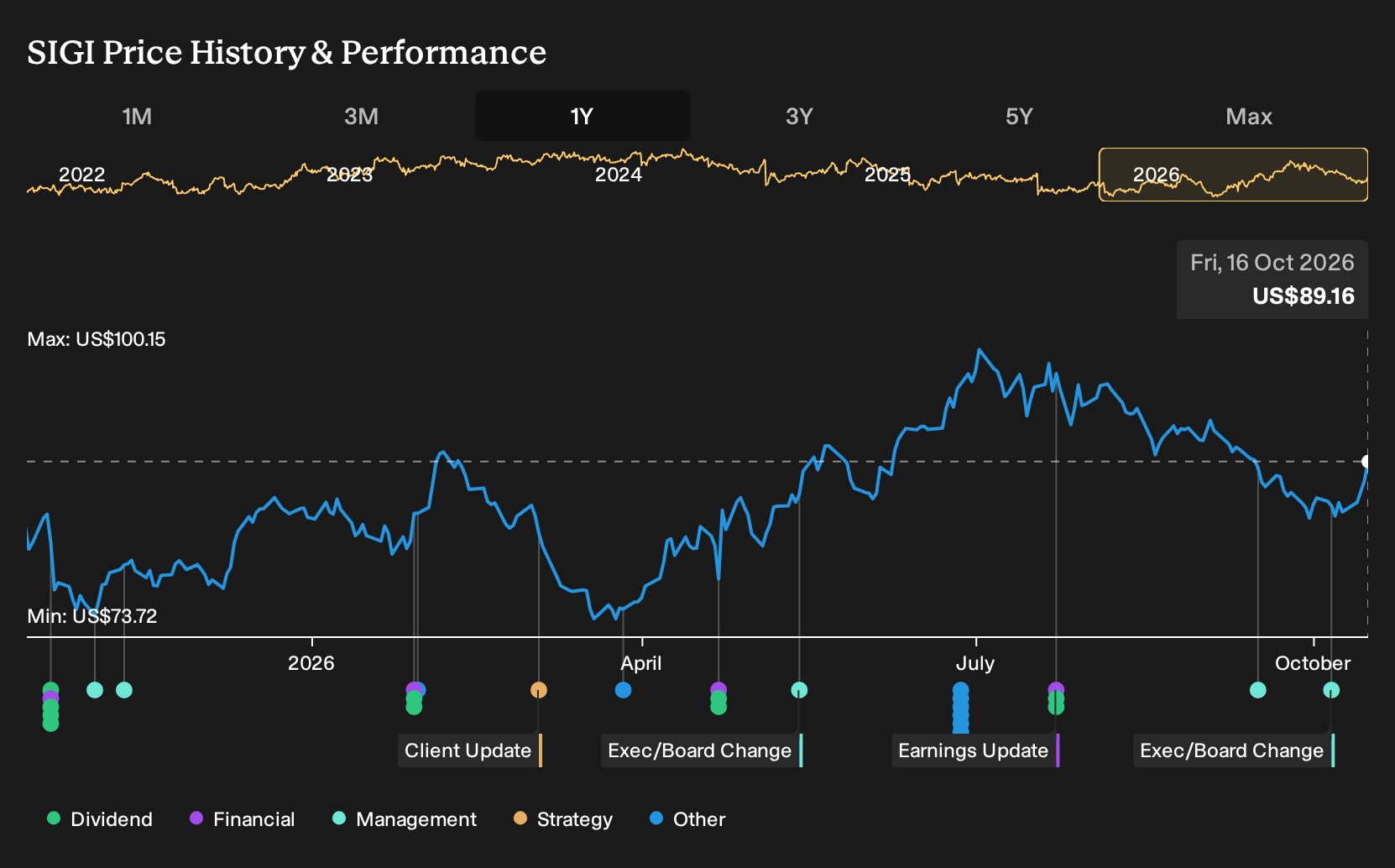
Current pricing adds context but does not settle the debate. With the shares at US$85.59 as of October 2026, the US$101.86 consensus points to about 16% upside implied by the street models. The range around that target is wide enough to matter, from US$80 on the cautious end to US$115 at the optimistic end. That spread tells you analysts do not share a single view on how casualty inflation, re underwriting actions and investment yields will interact over the next three years.
Selective Insurance Group's narrative projects US$5.5b revenue and US$575.2 million earnings by 2029. This rests on fairly flat yearly revenue growth assumptions and an earnings increase of about US$86.8 million from current earnings of US$488.4 million.
Uncover why Selective Insurance Group's fair value indicates a 14% potential upside to its current price that could narrow quickly.
Exploring Other Perspectives
The Simply Wall St Community only supplies two fair value views for Selective Insurance Group, yet they already stretch from about US$101.86 to nearly US$189.78. That kind of spread shows how far private investors can diverge on upside. You can then set that against casualty trend risk and upcoming earnings expectations, and weigh which story feels more convincing.
Explore another Selective Insurance Group fair value estimate, including one that suggests as much as 113% potential upside from the current price.
Reach Your Own Conclusion
Disagree with existing narratives? Extraordinary investment returns rarely come from following the herd, so trust your own analysis and judgment.
- A great starting point for your Selective Insurance Group research is our analysis highlighting 4 key rewards and 1 important warning sign that could impact your investment decision.
- See our latest analysis for Selective Insurance Group. The report includes a comprehensive fundamental analysis summarized in a single visual, the Snowflake, making it easy to evaluate Selective Insurance Group's overall financial health at a glance.
Looking for more investment ideas beyond Selective Insurance Group?
If the Selective Insurance Group story has sharpened your view on risk, return and valuation, it can be useful to widen the lens and compare it with other businesses that fit different profiles on income potential, balance sheet strength and perceived mispricing.
- For investors who want income to do more of the heavy lifting, consider high yield opportunities by reviewing 8 dividend fortresses with payouts that aim to compensate you for staying patient.
- If capital preservation and steadier fundamentals come first, focus on financial strength by filtering for companies in the list of solid balance sheet and fundamentals (25 results) that pair robust finances with measured risk.
- When you are hunting for mispriced opportunities backed by real fundamentals, broaden your watchlist using the 33 high quality undervalued stocks and see which stocks currently screen as potential value candidates.
This article by Simply Wall St is general in nature. We provide commentary based on historical data and analyst forecasts only using an unbiased methodology and our articles are not intended to be financial advice. It does not constitute a recommendation to buy or sell any stock, and does not take account of your objectives, or your financial situation. We aim to bring you long-term focused analysis driven by fundamental data. Note that our analysis may not factor in the latest price-sensitive company announcements or qualitative material. Simply Wall St has no position in any stocks mentioned.
Have feedback on this article? Concerned about the content? Get in touch with us directly. Alternatively, email editorial-team@simplywallst.com