


Bond markets have turned into the story everyone else must live with, as hedge fund leverage collides with record size government debt markets and warnings from the IMF and Bank of England about crowded trades. That stress can ripple into big primary dealers and fixed-income market-making banks, creating both pressure and openings. This piece walks through 3 stocks exposed to that news backdrop and explains why each one might matter to your portfolio now.
The three stocks below are just a starting sample. The full screen on publicly listed primary dealers and bond market-making banks surfaced 24 more companies with equally detailed narratives that are not covered here.
To move beyond this short list and identify which bond market banks best fit your risk, income, and capital appreciation goals, head straight into the Global Primary Dealers and Fixed-Income Market-Making Banks screener to filter, compare, and analyze the highest-conviction candidates.
Raymond James Financial (RJF)
Overview: Raymond James Financial is a diversified financial services group whose wealth management, capital markets, and banking units link clients directly to bond and equity markets.
Operations: Raymond James Financial generates most of its US$13.3b revenue from the Private Client Group at US$11.1b, with Capital Markets at US$1.8b and Bank at US$1.9b. Its revenue is primarily sourced from US clients contributing US$14.0b.
Market Cap: US$30.2b
Raymond James Financial matters in this primary dealer themed screen because its capital markets arm connects institutional clients to government bond and underwriting activity, while its large wealth platform feeds those trading and advisory flows.
"The build out of firmwide artificial intelligence capabilities, including more than US$1.1b in annual technology spending, the rollout of the Raimond AI assistant with a reported 99.5% satisfaction rate among 6,500 users, and broad training through the AI Academy, is expected to drive productivity gains that could support net margins."
The real swing factor is how one evolving pressure in its bond focused capital markets franchise ultimately shapes those margin outcomes investors care about.
That pressure point is exactly where the story gets interesting. Read the full narrative for Raymond James Financial to see how Raymond James Financial’s bond engine and AI push could be decoupling.

UMB Financial (UMBF)
Overview: UMB Financial is a Kansas City based bank holding company that provides commercial, institutional, and personal banking plus asset servicing.
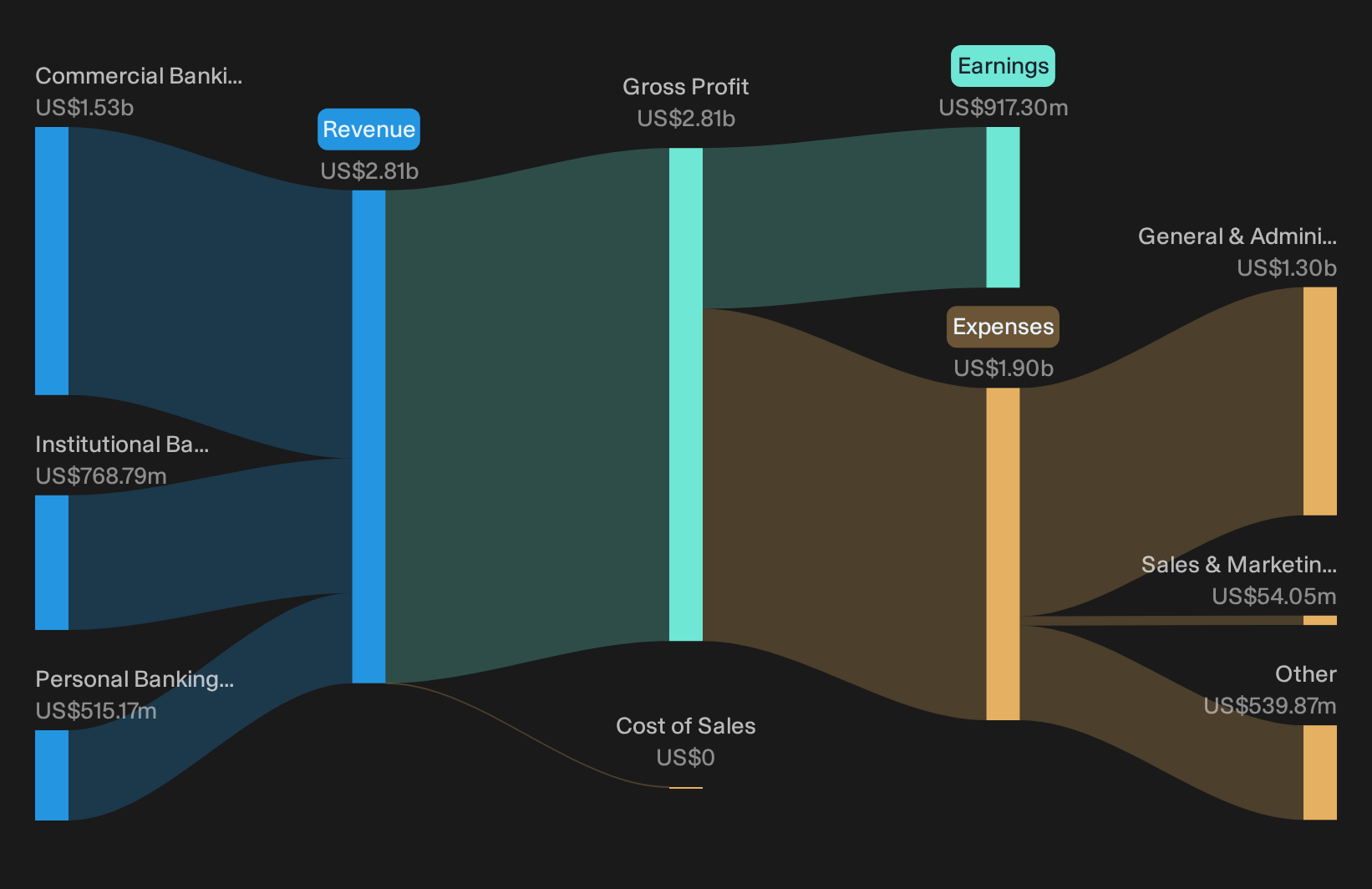
Operations: UMB Financial generates about US$1.5b from Commercial Banking, US$769m from Institutional Banking, and US$515m from Personal Banking, almost entirely in the US.
Market Cap: US$10.0b
For this Global Primary Dealers and Fixed-Income Market-Making Banks screen, UMB Financial matters because its institutional banking and asset servicing work place it closer to securities and funding flows than a typical local retail lender.
"The successful integration of the Heartland acquisition, including vendor consolidation and conversion to the UMB platform, is now feeding through to lower underlying operating expenses and earlier contract termination synergies. This supports continued operating leverage and net margin resilience."
The key question is how one less visible shift in its institutional fee engine ultimately filters through to earnings durability when bond markets stay stressed.
That quiet shift deserves a closer look, so read the full narrative for UMB Financial to see how UMB Financial’s fee engine could be masking underappreciated upside.
Stifel Financial (SF)
Overview: Stifel Financial runs a global wealth management and investment banking platform that links advisers and institutional clients to equity and fixed-income markets.
Operations: Stifel Financial generates about US$3.7b from Global Wealth Management and US$2.1b from Institutional Group, mostly from US clients.
Market Cap: US$10.2b
Stifel Financial matters in this primary dealer themed screen because its institutional and wealth platforms sit close to bond trading, underwriting, and treasury flows that can feel every bump in stressed government debt markets.
"Stifel Financial's continued focus on attracting experienced, higher producing advisers, supported by top adviser satisfaction scores over multiple years, can extend the adviser led Global Wealth Management expansion and feed future fee based revenue growth."
What happens to those adviser driven fee pools and trading economics if one quiet shift in funding conditions or client risk appetite flips direction?
If that risk switch flips, read the full narrative for Stifel Financial to see whether Stifel Financial’s adviser engine is quietly accelerating or masking fragility.

Seeking Fresh Alternatives With Real Edge?
Fresh ideas move first. Breakout themes, new momentum, and under the radar opportunities often get caught by early screens while it matters. Do not delay; consider researching opportunities early.
- Research early trend shifts before they start accelerating by scanning the curated 33 high quality undervalued stocks built to spotlight stronger balance sheets and cash flows while they are still overlooked.
- Monitor future critical materials as demand develops and supply stories change by tracking the focused 32 best rare earth metal stocks designed to highlight producers with meaningful exposure.
- Review potential infrastructure activity and grid upgrades by using the hand picked 42 power grid technology and infrastructure stocks before projects move from planning into full execution.
This article by Simply Wall St is general in nature. We provide commentary based on historical data and analyst forecasts only using an unbiased methodology and our articles are not intended to be financial advice. It does not constitute a recommendation to buy or sell any stock, and does not take account of your objectives, or your financial situation. We aim to bring you long-term focused analysis driven by fundamental data. Note that our analysis may not factor in the latest price-sensitive company announcements or qualitative material. Simply Wall St has no position in any stocks mentioned.
Have feedback on this article? Concerned about the content? Get in touch with us directly. Alternatively, email editorial-team@simplywallst.com