


- CRH is facing pressure from higher energy costs and weaker US house building, which have led Wall Street analysts to flag a possible earnings shortfall.
- The shift in analyst tone highlights how CRH's exposure to energy intensive production and cyclical US residential demand can influence near term profit resilience.
- We will now look at how CRH's investment narrative could be affected by rising energy costs pressuring its near term earnings profile.
Stress test how CRH's pressures compare by scanning a hand picked group of infrastructure and construction exposed plays through 42 power grid technology and infrastructure stocks.
CRH Investment Narrative Recap
To own CRH, you need to be comfortable with a building materials group that leans heavily on US infrastructure spending and large projects like data centers, while carrying meaningful energy exposure. The near term story hinges on how well management can offset rising fuel and power costs with pricing and efficiency so that profit quality holds up.
The biggest near term swing factor is execution on its US heavy construction and aggregates led model, especially as US new build housing stays soft and ready mix volumes feel that pressure. A key risk is that higher input costs and weaker residential end markets combine with CRH's debt load to squeeze flexibility.
The planned Arcosa acquisition sits at the center of this discussion around earnings pressure from higher energy costs and a softer US housing backdrop. CRH is using this deal to add 35 million tons of annual aggregates capacity, deepen its exposure to publicly funded infrastructure and concentrate further on what it views as core materials platforms.
That expansion plan, funded alongside a pause in buybacks and an expected rise in leverage to 2.4x net debt to adjusted EBITDA on a pro forma 2026 basis, raises the operational bar. Integration, delivery of the targeted US$175m run rate cost savings and stable performance from the acquired assets now matter more if energy costs stay elevated and residential weakness lingers.
What CRH's Long Range Forecasts Assume
Analysts are effectively asking investors to underwrite a bigger and more profitable CRH over the next few years, even as energy costs and softer US housing weigh on nearer term earnings. The projections are anchored on CRH leaning into infrastructure exposed aggregates and heavy construction work, while tightening cost control to offset fuel and power pressure.
Consensus expectations outline a business that relies on mid single digit top line expansion rather than volume surges. The current analyst set assumes CRH's revenue grows by 5.1% each year on average over the next three years, reflecting a steady build in infrastructure activity rather than a sharp housing rebound.
Profitability assumptions also move higher from where CRH sits today. Analysts are modelling group profit margins at 9.9% currently and see those edging up to 11.0% over a three year window. This implicitly assumes that pricing discipline, a mix shift to aggregates and integration of Arcosa and other deals more than offset stubbornly high energy inputs.
Earnings today are estimated at US$3.8b. Consensus then steps that up to US$4.9b by 2029, with some analysts pencilling in as much as US$5.5b. That US$1.1b uplift in the core forecast is meaningful in the context of current energy and US housing pressures, so it places a clear execution hurdle on management to protect margins while integrating a larger asset base.
On these numbers, the market debate starts to look less about short term quarterly noise and more about whether CRH can grow into a valuation that implies a higher multiple on larger earnings. Analysts are using a terminal P/E of 22.2x on those projected 2029 earnings, compared with about 14.3x today and roughly 18.0x for the wider GB Basic Materials group. Investors therefore need to be comfortable that the business mix, margin structure and cash generation profile justify that step up.
CRH's narrative projects US$44.9b revenue and US$4.9b earnings by 2029. This rests on 5.1% yearly revenue growth and an earnings increase of about US$1.1b from US$3.8b today.
Uncover why CRH's fair value indicates a 55% potential upside to its current price, which could narrow quickly.
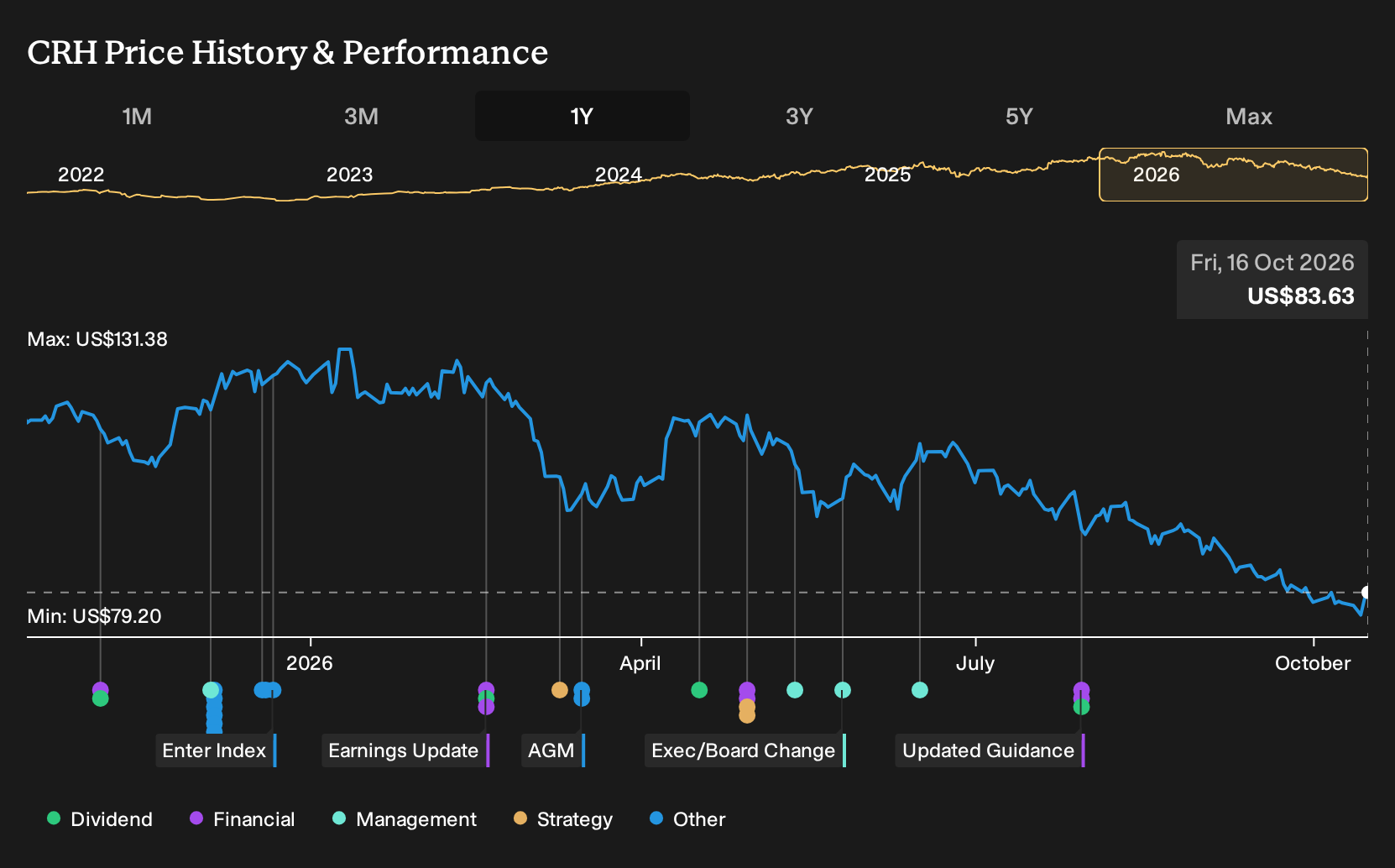
Exploring Other Perspectives
For CRH, the bearish twist in the alternate view is housing. The lowest analysts assumed only 3.0% annual revenue growth, with earnings reaching about US$4.5b by 2029 instead of US$4.9b. Those forecasts were set before this earnings scare, so treat them as moving parts and compare several viewpoints yourself.
Explore 5 other CRH fair value estimates, including one that suggests it could be worth just $96.00.
Reach Your Own Conclusion
Disagree with existing narratives? Extraordinary investment returns rarely come from following the herd, so consider doing your own research.
- A great starting point for your CRH research is our analysis highlighting 5 key rewards and 1 important warning sign that could impact your investment decision.
- See our latest analysis for CRH. The report includes a comprehensive fundamental analysis summarized in a single visual, the Snowflake, making it easy to evaluate CRH's overall financial health at a glance.
Looking For More Ideas Beyond CRH?
If the CRH story has you thinking about portfolio balance, it can help to line it up against other opportunities that share some traits or offer something very different. The Simply Wall St Screener lets you quickly filter for financial strength, income potential or mispriced quality so you can pressure test your thesis across a broader watchlist.
- If resilience is your priority, you can compare CRH with a curated group of businesses that screen well on financial stability and fundamentals through the list of solid balance sheet and fundamentals (25 results).
- If value is the angle you care about most, you can weigh CRH against companies that our filters flag as mispriced relative to their quality profile using the 33 high quality undervalued stocks.
- If you want to hunt for less crowded opportunities, you can set CRH alongside a pool of under the radar businesses that still show strong fundamentals by running the 20 high quality undiscovered gems.
This article by Simply Wall St is general in nature. We provide commentary based on historical data and analyst forecasts only using an unbiased methodology and our articles are not intended to be financial advice. It does not constitute a recommendation to buy or sell any stock, and does not take account of your objectives, or your financial situation. We aim to bring you long-term focused analysis driven by fundamental data. Note that our analysis may not factor in the latest price-sensitive company announcements or qualitative material. Simply Wall St has no position in any stocks mentioned.
Have feedback on this article? Concerned about the content? Get in touch with us directly. Alternatively, email editorial-team@simplywallst.com