


GSK has delivered a 59.1% share price gain over the past five years, and that kind of run naturally raises a blunt question for investors who focus on the numbers. Is the current price on the London market still in line with what the drug maker’s earnings can reasonably support?
- A 59.1% return over five years places real emphasis on whether GSK's earnings profile can support this higher valuation base over time.
- Recent restructuring plans and new investment commitments, including job cuts in Belgium alongside more than $800 million earmarked for US biopharma expansion, can reshape the timing and level of future profits and cash generation that underpin any earnings based valuation.
- Your read on GSK is one view; the desks covering it have another. See what analysts think GSK's shares could be worth.
The issue now is whether GSK's current share price is justified by its earnings when judged against the Fair Ratio benchmark.
If you want a broader watchlist of companies that also clear a basic quality bar before you compare P/E and earnings stories like GSK's, a focused stock screen is a useful next step, such as solid balance sheet and fundamentals stocks screener (9 results).
Is GSK Still Cheap on Earnings?
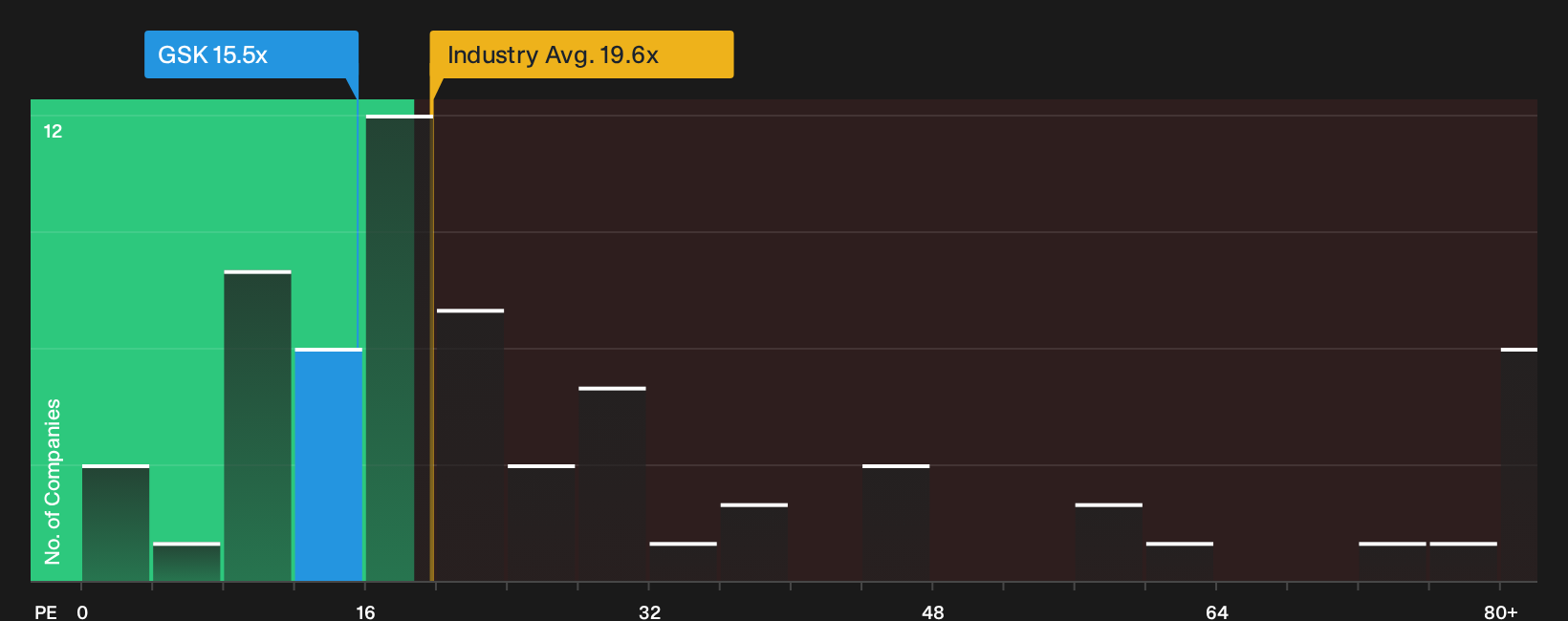
The P/E ratio is a straightforward way to see what you are paying for each pound of GSK earnings. On this measure, GSK trades at about 15.5x, which is below the wider pharmaceuticals sector on roughly 21.6x and far under the peer group average near 49.2x. The Fair Ratio, which factors in GSK's growth profile, profitability, size and risk, points to a higher level than where the shares change hands today, so the current multiple screens as undervalued on this framework.
Because the restructuring in Belgium is aimed at lifting efficiency and reshaping the cost base, the fact that GSK is on a discount P/E despite that plan on the table is an important signal for anyone weighing whether sentiment has run ahead of the earnings line. For investors, the decision now is whether this lower multiple correctly reflects execution risk on projects like the Pennsylvania biopharma expansion or whether it marks a gap between current price and what the income stream could justify. Explore the numbers behind GSK's P/E valuation.
The GSK Narrative: What Would Justify Today's Price?
GSK Narratives on Simply Wall St pick up where the P/E puzzle leaves off and explain what paths for growth, margins and earnings would need to materialise for the current share price to look either stretched or conservative. Each scenario ties a fair value anchor to a particular mix of potential catalysts and risks in GSK's story. This makes it easier for you to track which version of events seems to be unfolding over time on the Community page.
On GSK, the community splits between investors who see underappreciated earnings power and others who think the price already bakes in too much optimism.
Bull case: 14% undervalued
"GSK is pushing deeper into long acting HIV injectables, with Cabenuva and Apretude driving a larger share of HIV division growth and backed by data showing Cabenuva superiority to daily oral therapy in high risk and viremic patients..."
Discover why this Narrative puts GSK at 14% undervalued.
Bear case: 28% overvalued
"Although GSK is pushing hard to lift its specialty medicines mix, the 9% decline in General Medicines sales in Q2 and the downgrade to full year guidance indicate structural pressure from aging brands and generic competition that could drag on revenue and dilute the margin uplift expected from higher priced therapies..."
Explore why this Narrative puts GSK at 28% overvalued.
GSK’s valuation still leaves one crucial angle unresolved
Numbers only tell part of the story for GSK, because the people setting priorities and their pay structures can strongly influence how those earnings are built and used over time. See who runs GSK and how they are paid.
This article by Simply Wall St is general in nature. We provide commentary based on historical data and analyst forecasts only using an unbiased methodology and our articles are not intended to be financial advice. It does not constitute a recommendation to buy or sell any stock, and does not take account of your objectives, or your financial situation. We aim to bring you long-term focused analysis driven by fundamental data. Note that our analysis may not factor in the latest price-sensitive company announcements or qualitative material. Simply Wall St has no position in any stocks mentioned.
Have feedback on this article? Concerned about the content? Get in touch with us directly. Alternatively, email editorial-team@simplywallst.com