


The Zhitong Finance App learned that the Australian Federal Reserve Assistant Governor Christopher Kent said that the Australian labor market is showing signs of cooling faster than expected by the central bank. This highlights the dilemma faced by policymakers: while trying to curb inflation, they must preserve the gains already made in the job market.
Kent said on Monday: “There are some indicators that show that the level of tension in the labor market is falling slightly faster than we previously predicted.” He added that an important question is whether this is due to weakening demand or rising labor costs.
Data released last week showed that Australia's unemployment rate in September was higher than expected. Although this data prompted traders to cut their bets on further interest rate hikes by the Reserve Bank of Australia, Kent cautioned that it is also important to focus on the inflation data to be released this week. He said, “Let's see what they think of the inflation data. Combining these two aspects of information is important for analysis. We'll do that when we update our forecasts.” He was referring to the economic outlook that the Reserve Bank of Australia will announce at its next Policy Committee meeting in November.
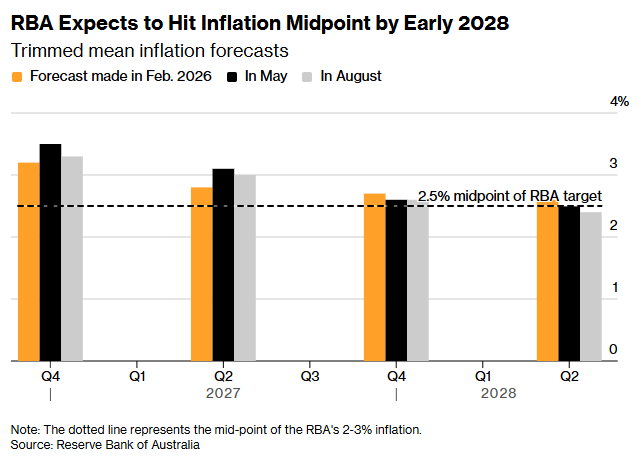
The Reserve Bank of Australia expects inflation to fall back to the midpoint of the target range by early 2028
Prior to Kent's remarks, the Reserve Bank of Australia raised interest rates for the fourth time in the year at the end of last month, raising the cash interest rate to 4.6%, reaching the highest level in 15 years to curb continuing high inflation. After the decision was announced, RBA Chairman Michelle Bullock's speech was interpreted as slightly dovish, in contrast to previous hawkish policy statements and September meeting minutes.
Luke Yerman, chief economist at Commonwealth Bank of Australia, said that this difference “reflects the Bank of Australia's progressive policy approach and the bank's continuing uncertainty about how the economy will respond to the fourth rate hike. This does not mean that the central bank lacks determination to fight inflation”.
RBA Deputy Governor Andrew Hauser is also scheduled to deliver a speech this week. His remarks will be closely scrutinized to find clues about the future path of interest rates. Investors and economists are also watching the quarterly inflation report to be released next week to assess whether the economy is gradually returning to balance or whether further interest rate increases are still needed.
According to swap market data, current traders expect the Reserve Bank of Australia to raise interest rates again before May next year. However, the market believes that the probability that the bank will raise interest rates at the end of the November 2-3 policy meeting is about a quarter.
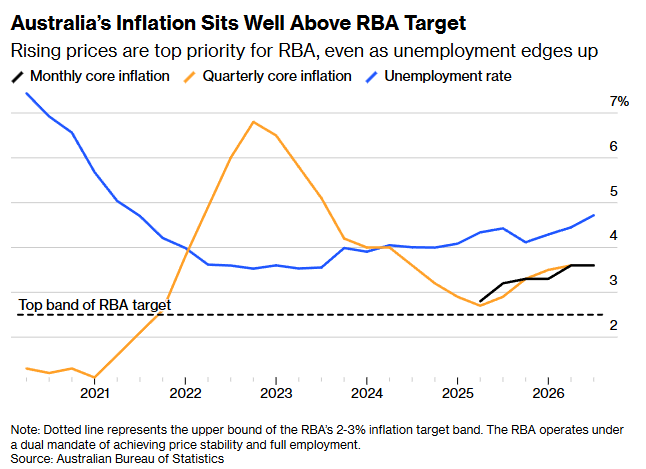
Australia's inflation level is still far above the central bank's target
Furthermore, Kent said that cash interest rates and the expected interest rate path for the next 18 months are currently at the top of the Reserve Bank of Australia's neutral interest rate estimation range. He said, “This means you can think with some certainty that monetary policy is currently somewhat restrictive. But the question is, is that restrictive enough?”
This year, Australia is implementing one of the most aggressive monetary tightening policies among developed economies. The Reserve Bank of Australia has raised cash interest rates by a total of 100 basis points and has sent signals that further interest rate increases may be needed.
Australia has been dealing with renewed price pressure since late 2025. Even before the US and Israel attacked Iran, triggering a global energy shock, the Reserve Bank of Australia had already raised cash interest rates. Kent said that the Middle East conflict is the most significant adverse supply shock the bank is currently facing, “making it more difficult to balance inflation, economic activity, and unemployment.”