


The Zhitong Finance App learned that J.P. Morgan Chase reaffirmed the “increase” rating of CoreWeave (CRWV.US) in the October 16 research report, which was signed by Samik Chatterjee (Samik Chatterjee), the chief analyst in the software industry.
CoreWeave dropped about 20% last week. The trigger for this round of decline was concerns raised by rising bond yields, and was compounded by a forecast released by Gartner this week: the latter questioned whether the AI revenue needed to support NeoCloud (a new cloud service provider) to achieve healthy returns was sufficient. Together, the two amplify investors' concerns about overcapacity and the sustainability of debt financing.
J.P. Morgan's position is clear: it admits that CoreWeave's valuation multiples depend not only on its own fundamentals, but also on investors' overall appetite for data center debt; but believes that current concerns are “too much” in relation to business fundamentals.
Five Reasons: Why Do You Think Your Concerns Are Being Magnified
The report gave five arguments:
First, data centers are in high demand, and they have been strengthening rather than cooling down in recent months, and there are almost no data points to support “questionable long-term demand.”
Second, actually putting production capacity online is much more difficult than making linear estimates based on announced contracted production capacity — it seems that the planned production capacity already announced by the industry can be directly combined into actual production capacity, but there is a huge execution gap between “signing” and “going online,” and CoreWeave's leadership in this area has been mentioned over and over again in its customer research.
Third, the economy at the project level is still stable, and the company can generate healthy profit margins and cash flow returns at the same time, even though initial concentrated investment will put temporary pressure on profit margins and cash flow.
Fourth, in addition to the robust economy of a typical 5-year contract, there is an additional monetization leverage—GPUs can be re-signed outside of the 5-year contract period.
Fifth, project-level returns (unleveraged IRR) are higher than the company's cost of capital, and the increase in capital costs is likely to be embedded in the pricing of new projects.
The report also leaves room: it admits that recent debt market concerns have boosted capital costs and may reduce the room for positive returns; however, it believes that the favorable context of computing power demand gives companies pricing power and can pass costs on to customers, thereby limiting changes in the fundamentals of the revenue/profit model.
Production capacity is “pre-sold”; it is not built according to predicted demand and then wait for customers
This is the most critical sentence in the whole story: CoreWeave's production capacity is pre-sold under long-term “take-or-pay” (take-or-pay) contracts, rather than being built first to match estimated requirements.
Gartner's prediction reveals an industry-level gap: AI data center owners will need to achieve a cumulative revenue of $8.5 trillion by 2030 to cover announced capital expenses, financing costs, and a 12% return on invested capital (ROIC); the agency predicts that enterprises and consumers that can be attributed to AI data centers will only be up to $3.6 trillion in AI revenue during the same period. According to this, J.P. Morgan notes that this gap points to the risk of “building production capacity before demand” rather than the risk of CoreWeave's “sign first, then go online” model.
And contrary to Gartner's concerns, demand for computing power in recent months has accelerated rather than decelerated.
Even if investors are still concerned about the persistence of demand and whether uncontracted production capacity can be leased out, the report provides a buffer: more than two-thirds of a typical data center's capital expenditure is invested in technology and short-term assets rather than the computer room shell itself — which means that the time window for reducing capital expenses is very short, thereby limiting the risk of long-term cash outflow. In other words, even if demand actually weakens, CoreWeave can absorb capital expenses relatively quickly because it mainly buys short-term assets such as chips, rather than smashing the computer room shell all at once.
Leading implementation: Nearly 500 megawatts were added in a single quarter, and the electricity in operation has reached 1.5 gigawatts
Transforming planned production capacity into production capacity in operation requires strong execution. CoreWeave added nearly 500 megawatts (MW) in the second quarter of fiscal year 2026 alone, reaching 1.5 gigawatts (GW) of electricity in operation; the contracted electricity was 4.2 GW as of August 11, and the company's goal is at least 8 GW by 2030.
Contract economics: After paying off asset-level debts, the parent company still receives about 16% of the remaining cash flow of the total contract value
According to the company's indicative contract cash flow: For a 5-year contract, the capital expenditure is about 51% of the total contract value, of which about 80% is funded by asset-level debt; after the asset-level debt is fully settled, the parent company can obtain a remaining cash flow of about 16% of the total contract value — even if production capacity is not renewed, this amount is enough to cover about 5 years of data center obligations.
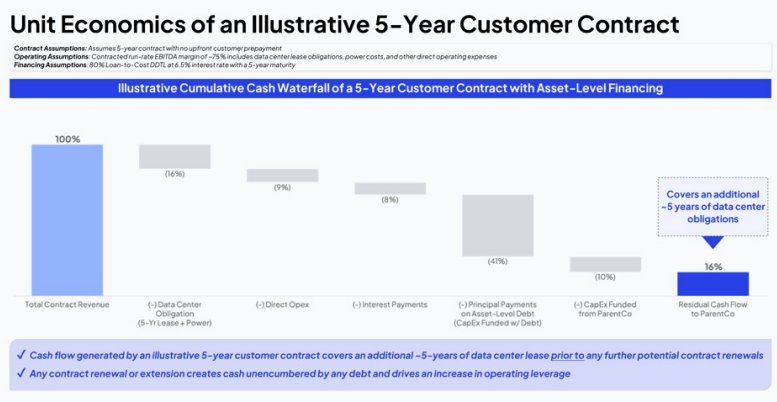
J.P. Morgan believes that the indicative economy of this set is conservative. The reason is that the actual useful life of the GPU is exceeding the 6-year depreciation period and contract period: the V100 on the market has been in use for about 8 years, the T4 is about 7 years, and the contract for the A100 specification introduced in 2020 has already been signed in 2029. This means that once the asset-level debt is paid off, CoreWeave only has to bear the cost of leasing and electricity and can continue to generate cash flow beyond the contract period — “renewal monetization” is therefore an additional option independent of the 5-year contract.
Project return: Unleveraged IRR “about ten percentage points”, higher than the mixed capital cost of 9% — 11%
According to the schematic estimate given in the report, the unleveraged IRR for a typical 5-year contract is in the “middle of ten percentage points” range, while the cost of mixed capital is 9% to 11% (assuming that the vast majority of capital expenses are co-funded by parent company debt and asset-backed debt). IRR will rise even higher if the contract is renewed after the initial 5-year term.
The report does not avoid the risk of rising capital costs, but it is expected that the pricing of additional computing power will embed higher capital costs, thus keeping the company's return fundamentals unchanged.
It's not that burning money is not economical; it's climbing too fast
The recent high demand for capital is mainly due to a steep rise in production capacity: production capacity will increase from 1.85 GW at the end of this year to 8 GW in 2030, which is equivalent to quadrupling in 4 years, adding about 1.5 GW every year — in comparison, only 500 MW will be added in 2025, and an additional 1 GW is expected in 2026.
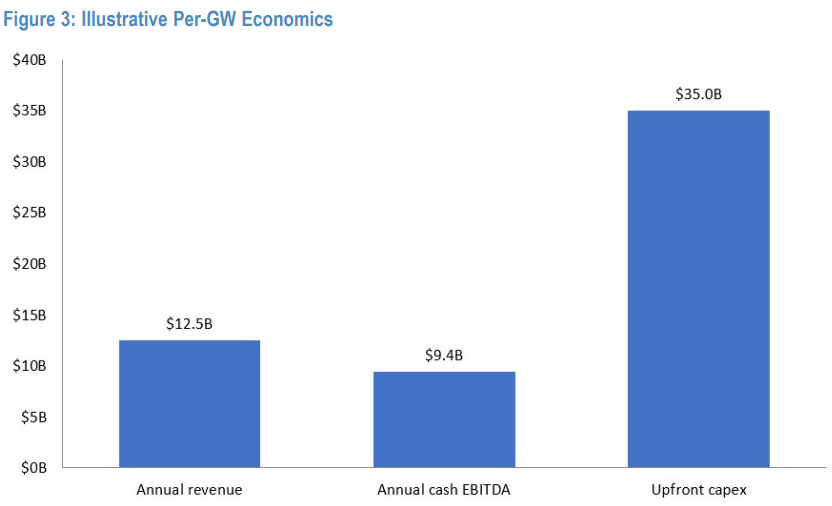
According to the simplified economy given in the report: After a project is fully produced, the annual revenue per GW is $10 billion to $15 billion, which corresponds to a cash EBITDA margin of about 75% at the contract level; in the climbing year, capital expenditure per GW is over $35 billion. The crux is a mismatch of pace — revenue was gradually released until the project was fully produced, yet capital expenditure was pressurized at once in the year when the slope climbed. According to this estimate, the company needs to “stabilize the installed base of the operating project” to reach 4 to 5 times the “production capacity that was climbing the slope back then” before the cash flow can be corrected after covering the capital expenses of the new production capacity.
The current situation is: the ratio of electricity in operation at the beginning of the year to the electricity added in that year is currently about 1:1 - CoreWeave enters 2026 with about 0.85 GW of electricity in operation, and is expected to add about 1 GW for the whole year; this ratio is still expected to be around 1.2 times higher by 2027. The report estimates that it will not reach about 4.5 times until 2030.
Therefore, J.P. Morgan's conclusion is that the current cash consumption is not the result of the project's poor economy, but rather that the production capacity that climbs every year is too high compared to the current production capacity; the timing problem generated by free cash flow will basically be solved as the scale of CoreWeave expands.
Looking at the other side of the market, there is a real sense of credit in this round of sell-off. According to domestic media, the yield on CoreWeave bonds has broken through 15%, and the rising cost of capital will directly reduce the safety margin of the “remaining cash flow” described above — this is the focus of this long and short division.
It should be clarified that the report disclosure page shows that J.P. Morgan has provided investment banking services and received compensation for CoreWeave in the past 12 months, and it is expected that it may still seek relevant compensation in the next three months; at the same time, it holds more than 1% of CoreWeave's common stock beneficiaries and acts as a market maker for related securities. Investors should consider this report as a reference factor in their investment decisions.