


The Zhitong Finance App noticed that some large investors are betting that British Chancellor of the Exchequer John Healy will adhere to fiscal discipline in his first budget, thus triggering a rebound in the Phnom Penh bond (British Treasury bonds) market.
M&G, Ninety One, Mediolanum International Funds, and Raymond James Wealth Management have bought British Treasury bonds before the October 28 budget announcement, betting that if Healy shows a steady hand in spending and borrowing, yields may fall.
Barclays UK interest rate strategist Muin Islam said, “For a new Chancellor of the Exchequer facing an uncertain background, handing over a lackluster budget is probably the best outcome from the perspective of bond market management. At a time when the global market is focused on Washington, Paris, and Tokyo, Healy should not give the market an exclusive British narrative that can be captured.”
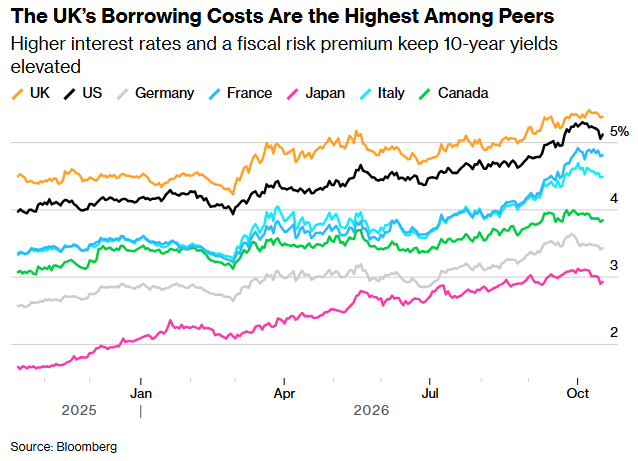
The UK's borrowing costs are among the highest in its category
With a 30-year yield of 5.8% and UK borrowing costs higher than other similar countries, the task before Healy was to explain Prime Minister Andy Burnham's tax and spending policies while maintaining the fiscal fence and avoiding the kind of “creative accounting” that would irritate the bond market. Recent history shows that once investors lose confidence in government plans, they may trigger a sharp negative reaction.
HSBC's chief multi-asset strategist Max Kettner was optimistic about Phnom Penh bonds, especially long-term products, on the eve of the budget, on the grounds that investors' concerns had been fully factored into the price. Among similar sovereign bonds in developed markets, this is the only target he recommended to buy. According to estimates by UBS Group strategists, the yield on 10-year Phnom Penh bonds can drop by up to 20 basis points, or 0.2 percentage points, if the budget is implemented smoothly.
Ninety One's fund manager Jason Bobola-Sheen has increased his holdings of long-term Phnom Penh bonds this year on the grounds that the market has “experienced the test of fire” and that the new administration has shown “some degree of orthodoxy, or concerns about how Phnom Penh bonds will be reflected in policy formulation.”
The UK has been paying for this in the bond market for many years — in 2022, then-Prime Minister Liz Truss introduced tax cuts for large-scale deficit financing in a “mini budget,” and the resulting market turmoil was so severe that she abandoned most of her initiatives, fired the Chancellor of the Exchequer, and resigned after only 44 days in office.
Thereafter, investors will respond to any sign of fiscal squandering by boosting bond yields. And recent finance ministers, anxious to keep borrowing costs as low as possible, are trying to convince the market that they will abide by fiscal rules — that is, the government can only borrow to invest, and that net financial debt must fall within a rolling three-year forecast period.
Chris Jeffrey, head of macroeconomic strategy at the French Communications Group, said that these guardrails set clear boundaries on how much debt the government can borrow and how large the debt can expand. He said that this kind of discipline “frankly doesn't exist in the US,” and the rules are much more vague in parts of Europe.
“I think the systems the UK has put in place to reinforce a sustainable fiscal policy are working.” Jeffrey said.
The International Monetary Fund (IMF), which bailed out the UK's monetary and debt crisis in the 1970s, has now warned Healy to use cost of living support measures “moderately”, otherwise there is a risk of reigniting inflation. However, IMF chief economist Sylvana Tenrello also said that in the G7, Britain stands out for implementing a “debt stabilization” budget plan, and these plans are steadily returning public finance back to control.
This may be beginning to change the narrative around Britain's debt. In July of this year, on Burnham's first day as prime minister, Phnom Penh bonds were sold because he said he would seek “any flexibility” while adhering to the government's rules on borrowing and spending. Last year, Burnham complained that Britain was “indebted” to the financial market, and later retracted this statement.
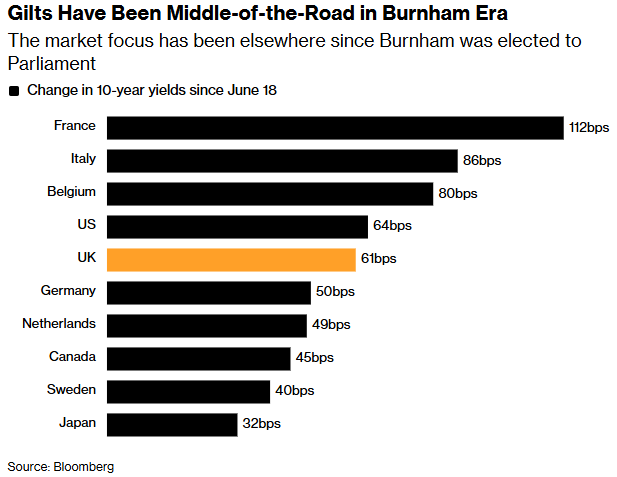
Since Burnham was elected MP, market focus has shifted to other aspects
Recently, Burnham's adherence to fiscal rules helped calm market nerves, and investors turned their attention to other markets. Since Burnham was elected as a member of parliament on June 18, clearing the way for his entry into Downing Street, the UK's 10-year yield has risen by about 0.6 percentage points; during the same period, due to political and financial concerns, French comparable bond yields increased by more than 1 percentage point.
“The rise in long-term government borrowing costs in the UK over the past year was mainly driven by changes in the central bank's policy interest rate expectations, not due to changes in risk views on holding British Treasury bonds themselves.” Islam said.
However, some investors still believe that the UK is facing major challenges — the country's economic growth is weak and is plagued by inflation fueled by the Middle East war. David Zahn, head of European fixed income management at Franklin Templeton, said that the government is actually “seeking more time to come up with a plan” because Burnham's Labor Party “has no interest” in cutting expenses such as benefits.
“They're procrastinating, hoping something will pop up to solve the problem.” he said.
However, as of now, as France becomes the focus and the level of US debt has attracted more attention, this budget has changed from a possible “stumbling block” to a potential “benefit.”
“Britain's current advantage is that it is being overlooked by the market, and it can be said that the Chancellor of the Exchequer is responsible for maintaining this state of affairs.” Islam said.