


The Zhitong Finance App learned that according to TrendForce Jibang Consulting's latest communications industry research, as AI data centers, cross-data center interconnection, and high-capacity backbone network construction drive optical fiber demand demand, it is estimated that the global optical fiber supply and demand gap will reach 180 million core kilometers in 2026, and supply contraction will drive the spot price of finished optical fiber products to increase 2.8 to 5 times a year. To this end, telecom vendors have begun to gradually adjust their procurement models, shifting from short-term to long-term arrangements in order to lock down optical fiber resources in advance.
TrendForce Jibang Consulting said that due to the large demand created by applications around AI data centers, global fiber supply has been tight since the end of 2025 and is expected to continue until at least 2028. From a supply-side analysis, the global optical fiber production capacity utilization rate has risen to 92% in 2026, inventory levels have dropped from 4 months in 2024 to only 1 month, and orders from some major manufacturers have already been scheduled for the first quarter of 2027, indicating that current production capacity is close to full capacity. On the other hand, the expansion of light bar production involves the introduction of deposition equipment and process construction. The construction period is about 18 to 24 months. Even if the manufacturer plans to expand production, it will still take some time for the additional production capacity to be released one after another, making it difficult to effectively increase supply in the short term.
Looking at demand, it is estimated that global fiber demand will reach 577 million core kilometers in 2026. The growth momentum mainly comes from data center construction, accounting for about 18% to 20%, and it is estimated that the share will increase to 30% to 35% in 2027. In addition to large cloud service providers continuing to expand AI data centers, chip manufacturers and telecom vendors are also investing in related infrastructure one after another to further drive the optical fiber demand for data center interconnections and high-capacity backbone networks.
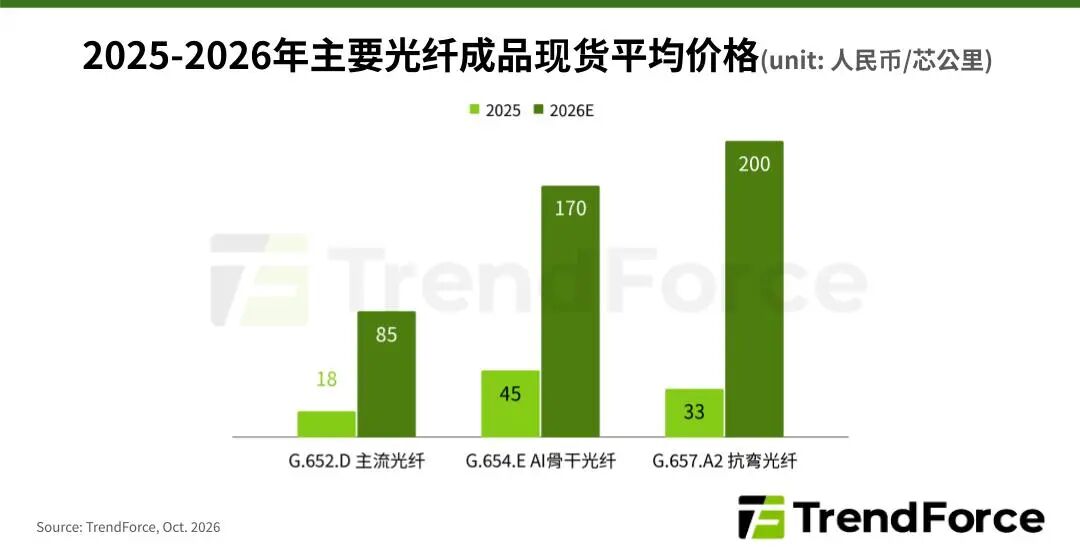
According to the TrendForce Jibang Consulting survey, the shortage of supply has led to a rise in the spot price of finished optical fiber products. Taking bending resistant optical fibers for wiring in data centers as an example, it is estimated that the average price in 2026 will increase by more than 5 times compared to 2025. The price of AI backbone fiber used for data center interconnection and high-capacity backbone networks has increased about 2.8 times a year, and the price of mainstream optical fiber for telecommunication services has also increased about 3.7 times a year.
As supply continues to tighten, telecom vendors are also beginning to secure the optical fiber supply needed in the future through long-term contracts. For example, Verizon and Corning (Corning) signed a multi-year supply agreement in September 2026, planning to obtain over 129 million core kilometers (about 80 million miles) of high-density fiber and connectivity solutions between 2027 and 2032. In addition to supporting broadband construction, they will also be used to connect high-capacity backbone networks to AI data centers.
TrendForce Jibang Consulting believes that this round of tight fiber supply is due to the continuous expansion of new demand related to AI data centers, which is different from previous telecom construction cycles. Considering that supply is difficult to increase rapidly in the short term, but demand is growing steadily, the trend of telecom vendors and large infrastructure vendors to lock in optical fiber resources through long-term agreements in advance will become more common.