


The Zhitong Finance App learned that at a time when global new cloud financing was being tested under stress, Elice, a “new cloud” (NeoCloud) force from South Korea, was using top pricing and more than 400 times more retail subscriptions to try to prove that AI infrastructure can still win capital. The company plans to land on KOSDAQ on October 20 and raise about 2010 billion won, making it the largest IPO in the market during the year; supporting the offering was a 200% increase in revenue and a correction in operating profit in the first half of the year.
In stark contrast to South Korea's new cloud Elice, it can be described that nScale, which is funded by Nvidia, the “global AI chip superpower”, is seeking an IPO valuation of about 30 billion US dollars, but some investors are recommending that it be reduced to 16 billion to 19 billion US dollars, which is 37% to 47% lower than the target. This also means that this high-profile IPO valuation is expected to fall close to a loss in price.
US tech giant Microsoft also terminated the Nscale UK Loughton data center agreement. Some media reported, citing information revealed by people familiar with the matter, that the project has been postponed several times, and power to the grid may have to wait until the 2030s; Nscale said that other Microsoft contracts are unaffected. This case revealed the most critical bridging problem with the new cloud business model — the signing of contracts with super-large customers such as cloud computing can support financing, but only when electricity access, rack delivery, and service acceptance are completed can orders continue to be converted into revenue. This also highlights that delays in delivery will prolong the capital occupation period and may also trigger customer withdrawal, causing contracts that previously supported valuation to face discounts again.
The secondary market is already being revalued ahead of schedule. In the week ending October 16, the Philadelphia Semiconductor Index fell by about 11.4%, and Korea's KOSPI Index fell sharply by more than 14%. The Korean market, where storage stocks are concentrated, is under particular pressure. CoreWeave fell 11.9% on Friday, down 25.2% in a single week. The cumulative decline in October was 29.5%. During the year, it turned into a decline of 14.3%, retreating about 55.5% from the May closing high. This adjustment has gone from short-term technology stock profits to the market's re-evaluation of the financing capacity and return on capital associated with AI computing power infrastructure construction.
The pessimistic signal in the credit market is more direct — the US new cloud leader CoreWeave has a dollar bond due in October 2031, and the yield exceeded 16% on October 15; the cumulative implied default probability for the next five years corresponding to CDS quotes during the same period is about 63%. It is worth looking at the latest trends. The 10-year and 30-year US bond yields fell by 15 and 17 basis points, respectively, to 5.09% and 5.43% last week, highlighting that the risk-free yield has begun to decline and has not fully relieved Xinyun's credit pressure; generally speaking, large-scale Nvidia AI GPU procurement and computer room construction require a huge amount of money to be paid first, and revenue is recovered in installments; once delivery is delayed, customer utilization is insufficient, or refinancing pressure continues to rise, interest expenses and equipment renewal pressure will reduce the cash returns that can be obtained by shareholders.
Dingge Distribution fights against the “cold wave of AI computing power financing”! Korean data center IPO will test bullish confidence of AI investors after turmoil
Data center infrastructure company Elice Inc. is about to enter the KosDAQ market, where South Korean technology stocks are concentrated, on Tuesday. After peer Firmus cancelled its high-profile listing plan this month, the listing will test AI computing power infrastructure and the financial resilience and bullish confidence of global technology stock investors in a broad sense.
According to the latest statistics compiled by the agency, the Seoul-based new cloud service provider plans to raise 2010 billion won, or about US$151 million, through an initial public offering, making it the largest IPO in the KOSDAQ market this year. Elice has set an issue price of 90,500 won per share, which is at the upper end of the offering range, and the market value will exceed 1 trillion won after listing.
Korean retail investors actively subscribed and paid a subscription deposit of approximately 10.3 trillion won, hoping to receive stock placements. The subscription ratio for the retail distribution portion is over 400 times.
When Elice went public, it was less than two weeks until Nvidia-backed data center operator Firmus Grid Ltd. withdrew its proposed IPO. Investors' concerns about rising borrowing costs, intense competition, and long-term returns on huge AI-related expenses are suppressing valuations of global companies and disrupting IPO plans: CoreWeave's stock price has fallen by more than half since its May high. Bloomberg News previously reported that the IPO valuation target sought by NScale is also facing opposition from investors.
To gain investor support, Elice emphasized in its prospectus that revenue surged 200% in the first half of the year, reaching 34.4 billion won. The company turned a loss into a profit and achieved operating profit of 10.3 billion won; profit before interest, tax, depreciation and amortization (EBITDA) increased 11 times the same period last year to 23.2 billion won. Douglas Kim, a senior analyst of the Korean stock market, predicts in a research report published by Smartkarma that the company's revenue will grow by 83% in 2026, and the operating profit margin will be about 33%.
Elice was founded in 2015 by three PhD students from Korea Institute of Science and Technology (KAIST), Korea's top science and technology university. It initially became a programming education platform, then switched to AI cloud infrastructure. The products provided include servers, chips using liquid cooling, cloud and network infrastructure, and software. Since then, the company has developed a modular data center platform, equipped with a high-density power supply system and advanced liquid cooling technology, specially designed for high-performance AI chip clusters.
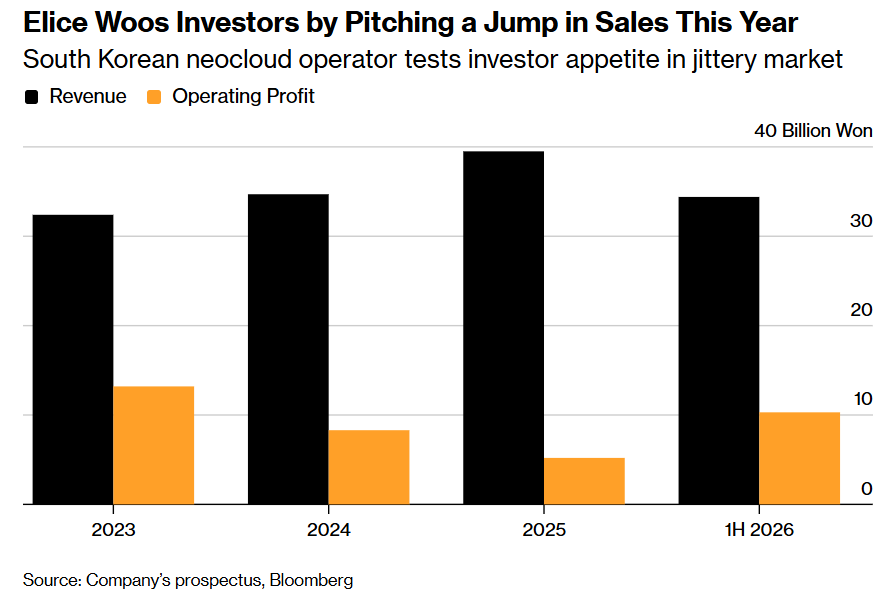
As shown in the chart above, Elice is attracting huge retail investors with the prospect of a sharp increase in revenue this year — South Korea's emerging new cloud operator is testing investor demand at a time of market turmoil.
The company's CEO, Jae Won Kim, said that Elice, which has received support from venture capital institutions such as Vertex Ventures and Altos Ventures, plans to use the IPO to raise capital to build more AI data centers in Korea and overseas. Future Asset Securities and Samsung Securities acted as the main underwriters for this offering.
In an interview with the media, Kim said, “We are doing our best to become a global leader in full-stack AI infrastructure. The purpose of this IPO is to give us the financial strength needed to achieve this goal.”
Institutional retreat, retail investors scramble to raise funds: the next round of AI computing power bottoming out will depend on delivery and cash flow
Howard Marx's judgment on the bubble provides another positive explanation for this round of potential AI computing power topics that have bottomed out and rebounded: investors continue to discuss risk, indicating that the market has not yet fully entered a frenzied state of ignoring risk. However, what this observation really supports is to distinguish between technology prospects and asset prices, and re-examine which companies are worth holding after the adjustments. The Elice distribution was highly sought after, while Firmus withdrew its listing and Nscale experienced price pressure, indicating that capital did not uniformly close the AI financing window, but rather paid more attention to whether there was a match between operating execution, financing structure, and issuance valuation.
This differentiation is also reflected in financial behavior. Goldman Sachs statistics show that technology stocks experienced record net sales last week. At the same time, about US$9.5 billion flowed into leveraged ETFs, of which about US$7 billion went into tripling the semiconductor ETF SOXL. Net institutional exposure has fallen to a historically low level, but total exposure is still high, which means that the market has retained a large number of long and short positions; retail investors are betting ahead of time on recovery after profits are realized. If cloud factory orders, storage prices, and equipment deliveries continue to support profits, under-allocated institutions may re-increase their positions, forming incremental purchases that drive a rebound. Elice's popularity also reflects that this risk appetite has not disappeared. However, it is important to note that subscription guarantee metal, when issuing subscription funds, is not directly equivalent to continuous buying after listing.
Looking at engineering and financial mechanisms, AI agents can increase the demand for GPUs, memory, networks, and electricity; however, transforming computing power requirements into return on investment also requires stable operation of clusters and continuous customer payments. Elice integrates modular data centers, high-density power supply, liquid cooling, and cloud software. The potential value lies in shortening deployment cycles and improving billable utilization rates, not just increasing the number of GPUs. The company's operating profit changed in the first half of the year, providing it with more direct operating evidence than simple order promises; if profits can be converted into cash flow sufficient to support expansion in the future, such companies will be in a better position to be recognized in the new cloud valuation rearrangement. The key to counterattacking AI computing power is progressing from “how big is the demand” to “who can deliver on time and meet demand at an affordable cost of capital”.