


The Zhitong Finance App noticed that after a weekend of violent riots, French treasury bonds fell, highlighting the tense relationship between protesters who were angry about the cost of living and a government that was unable to maintain stability.
French treasury bonds performed worse than other European countries. The interest rate spread between 10-year French treasury bonds and German treasury bonds widened by 8 basis points to 146 basis points, the highest in two weeks. Interest spreads with Italian treasury bonds set a new record, while the euro weakened, and the CAC 40 stock index fell 1.2%.
Last weekend, there was a wave of attacks on public buildings, stores, and restaurants in many parts of France. However, the mountains of debt and the Eurozone's budget deficit, mean that the government cannot simply reassure the public by increasing spending.
Louis Vincent Gaff of Gavekal Research said, “Today's France is facing a social crisis, an immigration crisis, an energy crisis, an economic crisis, and a financial crisis at the same time.” “And all this happened again when the French president 'was in power but had no rights'. Everything that happened this weekend doesn't seem to be in any way to support a higher euro or lower the yield on French treasury bonds.”
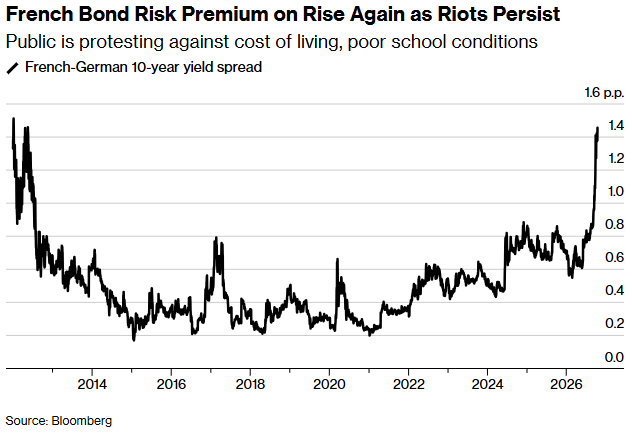
Unrest continues, risk premium on French bonds may rise again
Investors increasingly believe that French treasury bonds are riskier than German treasury bonds — the latter are generally regarded as the safest borrowers in the Eurozone. The difference between France and Germany is approaching 150 basis points, further deepening the range associated with the Eurozone debt crisis. At one point, during the most intense sell-off of French debt, this spread was close to 160 basis points.
The protest comes as the French political community is debating the 2027 budget. The bill proposed by the government contains 43 billion euros (about 48.2 billion US dollars) of deficit reduction measures. Reaching a compromise in a deeply divided parliament is already difficult, but with only six months left until the presidential election, it is likely to be even more difficult.
The euro fell 0.5% to $1.1183 at one point, bottoming out of the G-10 currencies. Despite a brief rebound last week, traders are still bearish on the future of the euro, and the cost of hedging against further depreciation of the euro has risen sharply.
Commerzbank strategist Eric Lim said, “Although the violent protests do not represent the vast majority of people, developments over the weekend still highlight the difficult balance faced by the government between appeasing the public and calming the market.”
Moody's will review France's sovereign rating on Friday, which will provide another weather vane for the country's fiscal health. Given its negative outlook, the rating downgrade was seen as a more likely next step. Moody's currently rates France one level higher than Fitch and S&P Global.