


- Travelers Companies reported third quarter 2026 revenue of US$12.4b and net income of US$1.9b, alongside a regular US$1.25 quarterly dividend per share declared for payment on December 31, 2026.
- The insurer paired strong underwriting-driven earnings and record investment income with continued capital returns, signaling disciplined execution even as Business Insurance pricing and expense pressures remain in focus.
- The focus now is on how Travelers Companies' strong underwriting-driven earnings performance may reshape the broader investment narrative around the stock.
Scan how Travelers Companies' underwriting-led quarter compares with other insurers returning capital at scale by moving through our curated 32 resilient stocks with low risk scores that focuses on resilience and balance sheet strength.
Travelers Companies Investment Narrative Recap
To own Travelers Companies, you need to buy into a story of underwriting discipline, technology heavy operations and consistent capital returns rather than rapid expansion. The latest quarter leans into that idea. Revenue was broadly stable, while net income and earnings per share moved higher, helped by an 86.8% combined ratio and record investment income.
The near term swing factor is whether Travelers can keep underwriting performance resilient while Business Insurance renewal pricing and new business stay softer. That is where long tail casualty trends, catastrophe activity and slightly higher expense guidance sit as the biggest risks to the current earnings power of the business.
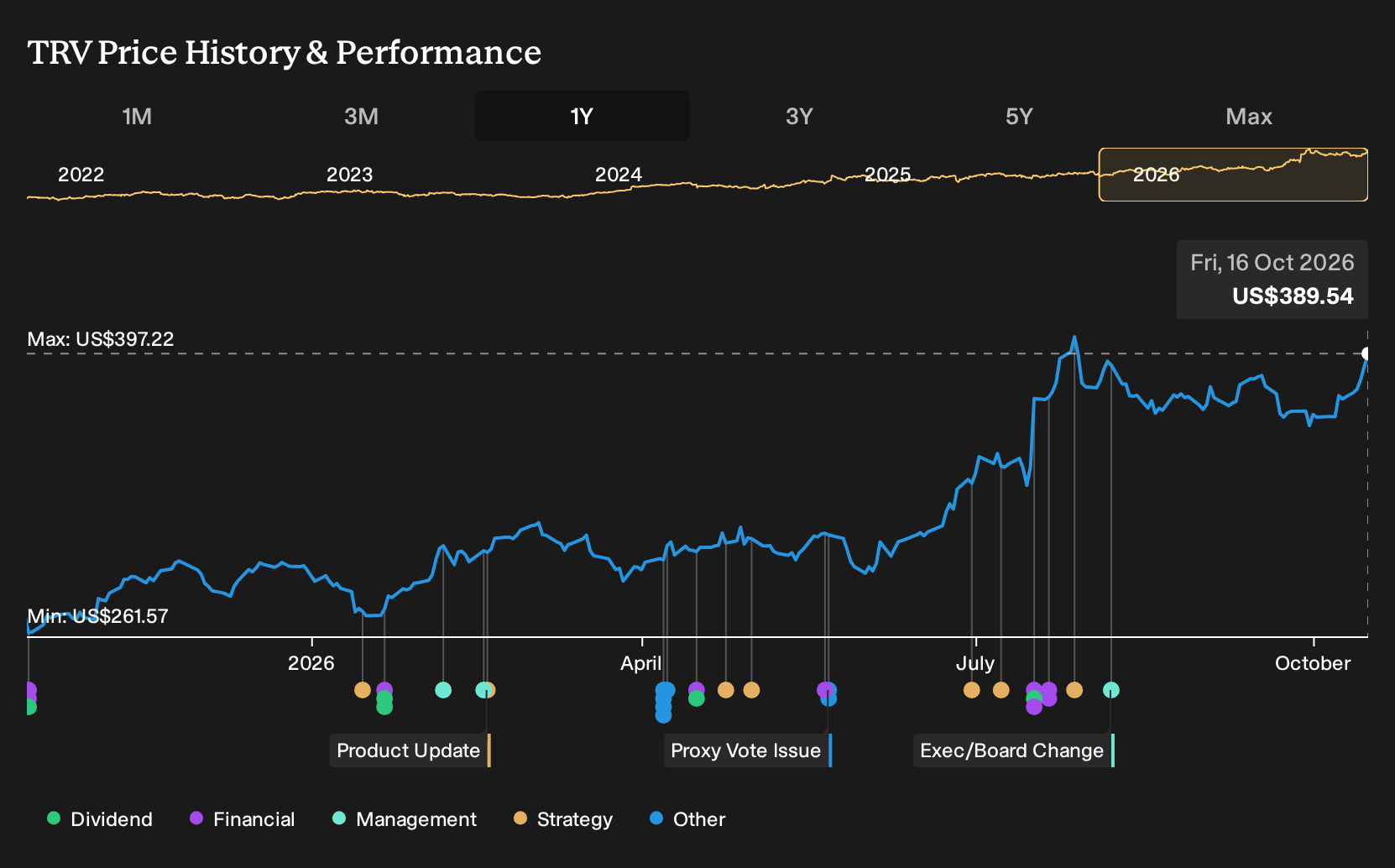
The regular US$1.25 quarterly dividend per share, declared for payment on December 31, 2026, is the announcement that most clearly ties this earnings print to your thesis as a shareholder. It underlines management’s pattern of returning cash alongside underwriting and investment results that have supported higher profit over the past year.
For you, the question is whether that dividend profile remains well covered if catastrophe losses, casualty severity or pricing headwinds bite harder. Capital returns have been large, including share repurchases earlier in 2026. Execution on underwriting, claims and AI driven efficiency therefore becomes even more important as the key catalyst to sustain that payout and per share metrics.
Travelers Companies Forecasts And Valuation Check
Analysts outline a future for Travelers Companies that focuses on shrinking headline numbers rather than growth assumptions. Revenue is expected to decline by 1.1% a year over the next 3 years, while profit margins are modeled to move from 16.8% today to 11.1% over that period.
For earnings, the consensus forecasts Travelers Companies at US$5.2b by 2029 compared with US$8.2b today. That implies a projected earnings drop of about US$3b, even though the most optimistic forecasts reach as high as US$6.0b.
Current pricing in the stock already reflects those assumptions. To align with the analyst view, this would imply a 2029 P/E of 14.5x on the US$5.2b earnings figure, compared with 9.5x on current earnings and above the 11.1x level cited for the wider US insurance peer group.
Travelers Companies' projections indicate US$47.3b in revenue and US$5.2b in earnings by 2029, based on a 1.1% yearly revenue decline and an earnings decrease of about US$3b from US$8.2b today.
Uncover why Travelers Companies' fair value indicates a 7% potential downside to its current price, leaving little room for error.
Exploring Other Perspectives
One alternative view on Travelers Companies puts much more weight on technology as a future earnings driver. The most optimistic analysts were modeling about US$47.2b of revenue and US$5.9b of earnings by 2029 before this report, which is materially higher than the consensus path. That gap shows how far opinions can stretch and why it can help you compare several pre news forecasts against these fresh underwriting and dividend signals.
Explore 3 other Travelers Companies fair value estimates, including one that suggests as much as 106% upside from the current price.
Form Your Own Verdict
Don't just follow the ticker. Dig into the data and build a conviction that's truly your own.
- A great starting point for your Travelers Companies research is our analysis highlighting 2 key rewards and 2 important warning signs that could impact your investment decision.
- See our latest analysis for Travelers Companies. The report includes a comprehensive fundamental analysis summarized in a single visual, the Snowflake, making it easy to evaluate Travelers Companies' overall financial health at a glance.
Looking For More Investment Ideas Beyond Travelers Companies?
Once you have a view on Travelers Companies, it can help to compare it with other businesses that share similar qualities or offer a very different return profile. The Simply Wall St Screener lets you do that quickly so you can line up capital strength, income potential and valuation in one place.
- If you want income that aims for durability, scan dividend payers that combine higher yields with balance sheet support through the 8 dividend fortresses.
- For readers who care most about downside protection, filter for financially resilient businesses using the 32 resilient stocks with low risk scores.
- If you are hunting for opportunities that are not yet widely followed, surface under the radar candidates with strong fundamentals through the 20 high quality undiscovered gems.
This article by Simply Wall St is general in nature. We provide commentary based on historical data and analyst forecasts only using an unbiased methodology and our articles are not intended to be financial advice. It does not constitute a recommendation to buy or sell any stock, and does not take account of your objectives, or your financial situation. We aim to bring you long-term focused analysis driven by fundamental data. Note that our analysis may not factor in the latest price-sensitive company announcements or qualitative material. Simply Wall St has no position in any stocks mentioned.
Have feedback on this article? Concerned about the content? Get in touch with us directly. Alternatively, email editorial-team@simplywallst.com