


War with Iran, a sharp spike in gasoline prices and sliding confidence in Trump’s economic leadership have pushed the cost-of-living story back to the forefront, and value-focused consumer staples and discount retailers are suddenly in the spotlight again. If households feel squeezed, some businesses could gain fresh attention while others lose it. This article walks through three stocks from our U.S. Value-Oriented Consumer Staples and Discount Retailers screener that appear especially exposed to these shocks.
The three stocks below are only a small sample from the idea. The full screen turned up 34 more U.S. value-oriented consumer staples and discount retailers with equally compelling stories that are not covered here.
If you want to move faster from headline risk to specific opportunities, head straight into the U.S. Value-Oriented Consumer Staples and Discount Retailers screener to analyze, filter, and identify the candidates that best fit your own conviction and risk tolerance.
Dollar Tree (DLTR)
Overview: Dollar Tree runs discount variety stores in the U.S. and Canada, selling low priced everyday essentials, seasonal goods, and general merchandise.
Operations: Dollar Tree generates about US$20.1b in revenue primarily from its Dollar Tree segment, with a small US$16 million segment adjustment.
Market Cap: US$23.3b
Dollar Tree fits into this value oriented, discount retail theme because it targets shoppers looking to stretch every dollar when budgets tighten.
"Dollar Tree is capitalizing on increased consumer prioritization of value and convenience as cost of living pressures persist, with positive traffic in Q2 2026 alongside higher average ticket."
The key issue is how one pressure on its cost base ultimately filters through to margins and day to day pricing power.
That margin question is exactly what the full narrative for Dollar Tree unpacks, showing how Dollar Tree’s value traffic, cost pressures, and pricing power could be quietly decoupling.

Church & Dwight (CHD)
Overview: Church & Dwight sells value oriented household and personal care staples like Arm & Hammer, OXICLEAN, THERABREATH and TROJAN, which tend to stay in shopping baskets when budgets tighten.
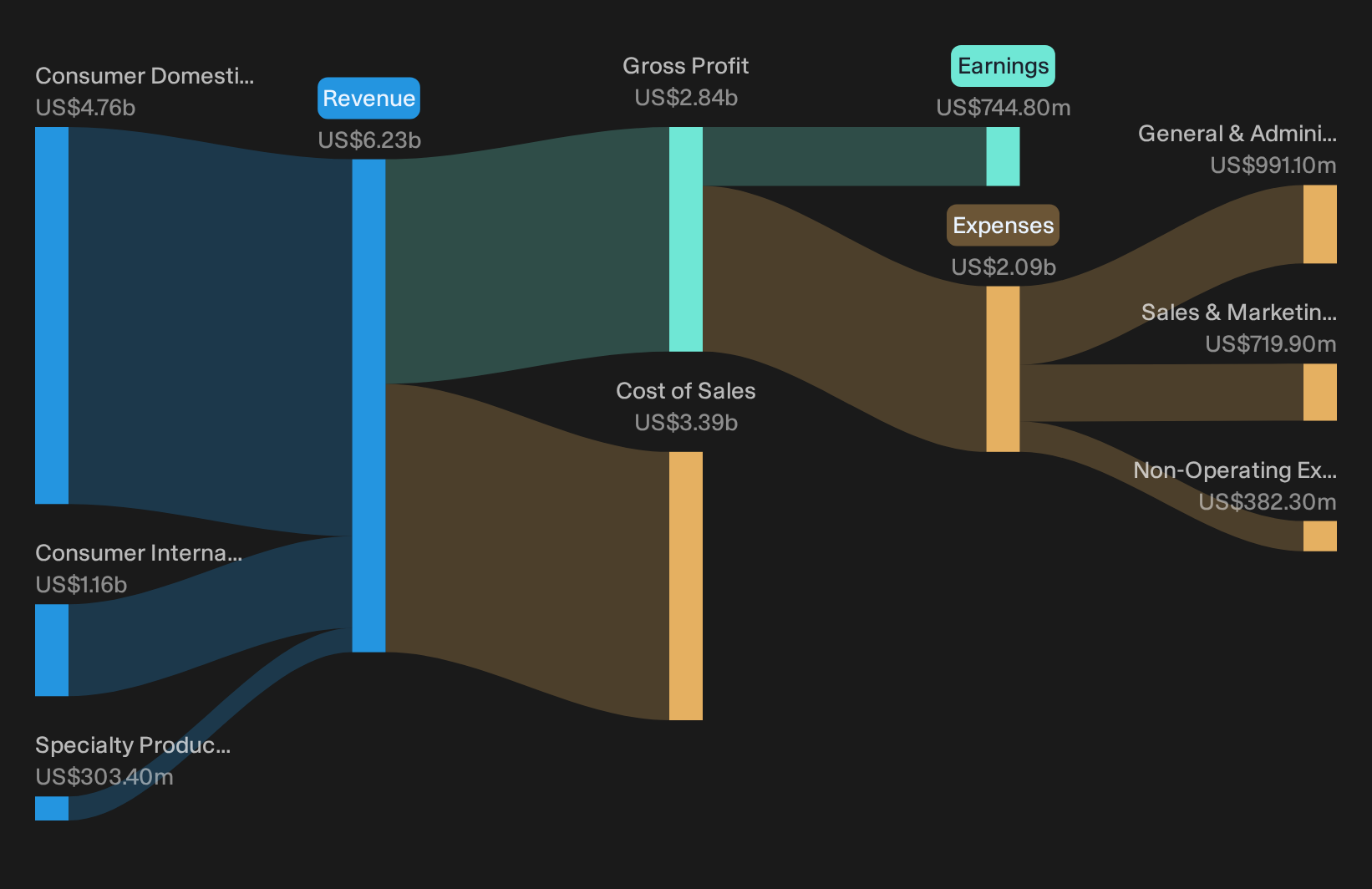
Operations: Church & Dwight generates about US$4.8b from Consumer Domestic, US$1.2b from Consumer International, and US$300 million from its Specialty Products Division.
Market Cap: US$24.8b
Church & Dwight fits the screener’s focus on resilient U.S. value staples because its products cover everyday needs across supermarkets, warehouse clubs and discount channels. That can matter even more as fuel costs rise and consumers look harder at each recurring line in the household budget.
"The strong trajectory of e commerce and online sales, with Church & Dwight's online channel now accounting for roughly 25% of global consumer sales, continues to support a mix shift toward higher margin, data rich distribution that can lift revenue and earnings quality over time."
The real swing factor for Church & Dwight is how one stubborn cost pressure interacts with that higher quality mix to shape future margins.
That margin equation is exactly what the full narrative for Church & Dwight lays out in full, showing how pricing power, mix shift and input costs could be quietly re-rating expectations.
Dollar General (DG)
Overview: Dollar General runs low priced neighborhood stores across much of the U.S., focusing on everyday essentials for budget conscious shoppers under cost pressure.
Operations: Dollar General generates about US$43.6b in revenue from its Retail Store Operations segment across its U.S. discount outlets.
Market Cap: US$29.6b
Dollar General may be the purest expression of this screener’s theme, with fuel sensitive, lower income households shifting more of their weekly basics into its small box stores when cash feels tight.
"Strengthening value focused shopping behavior as low income customers stay under pressure and higher income cohorts continue to trade down to Dollar General is helping sustain customer traffic and support same store sales and revenue."
What happens to Dollar General’s appeal and earnings power now largely hinges on how one cost pressure collides with that trade down tailwind.
When that trade down tailwind meets rising costs, the full narrative for Dollar General shows where Dollar General’s model could accelerate, stall, or quietly reset expectations.

Seeking Alternatives Before The Crowd Moves?
Fresh ideas do not sit still. Breakout themes gather momentum, under the radar for now, then get caught once attention floods in. Scan what is flying or dropping and act now.
- Target cash generative businesses by running your eye over the 33 high quality undervalued stocks, before stronger balance sheets and steady cash flows stop trading at a discount.
- Track the next leg of the AI build out with the 55 AI infrastructure stocks, while demand for chips, data centers, and power solutions is still being priced in.
- Focus on payout resilience through the 8 dividend fortresses, while high yield, income focused opportunities remain under the radar for now.
This article by Simply Wall St is general in nature. We provide commentary based on historical data and analyst forecasts only using an unbiased methodology and our articles are not intended to be financial advice. It does not constitute a recommendation to buy or sell any stock, and does not take account of your objectives, or your financial situation. We aim to bring you long-term focused analysis driven by fundamental data. Note that our analysis may not factor in the latest price-sensitive company announcements or qualitative material. Simply Wall St has no position in any stocks mentioned.
Have feedback on this article? Concerned about the content? Get in touch with us directly. Alternatively, email editorial-team@simplywallst.com