


The US semiconductor sector index, which has experienced intense sell-off for eight consecutive trading days — the US stock Philadelphia Semiconductor Index, which is also the “key weather vane for global AI computing power and semiconductor trading,” finally experienced a massive rebound on Monday, and capital flow data highlights that the bullish logic of a contrarian layout is constantly accumulating, and the key to determining whether the market can continue is still whether AI computing power requirements can be transformed into real cash returns sufficient to cover the financing costs associated with early data center investment and deployment, operation, and AI infrastructure.
When will this round of drastic sell-off of stocks and even the semiconductor sector of the global stock market, which revolves around the theme of AI computing power completely stop? According to a summary of reports recently released by senior Wall Street analysts, these analysts have noticed that this round of AI sell-off seems to be coming to an end, and the following four potential catalysts can be described as critical to the AI computing power theme and the semiconductor sector's bullish trajectory from a rebound trend — namely, the rapid decline in oil prices and dollars, 10-year US bond yields, cloud computing giants confirm strong capital expenditure and revenue growth, CoreWeave's new cloud (NeoCloud) enterprise financing and business conditions continue to grow, and AI When did Anthropic, the app leader, successfully launch.
The Zhitong Finance App learned that just as senior Wall Street analysts began to notice that this round of AI sell-off is coming to an end, and Wall Street financial giants such as Goldman Sachs and J.P. Morgan Chase are throwing positive bullish views on CoreWeave (CRWV.US), which is the core stock target of the “AI computing power sell-off storm” and “AI bubble bursting argument,” Michael Wilson, the chief stock market strategist at another financial giant, Morgan Stanley, wrote in the latest research report that continued for several months Internal valuation adjustments Towards the end, investors in global stock markets should be prepared to increase their risk exposure.
Furthermore, Wall Street commercial banking giant J.P. Morgan Chase's medium-term bullish logic for Samsung Electronics, SK Hynix, and the South Korean stock market, which has recently been hit hard and fell into a technical bear market, is based on the judgment that the upward super-boom cycle of memory chips may last longer. The two major financial giants can be described as pointing to the fact that the market's excessive pessimistic pricing on semiconductor valuations is creating opportunities to buy on dips, and the next round of stronger bull market purchases will need to provide a basis for profit cashing out.
It is worth noting that at a time when the global semiconductor sector has plummeted, institutions have drastically reduced their directional allocation exposure, but retail investors' long-term favorite semiconductor leveraged ETF (that is, a leveraged ETF that tracks three times the Philadelphia Semiconductor Index — US stock code “SOXL”) has ushered in huge inflows. Potential institutional recovery demand and leveraged capital can be said to have amplified the market's sensitivity to the strong catalytic fundamentals of the earnings season.
According to top strategists at Wall Street financial giants such as Morgan Stanley, the global AI computing power theme, which has recently been hit hard by sell-offs, and the logic of increasing positions and buying on dips in a broad sense is being formed, but whether technology can achieve a bottoming rebound and a continuous upward trend thereafter will enter a period of dual verification of performance disclosure season and AI financing conditions. Wilson said that as the major correction in technology stocks, which has continued in some sectors of the stock market for several months, comes to an end, investors should be prepared to increase the stock risk exposure of their portfolios.
Wilson said in a client report: “We recommend investors be prepared. The market may complete the adjustment very quickly or continue with a slow decline until November, because in our opinion, we should increase risk exposure rather than avoid risk at that time.” Just as the stock price of the memory chip sector, which has benefited from an unprecedented AI infrastructure frenzy, J.P. Morgan said that the cooling of the memory chip cycle at the stock price level ahead of time can occur simultaneously with the profit supercycle of the global AI computing power industry chain, which includes memory chip components, remaining strong for a long time.
According to J.P. Morgan's semiconductor research report on the Korean stock market, concerns about the sustainability of AI investment at the macro level are clearly disconnected from the storage industry's bottom-up supply and demand data, so the third quarter is viewed as an “expected reset season”. The next six months will be overequipped with Samsung Electronics, SK Hynix, and Kioxia, and extended to Samsung Electric, as well as ISU and ISC companies — leading manufacturers of AI PCBs and test sockets, respectively. The “long-term deal” here is betting that the upward cycle will last longer and that high profits will last longer: even if the DRAM/NAND price slope slows down, as long as demand for HBM, server DRAM, and enterprise-grade SSDs continues to absorb new production capacity and achieve a significant growth trajectory, the rapid decline in profits previously included in the market may need to be revised again. This also explains why storage stocks can peak and fall before profit, but they may rebound early after the profit duration is verified; what determines trading opportunities is the gap that continues to evolve between actual profit paths and implied stock price expectations.
Behind the end of eight consecutive declines for Philadelphia Semiconductors: AI counterattacks begin to find a common positive fulcrum of cash flow and credit
On Monday, October 19, the Philadelphia Semiconductor Index rose 1.61%, ending eight consecutive declines; the memory chip industry chain led the US stock market. SanDisk and Micron rose 5.53% and 2.97% respectively, while Western Digital rose 6.09%. However, the phased adjustments are still deep: the Fei Ban Index fell 11.41% in the previous week, and the cumulative decline of about 15.74% fell directly into the technical bear market; as of Monday, the cumulative decline in October was about 10.39%, retreating about 22.78% from the 52-week intraday high, even though it still rose by about 59.76% during the year. The Nasdaq 100 index rose 1.17% on Monday, and fell significantly by about 5.49% the week before. These latest pricing trends all mean that the market is repairing a significant AI computing power theme and a wide range of semiconductor sector valuation compression.
In terms of the Korean stock market, the KOSPI index, which accounts for 50% of the weight of SK Hynix and Samsung, finally rebounded 1.76% on Monday, but fell about 14.46% the previous week, and the cumulative decline as of Monday October was still 15.65%; by the close of the Korean stock market on October 20, Beijing time, the KOSPI index of the Korean stock market fell nearly 4%, indicating that the market selling pressure associated with AI computing power trading in Asia has not stabilized.
The credit market explains why it is still difficult for strong orders to fully hold up stock prices. CoreWeave's stock price fell sharply by about 25% in the previous week. Although boosted by the bullish boost brought by Goldman Sachs's upgrade to “buy” on Monday, it once rose by about 5% in the intraday period and eventually closed down 0.44% to $61.12; the yield on its US dollar bond maturing in 2031 broke through 16% last week and fell back to 15.13% on Monday as market pessimism eased. The previous five-year CDS surpassed 1,100 basis points, reflecting extremely high credit risk pricing; the so-called implied default probability of over 60% is the result of a market model that includes risk premiums and relies on recovery rate assumptions.
New cloud companies need to pay the GPU, network, electricity, and computer room deployment costs first, but the revenue has to be gradually released after power generation, cluster delivery, and customer acceptance; rising interest rates and credit spreads at the same time will reduce the space between project returns and capital costs, and widen the refinancing gap. The same AI financing cost pressure and delivery-side constraints are also reflected in Nscale: some investors are demanding that their IPO valuation be reduced from the US$30 billion sought by the company to US$16 billion to US$19 billion, which is equivalent to a discount of about 37% — 47%; it is worth noting that recently one of Nscale's major customers, the major US tech giant Microsoft, withdrew from a single Nscale project in the UK with delayed power supply, and the two sides continue to cooperate on leasing and computing power resources related to other AI data centers.
The reason Goldman Sachs and Komo are bullish is that the economy of the contract may still withstand the impact of this round of financing. Goldman Sachs raised the CoreWeave rating from “neutral” to “buy,” and also lowered the target price from $139 to $106, focusing on improvements in revenue per megawatt and unleveraged returns over the next two years; Xiaoma emphasized that long-term “no payment” contract pre-sale production capacity, deployment execution capacity, and subsequent GPU contract value will support the return. This indicates that the unleveraged internal return of the project is in the middle of about ten percent, which is higher than 9% — 11% of the capital cost.
According to the Goldman Sachs research report, Goldman Sachs analysts use a five-year contract as an indicative estimate: initial capital expenditure of 6 billion US dollars, annual revenue of 2.6 billion US dollars. After deducting annual operating expenses of 585 million US dollars and about 213 million US dollars in cash taxes, the annual unleveraged free cash flow after tax is about 1,802 million US dollars. When the initial investment of $6 billion is combined with the cash flow for the next five years, the unleveraged IRR (Unlevered IRR) after tax is approximately 15.3%. This directly shows that under the model assumptions, the project can recover investment, pay operating costs and taxes, and receive returns.
Goldman Sachs's final calculation data shows that under the assumption of annual revenue of 13 million US dollars per megawatt and a debt interest rate of 10%, Goldman Sachs measured a weighted average cost of capital (WACC) of 11.8%, which is significantly lower than the 15.3% project return described above, forming a positive return difference of about 3.5 percentage points. Therefore, the latest Goldman Sachs estimate here can be described as a complete reflection — after covering investment and operating expenses, the return earned by the project still exceeds the return required by the funder, thus creating economic value. Goldman Sachs and Xiaomo's latest bullish views can be described as a strong reflection of the fact that after the project covers investment and operating costs, it is still expected to earn returns exceeding capital costs; the financing required for continued expansion is another problem that must be solved.
Goldman Sachs believes that CoreWeave mainly relies on asset-backed financing linked to customer contracts, GPU assets, and project cash flow. The cost of additional debt is expected to be about 7.5% to 10.5%, and the model is 10%. Therefore, the 13.5% — 15% transaction yield of unsecured bonds does not directly represent the financing costs of all new projects. Furthermore, Goldman Sachs said that the above estimate of about 15.3% did not take into account the GPU residual value after the end of the five-year contract; under Goldman Sachs's separate six-year residual value scenario, the corresponding return could be increased to about 20% to 25%. This means that the basic argument is already based on the cash flow of the first contract, and subsequent asset liquidation constitutes an additional source of income.
As of October 19, StockAnalysis quoted S&P Global's statistics for the average target price of CoreWeave (CRWV.US), which is at the core of the “AI computing power sell-off storm” and “AI bubble bursting argument”, as high as $140.58, which is about 130% higher than the closing price of $61.12. The consensus rating is “buy,” but there are also analysts who gave the most negative rating of “sell”; Goldman Sachs's target price of $106 corresponds to about 73% of the potential space. This huge spread reflects the major differences in the capital market over growth delivery and financing risks.
What can put an end to this round of AI sell-off? Wall Street focuses on four major restoration paths
Senior Wall Street analysts agree that the final recovery of AI trading and the pace of the new AI bull market depend on oil prices and the US dollar, the continued and significant decline in long-term US bond yields, hyperscale cloud service providers confirming capital expenditure plans, profit growth and stock price stabilization of new cloud companies, and the successful listing of Anthropic to restore market sentiment and liquidity.
Previously, the high yield on US 10-year Treasury bonds had not disrupted AI trading; however, last week's heated inflation report, the rise in oil prices above $100 per barrel, and the rapid increase in US dollar, 10-year, and 30-year US bond yields, all affected liquidity conditions.
Meanwhile, the Federal Reserve has been hampered by this situation. CPI rose 3.7% year on year, higher than expectations of 3.4%; PPI rose sharply by 6.3% year on year, significantly exceeding expectations and seriously above the lower line of market consensus expectations of 5.4%, and the Federal Reserve was under pressure to raise interest rates as a result. But the problem isn't that simple.
The Federal Reserve faces a dilemma: on the one hand, its ability to control current supply-driven inflation is limited; on the other hand, if it chooses to raise interest rates, it will significantly increase the US government's borrowing costs, thereby widening the deficit, further worsening the already huge treasury debt problem.
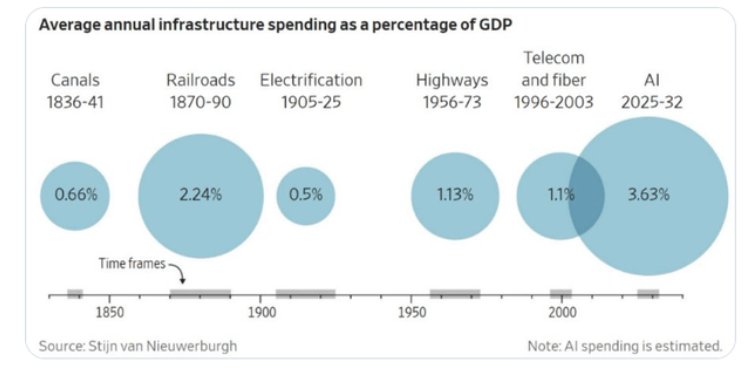
The good news is that the US economy is still extremely strong, driven by AI investment and consumer spending. AI spending, in particular, has become one of the most important drivers of US GDP growth, as shown in the figure below. The figure below shows annual infrastructure spending as a percentage of GDP.
To revitalize AI trading, we first need to see signs of improved liquidity conditions.
According to Wall Street analysts, this will begin with a diplomatic breakthrough between the US and Iran, driving oil prices below the 200-day moving average of 83 US dollars per barrel. This will almost immediately push the US dollar index to weaken and fall below the 200-day moving average at 99.45. As pressure to raise interest rates lessens and long-term treasury yields peak, this will benefit liquidity.
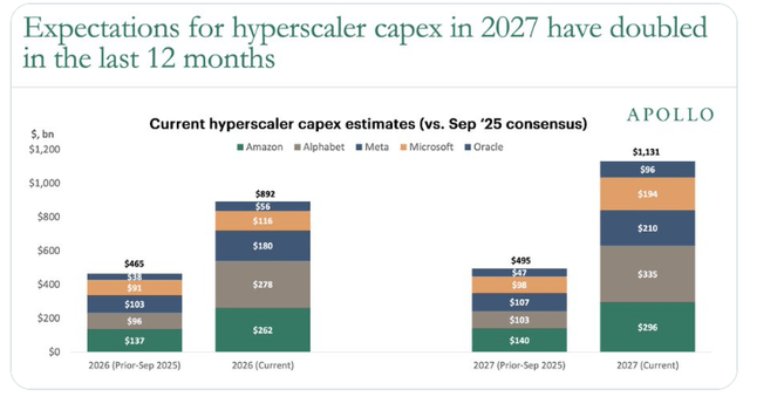
The second major catalyst was the hyperscale cloud service provider's positive statements about capital expenditure plans for the remainder of fiscal year 2026, as well as forward guidance for fiscal year 2027, particularly profit and cash flow trajectories.
In the previous second-quarter earnings season, with the exception of Microsoft, all hyperscale cloud service providers raised their future capital expenditure forecasts. Amazon management has even provided an exceptionally clear and credible analytical framework to help investors understand the links between AI needs, capital expenses, profit margins, and payback periods. Specifically, they divided AI spending into two categories: one is servers and network equipment, and the other is data centers.
According to Apollo's research, current forecasts show that capital expenditure for hyperscale cloud service providers, including Oracle, will increase to $1.13 trillion. According to Wall Street analysts, if these companies confirm the spending cycle shown in the figure below, it will be beneficial to AI transactions, because this means that more of the required capital will flow to GPUs, customized AI chips, memory, network equipment, optical components, power infrastructure, cooling systems, and data center construction.
In addition to confirming the spending cycle, we also need to see revenue growth from AWS, Azure, and Google Cloud platforms continue to accelerate, while on-hand orders increase dramatically, providing visibility into future revenue.
In the second quarter, the revenue growth rate of Azure and Google Cloud reached 43% and 82% respectively, far exceeding expectations; AWS revenue grew 37%, the fastest growth rate in 18 quarters. Ongoing orders, including Oracle, increased by more than 180% year over year, to reach $2.3 trillion.
Another factor that is expected to boost investor sentiment is the expansion of companies' cloud business gross margins. In particular, all hyperscale cloud service providers are investing heavily in self-developed chip routes to improve full-stack efficiency and improve customers' total cost of ownership.
Recently, Microsoft announced that it will expand the Maia series of dedicated integrated circuits to multi-gigawatts of deployment, making it the main inference system for its products and services. Previously, the company redesigned Copilot to integrate Office productivity tools, code generation, and an autonomous AI agent called Autopilot, marking a key shift from an independent chatbot assistant to an “AI operating system.”
For Meta, the focus of the market is on how quickly the company can expand Muse's revenue scale through a combination of transaction fees and subscription revenue. According to Truist research estimates, Meta Muse's revenue could reach about $29 billion by 2030, of which advertising and smart commerce will be the biggest revenue source, accounting for about 44% of Muse's revenue.
There is no doubt that the fear in AI trading is already clearly visible. Investors are beginning to question whether companies can generate sufficient profits to repay growing debts; these concerns are reflected in a sharp rise in credit default swap spreads on AI-related debts. According to this set of posts on X: “Bonds that finance large US data centers for companies such as Meta, Nvidia, Oracle, and Microsoft have traded at significantly lower price than face value. Meta's' Hyperion 'bonds fell to 92 cents per dollar face value, Microsoft's 'Project Excalibur' bonds fell below 88 cents, and CoreWeave-related bonds fell below 80 cents.”
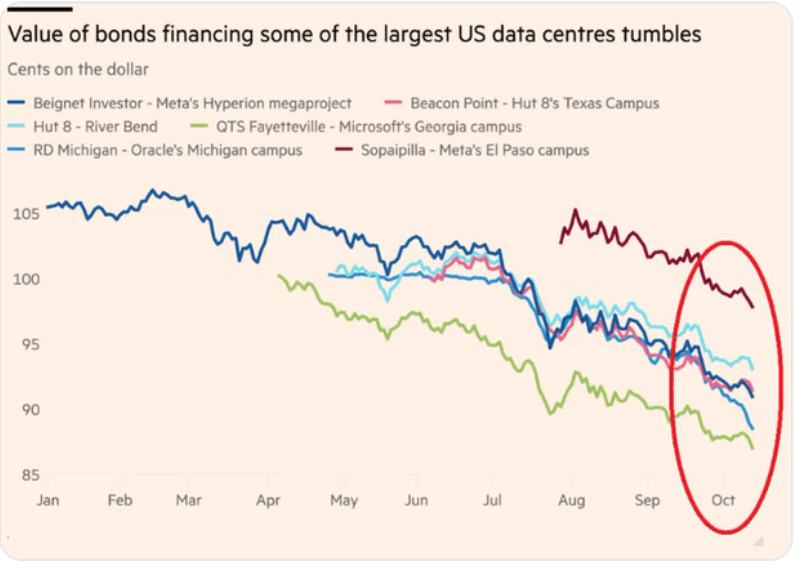
However, Wall Street analysts believe that hyperscale cloud service providers are in a much more stable position because they have higher quality balance sheets, while the price of GPUs across generations is still strong. According to Wall Street analysts, this means that their on-hand orders are being converted into revenue at a higher rental price than the original contract, which is beneficial to the revenue and profit performance of these companies.
Compared to hyperscale cloud service providers, new cloud enterprises are in a more dangerous situation.
It all started with news that OpenAI might have a $20 billion revenue gap, followed by a slowdown in Anthropic's revenue growth, further fueling market concerns about circular financing.
According to Gartner's estimates, AI data center owners will need to achieve $8.5 trillion in revenue by 2030 to cover costs and receive reasonable returns. However, the estimated AI service spending that can flow to these vendors is no more than $3.6 trillion, which means a potential gap of $4.9 trillion. As a result, Gartner believes 80% of new cloud companies will fail or be integrated by mergers and acquisitions by 2030.
The stock price of CoreWeave, a highly leveraged new cloud company, has dropped more than 20% in the past week. Last Thursday, its five-year credit default swap spread widened by 74.5 basis points to a record of 1194.5 basis points, implying that the probability of default over the next five years is over 60%. The sell-off continued until Friday, even though Nvidia CEO Hwang In-hoon came forward to refute concerns about CoreWeave's financial situation.
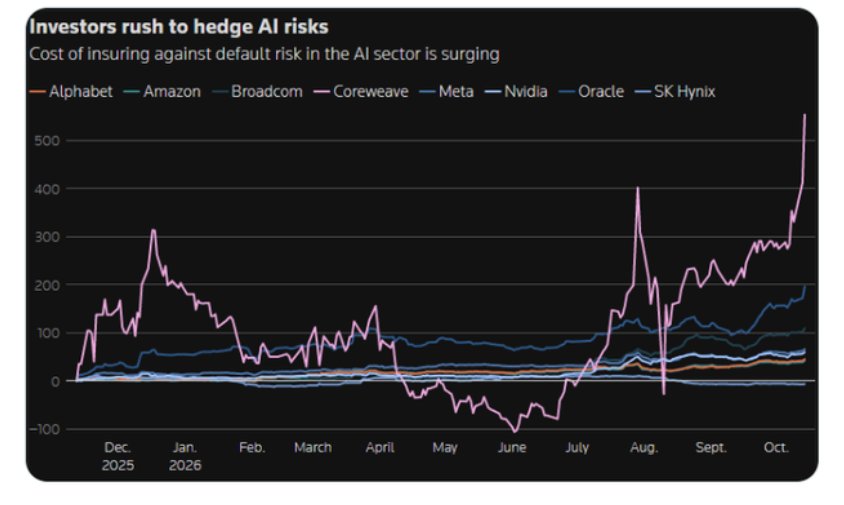
Morningstar believes that as competition for financing intensifies, new cloud operators may face higher debt costs because hyperscale cloud service providers are also seeking large amounts of capital to expand their AI infrastructure. However, Morningstar pointed out that CoreWeave's new cloud competitor Nebius has a more stable balance sheet than its peers. The company raised funds by issuing shares and convertible securities, thereby limiting its reliance on debt financing.
According to Wall Street analysts, the sharp sell-off in the Xinyun sector has a possible path to stop the decline. On the one hand, if oil prices begin to fall, it will ease concerns about inflation, reduce bond yields and the US dollar, and improve liquidity conditions. This will improve the financing environment for highly leveraged new cloud companies such as CoreWeave, and enable them to obtain capital at reasonable interest rates.
On the other hand, if a new cloud enterprise can prove that it is converting orders into revenue and cash flow more quickly by putting more production capacity into operation, it may also temporarily ease investors' anxiety. Wall Street analysts believe that this is the reason why the financial reports of hyperscale cloud service providers are critical to new cloud enterprises and the AI credit environment as a whole: if they continue to indicate that production capacity is difficult to keep up with demand, at least in the short term, they can verify the value of the existence of new cloud enterprises.
The fourth major positive catalyst is Anthropic's possible IPO around next month. Wall Street analysts believe this could be an important bullish trigger, attracting large amounts of liquidity into the market before listing.
Anthropic reported third-quarter revenue of $16.8 billion, up 45% from the previous quarter. However, even if the company announced that it had achieved adjusted profits, investors still didn't buy it because this growth rate was significantly slower than 100% month-on-month growth in the second quarter.
But the point is: Anthropic plans to invest more than $500 billion over the next ten years in computing resources and AI infrastructure. This is equivalent to an average of 50 billion US dollars per year, which will gradually flow to fields such as GPUs, memory, network equipment, optical components, and power infrastructure.
Although some people think it is best for Anthropic to delay listing as the expected valuation falls from $2 trillion to $1.5 trillion, this valuation is still equivalent to more than 20 times its annualized revenue. According to Wall Street analysts, it can provide a more predictable benchmark for market expectations and reduce volatility.
$7.2 billion pours into leveraged semiconductor ETFs! Retail investors rebound capital first, and the storage super cycle and the new round of AI super bull market need to wait for profit confirmation
J.P. Morgan's October 19 capital flow report shows that for the week ending October 16, global stock ETFs had a net inflow of 46.3 billion US dollars, and leveraged ETFs attracted 9.3 billion US dollars; semiconductor ETFs had inflows of 7.6 billion US dollars, of which leveraged ETF fund products that tripled the Philadelphia Semiconductor Index — SOXL alone received a record $7.2 billion in a single week.
According to J.P. Morgan's capital flow data, the ETF product line that tracks the Korean stock market has accumulated a sharp inflow of 1.3 billion US dollars, the strongest since July. Of this, about 600 million US dollars has tripled into the Korean ETF KORU. These all positively indicate that the sharp decline has attracted a sizable amount of contrarian capital, and purchases are highly concentrated on instruments with high rebound flexibility. At the same time, SOXS also received an inflow of about 500 million US dollars, and the CTA reduced its exposure to US stocks. The capital structure showed that long and short differences widened, rather than the institutional unanimous shift to increasing positions.
Memory-themed ETFs — that is, US memory-themed ETFs with the code “DRAM” have flowed out for eight consecutive weeks, and redeemed $900 million in a single week can occur simultaneously with Korean and semiconductor ETFs: the scope, leverage, and trading uses of these products are different, and the Korean ETF itself also contains a large amount of exposure from Samsung and Hynix, so it cannot be deduced from this that the entire storage industry continues to be abandoned by capital. The difference that makes more investment sense is whether the market should lower valuations based on “price increases and profit improvements slow down” or whether to “extend the boom cycle” based on “HBM, server DRAM, and enterprise-grade storage requirements prolong the boom cycle.” J.P. Morgan is optimistic about South Korea's storage leader and is betting on the latter; the storage sector led the way on Monday, indicating the possibility that it already has capital to start trading.
Looking at the underlying mechanism, AI training and inference expansion require joint investment in GPU computing, HBM bandwidth, host memory, storage, and high-speed interconnection, but hardware procurement must ultimately be supported by sustainable application revenue and cash flow from computing power services. Therefore, the second and third positive factors of the four major positive trends urgently needed in the new AI bull market mentioned above can be described as critical — that is, “hyperscale cloud service providers confirm capital expenditure plans, profit growth and stock price stabilization”. The rebound has completely escalated into a bullish trend. It requires cloud factory capital expenditure, cloud revenue, and order conversion to remain strong at the same time, and the revenue and cash return per unit of computing power can cover higher capital costs. If Anthropic is successfully listed, further positive significance for the AI computing power industry chain and a new round of potential AI bull markets is to supplement issuers' share capital, improve the ability to pay computing power bills, and test the financing window.
Only by gradually transforming demand for GPUs, HBM, and high-speed connectivity into billable computing power services and bringing in cash flow covering investment, operation, and capital costs can the market further enhance the market's confidence in the next round of production expansion. If financial reports prove that this transformation process is still smooth, and bond yields and credit spreads stabilize, the market is expected to re-raise the profit expectations and valuations of the AI industry chain, push back up lower-allotted institutions, allow the rebound trend of semiconductors and even global technology stocks to gain more lasting fundamental support and drive a new round of AI super bull market.