


The Zhitong Finance App learned that at a time when shares and bonds of AI New Cloud (NeoCloud) listed companies continued to plummet, Wall Street financial giants such as Goldman Sachs and J.P. Morgan Chase threw positive bullish views and optimistic outlook on CoreWeave (CRWV.US), which is at the core of the “AI computing power sell-off storm” and “AI bubble bursting argument”. J.P. Morgan Chase also directly stated on Tuesday that most global commercial banks have very limited investment and allocation exposure to CoreWeave, that related loans have sufficient guarantees, and that they are strictly deployed in batches according to the progress of AI infrastructure projects.
Combined with Goldman Sachs announcing an increase in stock ratings the day before when CoreWeave's stock price plummeted, Wall Street financial giants are gradually making their positive judgment on CoreWeave — as cutting-edge AI agents such as Muse and Astra take the world by storm, and the global blowout of AI computing power demand and project economics are still strongly supported, and the market is re-evaluating how much the financing pressure associated with AI infrastructure actually responds to the valuation discount; however, the specific margin of safety of bank loans and investment returns on common stocks still depend on different cash flow allocations.
Although boosted by the bullishness brought about by Goldman Sachs's upgrade of CoreWeave stock rating to “buy” on Monday, CoreWeave's stock price rose by about 5% in the intraday period and eventually closed down 0.44% to 61.12 US dollars. The yield on its US dollar bonds due in 2031 broke through 16% last week, and fell back to 15.13% on Monday as market pessimism eased.
According to the Goldman Sachs research report, Goldman Sachs analysts use a five-year contract as an indicative estimate: initial capital expenditure of 6 billion US dollars, annual revenue of 2.6 billion US dollars. After deducting annual operating expenses of 585 million US dollars and about 213 million US dollars in cash taxes, the annual unleveraged free cash flow after tax is about 1,802 million US dollars. When the initial investment of $6 billion is combined with the cash flow for the next five years, the unleveraged IRR (Unlevered IRR) after tax is approximately 15.3%. This directly shows that under the model assumptions, the project can recover investment, pay operating costs and taxes, and receive returns.
Goldman Sachs's final calculation data shows that under the assumption of annual revenue of 13 million US dollars per megawatt and a debt interest rate of 10%, Goldman Sachs measured a weighted average cost of capital (WACC) of 11.8%, which is significantly lower than the 15.3% project return described above, forming a positive return difference of about 3.5 percentage points. Therefore, the latest Goldman Sachs estimate here can be described as a complete reflection — after covering investment and operating expenses, the return earned by the project still exceeds the return required by the funder, thus creating economic value. Goldman Sachs and Xiaomo's latest bullish views can be described as a strong reflection of the fact that after the project covers investment and operating costs, it is still expected to earn returns exceeding capital costs; the financing required for continued expansion is another problem that must be solved.
Goldman Sachs believes that CoreWeave mainly relies on asset-backed financing linked to customer contracts, GPU assets, and project cash flow. The cost of additional debt is expected to be about 7.5% to 10.5%, and the model is 10%. Therefore, the 13.5% — 15% transaction yield of unsecured bonds does not directly represent the financing costs of all new projects. Furthermore, Goldman Sachs said that the above estimate of about 15.3% did not take into account the GPU residual value after the end of the five-year contract; under Goldman Sachs's separate six-year residual value scenario, the corresponding return could be increased to about 20% to 25%. This means that the basic argument is already based on the cash flow of the first contract, and subsequent asset liquidation constitutes an additional source of income.
Philadelphia Semiconductor ended a series of declines, but the AI counterattack market still needed to cross the corporate credit hurdle
On October 19, the Philadelphia Semiconductor Index rose 1.61%, ending eight consecutive declines. Micron and SanDisk rose by 2.97% and 5.53% respectively, and memory chips became the main force in the rebound. However, Fei Half had a cumulative decline of about 11.4% in the previous week. As of Monday's closing, the October cumulative decline was still 10.4%, retreating about 22.8% from the 52-week high. Although it still rose 59.8% during the year, the phased adjustments have clearly crossed what is commonly known as the technical bear market threshold. The Korean market also failed to recover continuously: KOSPI rebounded 1.76% on Monday, then fell another 3.73% on October 20 to close at 5552.74 points. The bottom line has already occurred, and a full recovery in risk appetite is yet to be confirmed.
Coreweave, which is at the center of this AI sell-off superstorm, is under more concentrated pressure. Its stock price fell by about 25.2% last week and closed down 0.44% to $61.12 after an intraday rebound on Monday; the cumulative decline in October was about 29.8%, down 14.7% during the year, and retreated about 56.9% from its 52-week high. The repricing of the financing market also extends to unlisted peers: Nvidia-supported nScale is seeking an IPO valuation of around $30 billion, but some potential investors are asking for a $16 billion to $19 billion discount, which is equivalent to a discount of about 37% — 47% — Notably, this is an investors' price reduction; it is not yet a completed valuation reduction.
The underlying mechanism for this round of equity and debt resonance is that the financing gap between upfront capital expenditure and multi-year repayments is being repriced. GPU clusters must complete power supply, liquid cooling, high-speed interconnection, and delivery acceptance in order to continuously generate revenue from computing power services; high long-term interest rates combined with widening credit spreads will increase the cost of additional financing and reduce the present value of future cash flows. CoreWeave's 2031 bond yield was once close to 16% last week, and the CDS was about 1,000 basis points; Reuters quoted LSEG data as saying that the corresponding five-year cumulative implied default probability was close to 63%. This figure includes risk premiums and relies on recovery rate assumptions, and is not a direct prediction of the actual probability of default. On Monday, the bond's yield fell back to about 15.13%, indicating that credit pressure has abated, but the financing threshold associated with AI infrastructure is still very high. Although Goldman Sachs believes that after the project covers investment and operating costs, it is expected to earn an actual return on investment that exceeds the cost of capital, the financing required for continued expansion — is another issue that must be solved.
Will AI financing pressure infect global banks? Komo: CoreWeave bond sell-off poses limited risk to global banks
Most global commercial banks have limited risk exposure to CoreWeave (CRWV.US), according to a recent research report released by J.P. Morgan Chase on Tuesday. Previously, shares and bonds of this Nvidia-backed AI cloud computing company fell sharply last week as investors worried about debt financing issues.
AI infrastructure spending is making institutional investors around the world increasingly uneasy. Technology companies around the world are investing heavily in private credit investors, banks, and bond markets for rapid expansion. At the same time, the market is increasingly questioning the return on investment, and is beginning to worry about whether the pressure on AI infrastructure financing will spread across the board from the bond trading market to the global banking system like the “Silicon Valley Bank Crisis” in 2023.
The Wall Street financial giant said in a research report that the potential exposure of major US investment banks and Japan's Mitsubishi UFJ Financial Group to CoreWeave may be in the range of 1 billion to 3 billion US dollars, while most European and Asian banks have exposures of less than 500 million US dollars.
According to J.P. Morgan Chase, a large portion of its exposure comes from term loans with delayed withdrawals. This type of loan is mainly arranged through special purpose carriers, and funds are released as the project reaches phased milestones.
An analyst at J.P. Morgan Chase, led by Kian Abu Hussain, said in the report: “From the perspective of banks providing financing, we believe that banking institutions have managed CoreWeave's risk exposure quite properly and have very full guarantees.”
The agency said that due to the bank's limited disclosure of its risk exposure in the AI investment cycle, the above estimate was based on a “simplified assumption” calculated by the agency.
According to information, the J.P. Morgan Chase stock analyst team gave CoreWeave an “gain” rating, and the target price was set at 125 US dollars by the end of 2027.
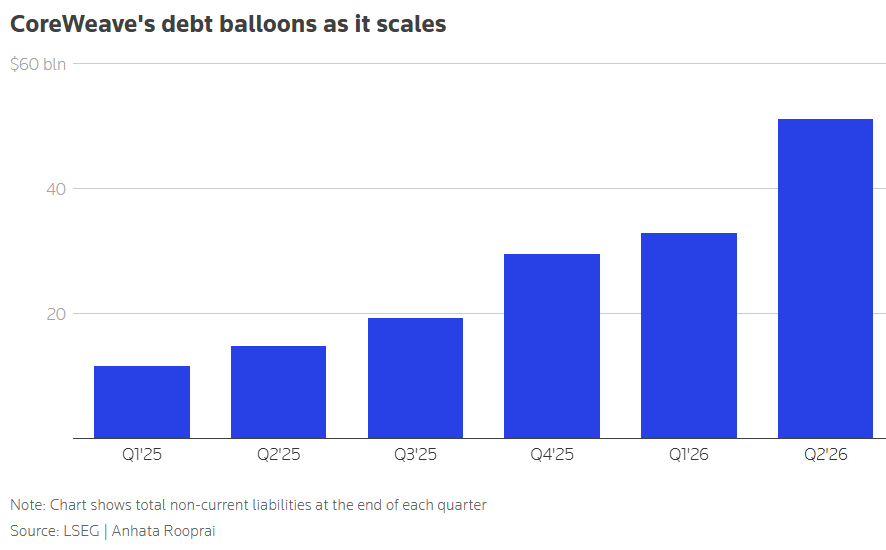
According to the agency's research report, the cloud computing company, which focuses on the new AI cloud field, has received a term loan commitment of about 24 billion US dollars with deferred withdrawals, of which 15 billion US dollars have been withdrawn and 9 billion US dollars have not yet been withdrawn.
CoreWeave has the title of “Nvidia's son”, focuses on providing high-performance computing infrastructure for AI, and has signed tens of billions of dollars in contracts with major technology companies. The size of the company's debt is approximately $50 billion.
As the earliest cloud leasing user of Nvidia graphics processors (AI GPUs) in the data center field, CoreWeave won the favor of Nvidia's venture capital department by seizing the wave of demand for AI computing power resources in data centers, and was even able to prioritize the extremely high demand Nvidia H100/H200 and Blackwell series AI GPUs, which forced cloud service giants such as Microsoft, Google, and Amazon to rent cloud AI computing power resources from CoreWeave.
The most prominent feature of the CoreWeave AI cloud computing power rental service is that it focuses on providing high-end AI GPU (especially NVIDIA GPU) clusters in large quantities and with high efficiency, so that users can obtain high-performance AI GPU computing power resources as needed in the cloud service system — that is, cloud AI computing power resources, for AI workloads such as machine learning, deep learning, and inference. CoreWeave supports large-scale flexible deployment. Users can quickly increase or decrease the number of AI GPUs according to project requirements, suitable for AI model training (such as large language models, computer vision systems, etc.) and huge inference workloads requiring real-time processing.
Last week, the yield on CoreWeave's notes due in 2031 was once close to 16%, and the cost of purchasing default insurance for its debts rose to about 1,000 basis points.
According to J.P. Morgan Chase, the main risk faced by banks is a time mismatch between early AI infrastructure expenses and subsequent gradual receipt of revenue. The bank added that CoreWeave's free cash flow is expected to remain negative until 2030.
Banks look at mortgage guarantees, and shareholders look at project returns
The key to Komo's judgment this time is that banks do not assume CoreWeave risks in the same way. According to estimates, the potential exposure of large US investment banks and Mitsubishi UFJ may be in the range of 1 billion to 3 billion US dollars, with most European and Asian banks below 500 million US dollars; related financing uses a large number of term loans with delayed withdrawals to guarantee equipment, customer contracts, and project cash flow, and funds are gradually released as the project reaches milestones. The company's disclosure also showed that part of the financing was underwritten by special-purpose subsidiaries holding equipment and contracts, and the relevant claims were secured by collateral. However, most of these loans are still guaranteed by the parent company, and SPV does not mean complete risk isolation. The yield of unsecured bonds in the secondary market is close to 16%, nor can it be directly viewed as an entire bank loan or the company's overall capital cost.
The logic of favoring equity lies in whether the project can create economic value. According to Komo's previous schematic estimates, the project return for a typical five-year contract is “10 percentage points in the middle”, which is higher than its estimated capital cost of 9% to 11%, which means that under relevant assumptions, the project can still generate returns that exceed capital costs after covering the initial investment and operating costs; GPU renewal after the end of the initial contract may also bring additional cash flow.
Goldman Sachs is optimistic about the tight supply of computing power and CoreWeave's delivery and performance advantages, and believes that there is room for improvement in unit capacity revenue and project returns. The two institutions' common judgment is that free cash flow consumption due to rapid expansion can coexist with good individual project economics; what really needs continuous verification is whether financing can be linked, production capacity can be delivered on schedule, and whether contract repayments can be fulfilled.
Implementing Wall Street's actual valuation and ratings, Goldman Sachs raised the rating from “neutral” to “buy,” while lowering the target price from $139 to $106, which corresponds to about 73.4% upward space compared to Monday's closing price; Xiaomo maintained an “increase in holdings”, with a target price of 125 US dollars at the end of 2027, corresponding to about 104.5%. Also, according to S&P Global statistics presented by Stock Analysis, the 41 analysts' overall rating is “buy,” with an average 12-month target price of 140.58 US dollars, which corresponds to about 130% of potential upward space. The target price period is different, but they all reflect that institutions are still willing to value long-term cash flow; Goldman Sachs also lowered the target price, which also shows that it has taken more expensive AI infrastructure financing conditions into its judgment.