


In the AI era, the computing power cluster “electric connection” (AI PCB) and the “optical module” (optical module) jointly build a high-speed Internet network of AI computing power clusters, ushering in a huge demand market.
This is because global tech giants are comprehensively increasing AI infrastructure. As of 2026, the four tech giants, Google, Amazon, Microsoft, and Meta, have a total annual capital expenditure of more than 650 billion US dollars, concentrating their capital on AI servers, data centers, high-speed networks, and large-scale model research and development. J.P. Morgan raised its AI infrastructure capital expenditure forecast, and the total investment of the Global Intelligent Computing Center is expected to reach 5.5 trillion US dollars in 2030.
More than a trillion dollars of capital investment has brought a market feast to the AI industry chain. However, there aren't many companies that have both AI PCBs and optical modules in their hands; Higashiyama Seimitsu (02384) is one of them.
The Zhitong Finance App learned that Dongshan Precision has passed the Hong Kong Stock Exchange hearing and plans to sell 113,783,200 H shares globally, including 11,378,400 shares in Hong Kong and 102,404,800 shares internationally. The maximum sale price is HK$93.80 per share (100 shares per lot, entry fee is approximately HK$9,474.59). It is expected to land on the main board of the Hong Kong Stock Exchange on October 28. If the launch is implemented, the company will achieve an “A+H” dual listing platform and enter the “allocation vision” of global investors.
The company's cornerstone investors include Aurora SF, Hong Kong Yonglian Investment Development Co., Ltd., Morgan Asset Management (Asia Pacific) Limited, Alibaba Investment Limited, CPE Bodhi Investment Limited, LMR Multi-Strategy Master Fund Limited, Ruiyuan Fund, and Montage Hong Kong Holdings Company Limited , Oriental Asset Management (Hong Kong) Limited, Spring River Greater China Fund, Jane Street Singapore Pte. Limited, Jinghe Integrated Hong Kong Co., Ltd., Baobin Asset Management Co., Ltd., Yuxuan Network Technology Co., Ltd., Tianhong Fund Management Co., Ltd., Xinhua Asset Management (Hong Kong) Co., Ltd., etc. The company's cornerstone investor structure is diverse and strong, and has established a solid subscription base for this global sale.
Higashiyama Precision is an A-share listed company. The market capitalization began a bull market in 2024. Although there was a sharp correction since July 2026, it still surpassed 5.8 times in less than 3 years. This time, the company will link “A+H”. What kind of new story does the company want to tell?
Net profit surged 293.5%, and performance entered a cycle of accelerated growth
The Zhitong Finance App learned that Dongshan Precision is in an accelerated growth cycle. From 2023 to the first half of 2026, revenue growth was 6.56%, 9.27%, 9.12% and 63.95% respectively, with net profit of 1,965 billion yuan, 1,085 billion yuan, 1,393 billion yuan and 2,985 billion yuan respectively. The key point in the company's performance cycle was 2025, when revenue and profit began to double increase. The first half of 2026 accelerated markedly, with net profit surging 293.5% and net interest rate rising to 10.7%.
This is driven by the company's diversified business. The company has four major businesses: PCBs, precision components, touch panels, LCD panels, and optical modules. In the first half of 2026, the PCB business was still the basic market, but structurally, high-end AI PCBs were the development focus. The business revenue was 12.53 billion yuan, revenue share 45.1%, and precision component revenue of 6.581 billion yuan, an increase of 178.6% over the previous year. The revenue share increased to 23.7%, while the optical module business was the most impressive, with revenue share of 5.351 billion yuan. 19.2%
The optical module business is a business expanded by the company's acquisition of Solss in 2025, and contributed mainly to revenue and profit growth after the merger. In the first half of 2026, the gross margin of PCB was 17.6%, the gross margin of precision components was 11.6%, while the gross margin of optical modules reached 39.2%, and gross profit contributed nearly 40%, and about 20% of revenue contributed nearly 40% of gross profit, directly driving the company's gross margin jump from 13.1% to 19.4%.
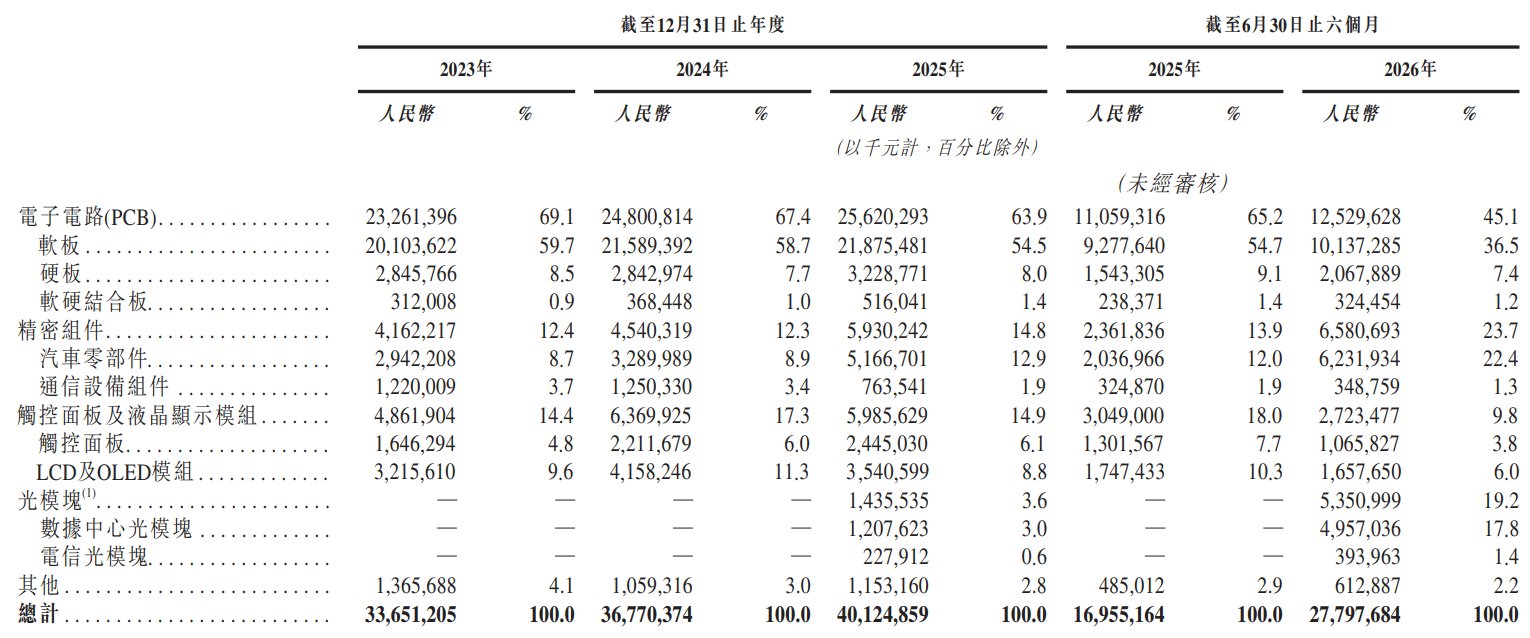
Photo source: Information from the company after the hearing
With this funding, Higashiyama Seimitsu plans to use most of the capital to expand production capacity for high-speed EML chips and optical modules, and to build new production facilities focused on high-end PCBs. As can be seen, the company has set the direction of development. These two businesses are in line with the main AI computing power circuit. One is a structural opportunity for basic disks, and the other is a growth track with high profit margins. The “AI PCB+optical module” dual engine is gradually being formed.
Furthermore, the current H-share listing is also in line with the company's capital globalization strategy. The company's business production capacity covers 14 countries and regions around the world, accounting for more than 80% of overseas revenue. In the first half of 2026, the revenue share of China and overseas markets was 16.8% and 83.2% respectively. Among overseas markets, the US market accounted for 46.1% of revenue. In addition, other Asian countries are also growing at an accelerated pace, with H shares stabilizing their leading position in the global market.
Two core logics, “AI PCB+ optical module” drive growth determinism
The “AI PCB+ optical module” is the two core tracks of Higashiyama Precision's accelerated growth. The sustainability of performance growth is highly deterministic, and has two core logic verifications.
First, demand from the two major racetrack industries continues to explode. Driven by AI infrastructure, the demand for high-rise AI PCBs continues to grow, and PCBs have obvious structured opportunities. According to Insight Consulting, for example, the edge AI equipment PCB industry, the compound growth rate for 2021-2025 is 64.2%, and the compound growth rate for the data center PCB industry is 21.5%, all significantly higher than the overall growth rate of the global PCB industry. The market size is estimated to be US$30 billion and US$36.4 billion respectively by 2030.
Optical modules are the core components that break through data transmission bottlenecks. Also driven by AI infrastructure, the global market size is 24.5 billion US dollars in 2025, with a compound growth rate of 21.5% from 2021 to 2025. It is expected to reach 108.6 billion US dollars by 2030, a compound growth rate of 34.6%. In terms of product lines, 800G modules have exploded, and 1.6T products have entered mass production and have become the core growth engine.
From the perspective of the industrial chain, AI infrastructure is still expanding at an accelerated pace, guaranteeing the demand for AI PCBs. According to TrendForce Jibang Consulting's latest AI server industry research, it is estimated that the total capital expenditure of the top nine global CSPs (Google, Amazon, Meta, Microsoft, Oracle, Byte, Tencent, Ali, and Baidu) will exceed 957 billion US dollars in 2026, an increase of 106% over the previous year. In 2027, it will exceed 1.5 trillion US dollars and continue to grow by 60%.
Second, Higashiyama Precision's AI PCB and optical module have achieved “dual card positions” in terms of scale and product technology. In the AI PCB field, the company is one of very few manufacturers that simultaneously cover soft boards, hard boards, and soft and hard boards. According to Insight Consulting, according to 2025 revenue, the company ranked third among global PCB suppliers with a market share of 4.2%, and ranked second among global soft board suppliers with a market share of 24.5%.
On the product side, the company's multi-layer PCBs and HDI use ultra-low loss M7/8 and above materials to achieve transmission rates of up to 224 Gbps, which can meet the multi-GPU interconnection requirements in AI clusters, and has expertise in high-multi-layer PCBs and high-end HDI with up to 78 layers. Based on M7/8 grade materials and above, the higher the number of layers, the higher the technical requirements. The company has the most advanced technical level in the card holder industry, and has mastered scarce high-end AI PCB products.
In the field of optical modules, Solsi, a subsidiary of the company, is one of only three companies in the world with independent design and manufacturing capabilities for high-speed optical chips and optical modules. According to Insight Consulting, the company ranked 7th in the global optical module market with a market share of 2.9% based on 2025 revenue. More than 10 million Sols' 100G PAM4 EML chips have been used in 400G and 800G optical modules. 200G PAM4 EML chips have entered mass production and supported the batch supply of 1.6T optical modules.
The company has complete self-developed technology from optical chip development to optical module manufacturing, and has dual technology route reserves for EML and silicon photonics. Its dual-track development routes for 800G and 1.6T optical modules cover the current mainstream product line in the industry. With technical advantages, the company continuously optimizes the performance of 800G and 1.6T optical module products, and is also accelerating the commercialization process of 3.2T and above optical modules.
More importantly, Higashiyama Precision's two tracks are not isolated. From electrical connections to optical connections, the company combines PCB technology expertise with optical chip and optical module production capacity to establish an integrated advantage in the field of high-speed transmission. This is something that most peers do not have, and supports the expansion of AI infrastructure. Under the high degree of certainty about the sustainability of growth, this H-share listing will once again bring the company an opportunity to revalue.
In the second round of investment cycle, the H-share listing is expected to be favored
In the capital market, AI technology has multiple long-term investment and allocation cycles. The first round of AI infrastructure investment, including AI models, AI chips, AI servers, and AI PCBs, etc., have all been tenfold bullish since 2024, such as Nvidia and TSMC. The A-share Shanghai Electric, Shennan, and Dongshan Precision also saw the highest increase of more than 10 times; the second round after AI infrastructure, the application layer exploded. This year, the physical AI circuit is on the cusp.
In fact, whether it is AI infrastructure or physical AI, AI PCBs and optical modules have a huge market as high-speed network interconnection hardware. Just like building multiple large cities, roads must be built to pass through each other. Therefore, Higashiyama Precision's dual track essentially covers the entire life cycle of the AI industry, so you can enjoy the market dividends brought by AI technology from beginning to end. And this is the core reason why the company attaches so much importance to these two tracks.
The valuation of Higashiyama Precision A-shares has been retracted to an undervalued “allocation area” over the past four months. H shares are generally priced according to A shares, and in the second round of investment, H shares are dominated by global institutional investors. The pricing mechanism is more reasonable, which is expected to smooth out the volatility and revaluation of A-shares. Based on the sale price of HK$93.8, the market value of the company's shares is HK$338.798 billion, PS (dynamic) is only 4.38 times. The PS value of the AI+ target for high-quality growth in Hong Kong stocks is concentrated 10-20 times, which is clearly undervalued.
Overall, Higashiyama Precision has entered the procurement process, only one step away from listing. The company's fundamentals are strong, and performance growth is accelerating in 2026. “AI PCB+ optical module” has become the core growth engine, and it is also the focus of fund-raising investment. These two major circuit industries have high prospects, covering the entire life cycle of the AI industry, and the company has card position advantages in terms of scale and product technology, and the sustainability of growth is highly certain.
The company's market value has fully withdrawn, and the H-share listing valuation is clearly undervalued. Combined, it is one of the few suppliers in the world that also has integrated self-development and manufacturing capabilities for AI PCBs, optical chips, and optical modules. It is a scarce target, and is expected to be favored by long-term capital.