


The Zhitong Finance App learned that Bernstein analyst Mark Shmulik's team published the latest research report to maintain Meta Platforms (META.US)'s “outperforming the market” rating, with a target price of 800 US dollars. The bank said that Meta is refocusing its business focus around Muse, positioning Muse as a new AI operating system (AI OS), and its various products will be an extension of AI's core capabilities, which is expected to unlock a series of unknown development opportunities; however, in the short term, the valuation and expectations threshold have been raised, and the fundamental environmental challenges faced by the company will increase.
At the beginning of the report, Bernstein quoted a sentence from Facebook's “Little Red Book” as saying, “If we don't create the product that will end Facebook ourselves, others will do it.” Analysts said that the bank's previous optimism about metaverse investment was based on this perspective: if the world moves in the direction of the metaverse, Meta will not only survive, but also lead the next era. That logic is now “fully back in Muse.”
The bank emphasized that the core of its logic for bullish Meta is that Mark Zuckerberg will not let the company fail.
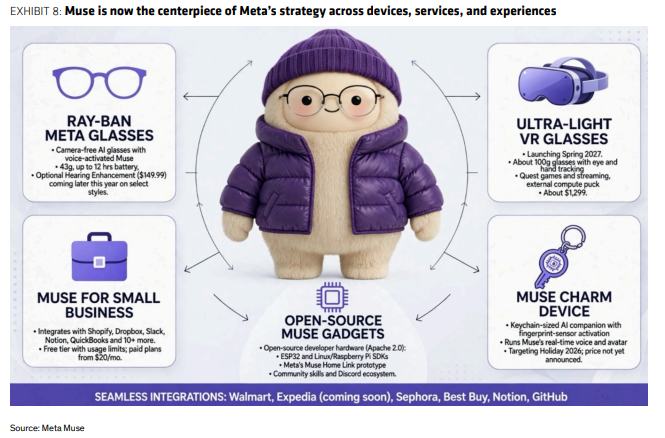
Shmulik likened Meta to “AI Thanos,” saying it has been gathering the “infinite gems” needed to become an AI player: computing power, talent, and cutting-edge models. After the Connect developer conference, the bank's core perception was that Meta is repositioning its business around Muse, using Muse as a new AI OS, and every product is an extension of the AI core. From core business and hardware to new products starting with Muse applications, the potential opportunities to serve creators, SMEs, advertisers, and even corporate customers are “endless.”
The bank pointed out that under the framework where Muse is the core, it is not overly concerned about the recent monetization of Muse Agent. Early download and retention trends are encouraging, but at the same time, it's a reminder to be cautious about the huge potential market space (TAM) corresponding to early popularity. Previously, the scale estimates of Facebook Shops and the metaverse had been too optimistic. What is certain, however: first, the ROIC at the strategic level is greater than zero; second, the level of investment is rising; third, Meta has sufficient resources and can flexibly adjust direction according to changes in market conditions and consumer behavior.
Bernstein explains the Muse strategy from three dimensions. For consumers, the Muse Flywheel has been launched: the app continues to be at the top of the US download list. Real-time voice, customizable personalities, avatars, email, computer usage, and ever-expanding business and productivity integrations are driving Muse beyond traditional chatbot experiences. At the beginning of the launch, there were dozens of publishing partners and connected to the Shopify product catalog, and the list of partnerships continued to expand. The bank said that this list should continue to expand, while the hardware strategy also fits the “use Muse in any way” framework.
For developers, the company claims that the goal is not only to have the best model. The key to winning over developers is rapid innovation iteration and high accessibility, that is, putting new innovations in the hands of developers as soon as possible, and making the ability to be used anywhere developers want to build. The popularity of the developer ecosystem stems from lower usage thresholds, and Meta is focusing on eliminating every point of friction between developers and users.
For investors, this is an “evolving AI ROI story.” At least, the ROIC for consumer AI investments is now greater than zero, which allays concerns that have plagued investors for a long time and associated with continued investment and loss in the metaverse. Meta's AI investment scale is among the highest in the industry, but unlike hyperscale cloud vendors, it cannot rely on cloud demand to prove returns. Muse provides a consumer-oriented revenue stream that can actually reflect the output of large investments. Even if commercialization starts on a small scale, investors can at least start linking AI investments to measurable results: millions of subscribers, billions of dollars in total product transactions, app downloads, user activity, etc., all of which can be used to measure the growth of the consumer AI business.
Bernstein also said that Muse is no longer just a model or another application, but is becoming an intelligent layer at the center of the Meta ecosystem. Glasses, VR, companion devices, standalone Muse apps, and integrations within the Meta family of apps are all like different endpoints for the same assistant. Hardware is a container; Muse is a product. From this point of view, the device itself is less important than the assistant. The bank said that last year the industry often felt like it was looking for devices that consumers would use; this year it was more like Meta saying “assistants first,” and users can access it in any way. Meta no longer forces consumers to choose a specific form, but instead builds an intelligence layer to let the hardware follow.
Short-term financial report: Strong revenue, profit hampered by $10 billion legal settlement
Looking ahead to the financial report for the third quarter of fiscal year 2026, Bernstein expects Meta revenue of US$64.058 billion, higher than the market's consensus estimate of US$63.312 billion, an increase of 25% year over year; the DAU/MAU forecast to be 3.646 billion, 1% higher than the consensus, and the implicit/guidance will increase 19%-25% year over year. However, the EBIT is estimated at US$11.338 billion, 40% lower than the market's consensus estimate of US$19.016 billion, mainly due to the inclusion of US$10 billion in legal costs associated with youth media use settlements during the quarter. EPS is expected to be $3.95, higher than the agreed $3.56 billion; free cash flow is expected to be -$13.756 billion, and market consensus is -$8.953 billion; capital expenditure is expected to be $41.958 billion, and market consensus is $41.011 billion.
According to the bank, revenue fundamentals remained strong in the third quarter, and Meta's digital advertising engine continued to operate at full speed, benefiting from improvements in AI targeting and advertising creativity. Even in the face of an exchange rate shock of about--- 1%, the bank still expects Meta to exceed its third-quarter revenue guidance of US$610-64 billion (up 19%-25% year over year).
However, the threshold for the fourth quarter is being raised: the company faced a high year-on-year base of up to 24% in the same period last year, while foreign exchange pressure is expected to continue. The fundamentals are still stable, but the high base combined with continued exchange rate headwinds will make the fourth quarter results guide more difficult to achieve.
Bernstein raised revenue forecasts for 2026 and 2027, but lowered EBIT and EPS forecasts, and significantly lowered free cash flow forecasts.
Furthermore, the bank mentioned that discussions on investment and capital expenditure are expected to remain the focus of the market. In the last quarter, Meta raised the low end of the 2026 capital expenditure range by $5 billion to 130 billion US dollars, while maintaining the high end of 145 billion US dollars unchanged, suggesting that spending may trend towards the upper end of the range.
Looking ahead, the bigger focus is 2027. Meta has always stated that the level of investment will remain high to continue to ensure sufficient AI production capacity, while at the same time continuing to invest in Muse marketing. Investors also increasingly expect that AI-related spending will rise again next year. The bank also said that as the popularity of Muse increased in the early days, the market began discussing equity financing as another means of funding ambitious infrastructure plans.
Bernstein said that the early popularity of Muse gave Meta key evidence that has been lacking in the current capital expenditure cycle: AI investment is being transformed into visual evidence of consumer demand, and now management can come up with a consumer-side AI product to prove that the product has achieved explosive user growth. Investors are increasingly concerned about whether management has this supporting evidence to start a new and larger AI capital investment cycle.
How high will Muse's growth ceiling be?
Finally, Bernstein also raised a question: How high will Muse's growth ceiling be? The bank said the rate of consumer adoption is difficult to predict, and despite strong momentum, history shows that meaningful behavioral changes are often slower and less predictable than the adoption curve suggests.
Bernstein explains with several historical examples: after more than 20 years of growth, e-commerce still accounts for less than 20% of total retail sales in the US, and smartphone adoption is faster, currently exceeding 80% of the US population. Although ChatGPT has one of the fastest adoption curves in the history of consumer technology, three years after its release, it is still mainly a useful but relatively narrow productivity tool, and commercialization is concentrated on limited applications; its promotion of smart commerce seems to have had limited results so far.
Compared to TikTok, the number of ChatGPT users is growing faster, but user activity is already showing signs of peaking. The daily usage time per person has stabilized at 15-20 minutes, while TikTok is about 90 minutes. TikTok has taken a larger role in consumers' daily lives, commercial success is more obvious, and consumer revenue is significantly higher. The annual revenue per DAU is about twice that of ChatGPT.
The bank believes that product ease of use and strong scenario value can significantly accelerate the popularization of consumer products and rewrite the competitive landscape. History shows that superior technology alone is often not enough; winning products are often products that make the experience simpler, more intuitive, or more immediate value to users. Facebook replaced MySpace with a cleaner, simpler, and more practical social networking experience; Gemini successfully gained a large number of users' minds last year through the explosion of Nano Banana's image editing features.
Muse may represent a similar inflection point: if it can unlock a consumer use case that is significantly simpler, more attractive, or uniquely differentiated from AI chatbots such as ChatGPT, it could stand out and accelerate mainstream adoption.