


Elice Group’s steep post-IPO slide has put a harsh spotlight on AI infrastructure valuations, yet it has also pushed attention back toward established giants that already earn real money from chips and cloud. When speculative listings wobble, investors often rediscover the appeal of scale, balance sheets and diversified AI exposure. This article walks through three stocks from the screener that appear more insulated from the latest AI data centre shock.
The stocks highlighted below are only a starting sample, and the full screen surfaced 22 more large, AI linked semiconductor and tech companies with equally compelling stories that are not covered here. To identify and analyze potential high conviction ideas across the full universe, move straight into the Established, diversified AI and semiconductor leaders screener.
GlobalWafers (TPEX:6488)
Overview: GlobalWafers is a large Taiwan based producer of silicon wafers that supplies essential inputs for a wide range of AI and semiconductor chips worldwide.
Operations: The group generates roughly NT$58.0b from its Semiconductor Business Group and under NT$1b from its Renewable Energy Division, with revenue spread across Europe, Taiwan, Northeast Asia, America and other Asian regions.
Market Cap: NT$421.7b
GlobalWafers fits this screener as a core upstream way to get diversified AI and semiconductor exposure. The key story is now shifting from promises of capacity to how quickly its new plants translate into real, wafer driven cash flow.
"GlobalWafers is moving its global capacity buildout from construction into qualification and ramp at new 12 inch fabs in Texas, Italy and Japan. Phase 1 tool installation at the Texas site is close to completion, the Italy line has achieved automotive grade certification and begun receiving subsidies, and Utsunomiya in Japan has turned profitable with high utilization."
What happens to margins and earnings will depend heavily on how one unseen cost pressure interacts with that new capacity over time.
Those cost pressures are exactly what the full narrative for GlobalWafers unpacks in detail, showing where GlobalWafers could see earnings power accelerate or quietly get capped.

Skyworks Solutions (SWKS)
Overview: Skyworks Solutions supplies analog and mixed-signal chips that handle wireless connectivity for smartphones, IoT devices and communications gear worldwide, giving diversified exposure to AI-linked demand.
Operations: Skyworks generates about US$4.0b from Proprietary Semiconductor Products, with roughly US$3.1b of sales coming from customers in the United States.
Market Cap: US$12.1b
Skyworks Solutions matters in this screener because it ties AI demand to something very tangible, the radios and power chips that let devices and data centers actually talk to each other, and the Qorvo deal pushes that reach deeper into both mobile and broad connectivity markets.
"The planned Qorvo merger is framed around creating a combined mobile business of roughly US$5.5b and a non mobile business of about US$2.5b to US$2.6b. This is together with at least US$500m of cost synergies over 24 to 36 months and a long term model of 50% to 55% gross margin and 30% to 35% operating margin."
What really matters now is how quickly one quiet integration choice shows up in the shape of future margins and cash generation.
Those integration choices are exactly where the full narrative for Skyworks Solutions digs in, mapping how synergy timing, product overlap, and capital allocation could turn Skyworks into an earnings compounder or a stalled merger story.

Realtek Semiconductor (TWSE:2379)
Overview: Realtek Semiconductor designs and sells a broad mix of communications, audio, connectivity and interface chips and related software worldwide.
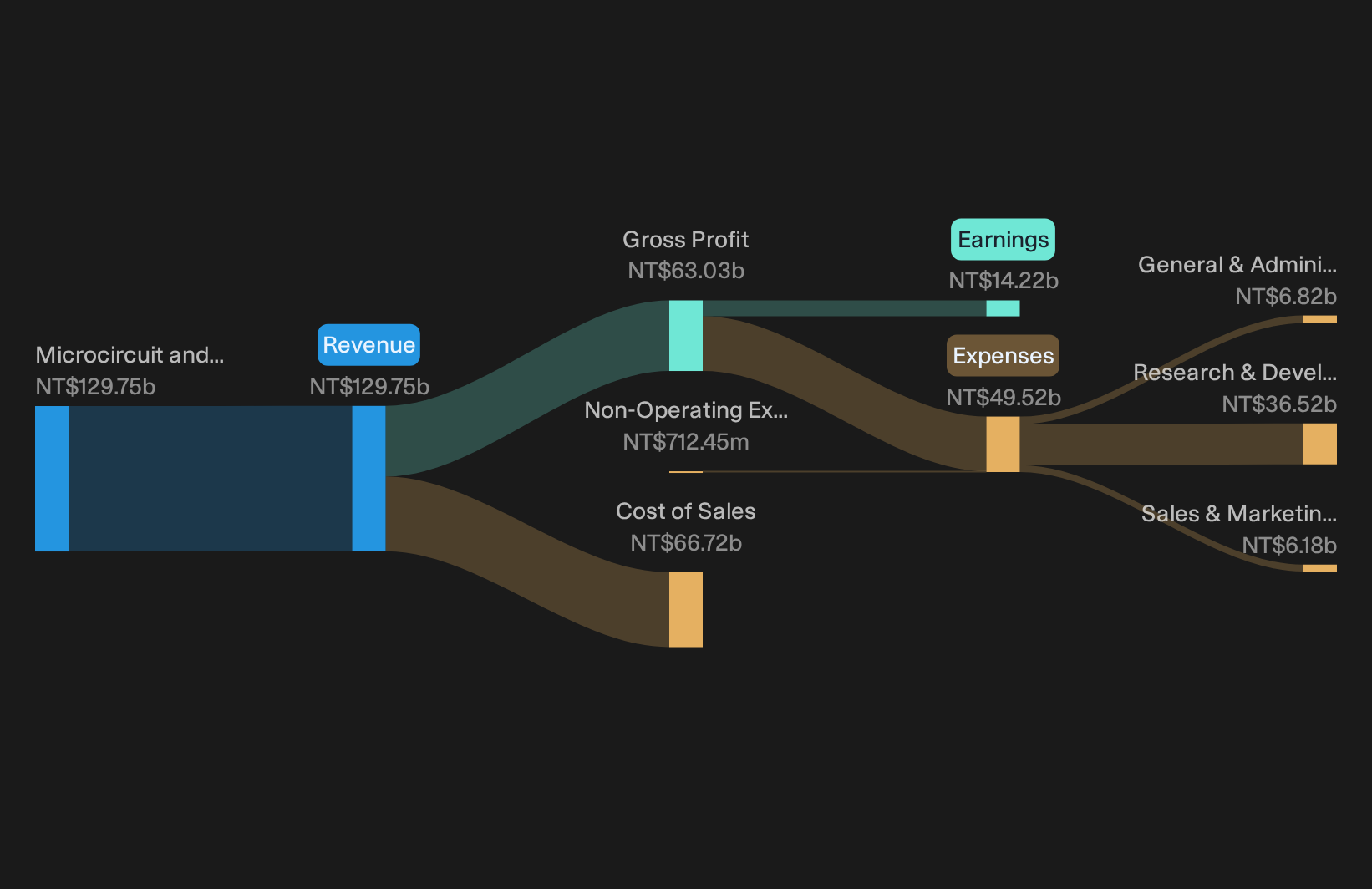
Operations: The business generates about NT$129.7b from microcircuit and related application software products across its various connectivity and multimedia lines.
Market Cap: NT$401.6b
Realtek Semiconductor fits this established AI and semiconductor leaders theme as a diversified way to gain exposure to connectivity chips that sit inside PCs, routers, cars and edge devices, where AI demand increasingly shows up.
"Realtek Semiconductor is positioned to benefit as AI PCs and Agentic AI workloads require higher spec connectivity, with wider adoption of Wi Fi 7 in notebooks and routers and higher content value per device, which can support revenue and earnings even if overall PC units decline."
What investors may find decisive is how one cost and pricing squeeze resolves, because that could quietly reshape both margins and growth expectations.
If that pricing squeeze matters to your thesis, the full narrative for Realtek Semiconductor shows where Realtek Semiconductor’s AI connectivity upside could be accelerating or quietly getting masked.
Seeking Alternatives Before Momentum Flies
Fresh opportunities rarely stay quiet for long. Breakout stories gain momentum, prices start flying, and the best entry points get caught quickly. Scan these under the radar ideas now and get in early.
- Target resilient income streams while they are still underappreciated by screening for companies in the 223 dividend fortresses before yields adjust and the crowd starts chasing them.
- Hunt for future compounders early by running the 614 high quality undiscovered gems and reviewing businesses that combine solid fundamentals with limited current attention from the market.
- Position ahead of the next infrastructure cycle by checking the 43 power grid technology and infrastructure stocks and assessing operators tied to long term grid upgrades while it still matters.
Have feedback on this article? Concerned about the content? Get in touch with us directly. Alternatively, email editorial-team@simplywallst.com