


CoreWeave’s (CRWV) stock crashed hard recently, falling about 19% over just two days. The warning came from the bond market, which hurt CoreWeave more than most companies. On Oct. 13, investors began demanding about 15% a year to hold its bonds due in 2032, a sign they see risk in lending to the company. The move went viral after investor Chamath Palihapitiya flagged it on X, and Elon Musk replied with a single word, “Yikes.” CoreWeave said its signed customer contracts more than cover its debt. A day later, Bank of America kept its “Buy” rating and $140 price target, and even raised its revenue forecasts. The stock has since recovered some of its losses.
Why the 15% Looks Scarier Than It Is
That 15% applies only to CoreWeave’s unsecured bonds, which aren’t backed by any assets. Much of its other debt is backed by its chips and contracts, at different rates. So the number overstates what CoreWeave pays overall. Its near-term bills also look manageable. It had about $15.6 billion in cash and available credit in June, against roughly $10.6 billion of debt due through 2027. I think the bigger concern is how much more money CoreWeave needs. BofA expects it to spend about $24 billion more than it brings in this year, and nearly $25 billion more next year. So it has to keep borrowing, and that just got pricier. I flagged this risk when the Fed raised rates for the first time since 2023. Strong customers help, including Meta (META), which accounts for about $35 billion of its contracts. I recently covered how AI companies now compete with the U.S. government for investors’ money, and CoreWeave sits right in the middle of it.
About CoreWeave Stock
CoreWeave is a cloud infrastructure provider specializing in GPU-accelerated computing for AI workloads. Its product portfolio includes AI cloud infrastructure, GPU compute instances, and cloud storage and networking solutions. Founded in 2017, the company is headquartered in Livingston, New Jersey, and is led by co-founder and CEO Michael Intrator.
Over the last 12 months, CoreWeave’s stock has fallen approximately 50%, sharply underperforming the Invesco QQQ (QQQ) Trust’s 18% gain during the same period. The stock has fallen 22% in the past month alone, following reports that Meta is building a cloud business to sell its spare computing power. Investors were concerned that CoreWeave could lose one of its largest clients and gain a competitor at the same time. Moreover, CRWV stock has slid to near its 52-week low this week, as investors turned wary of the debt behind the AI data center build-out.
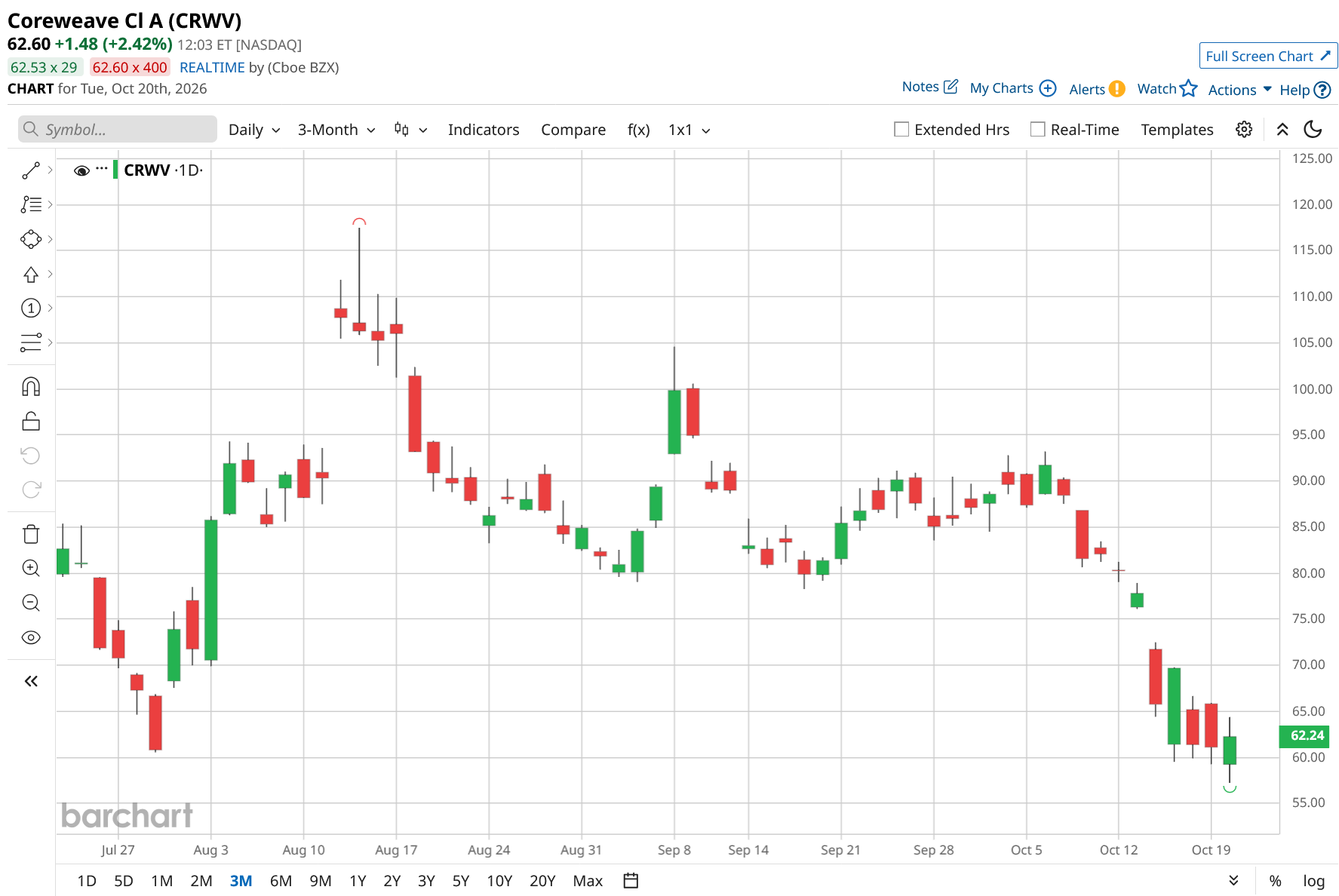
CoreWeave’s valuation shows how heavily debt now weighs on the stock. The company isn’t profitable yet, so its forward price-to-earnings (P/E) isn’t meaningful. The forward price-to-sales (P/S) ratio of 2.82x looks cheap for a business expected to more than double revenue next year. But the balance sheet explains the low multiple. CoreWeave carries $51.61 billion in debt and lease obligations against $5.54 billion in cash. The resulting net debt of around $46 billion is more than its entire $36.28 billion market value. That makes the stock behave like a leveraged bet on AI demand. Analysts expect losses through 2027, followed by a small profit in 2028. Earnings are then expected to jump sharply, putting the stock at about 8x 2029 earnings if those estimates hold. For investors, the upside is real, but so is the risk that higher borrowing costs eat into it first.
CoreWeave Lifts Revenue Forecast as AI Infrastructure Demand Grows
CoreWeave reported its second-quarter fiscal 2026 earnings on Aug. 11. It reported revenue of $2.58 billion, up 112% year-over-year (YoY). The earnings per share came in at -$1.14, beating the Wall Street consensus of -$1.41. Adjusted EBITDA for the quarter was $1.5 billion, up from $753 million a year earlier. The company posted a net loss of $626 million, wider than the $290 million loss a year earlier, as it continued to spend aggressively on power, infrastructure, and financing to support future growth.
Looking forward, CoreWeave raised its full-year 2026 revenue guidance to $12.4 billion to $13.2 billion. The company also lifted its full-year adjusted operating income outlook to $960 million to $1.15 billion and increased its exit ARR target to $18.5 billion to $19.5 billion. CFO Nitin Agrawal said the company expects to end the year with more than 1.85 gigawatts of active power, up from its previous guidance of more than 1.7 gigawatts. For the third quarter, the company expects revenue to be in the range of $3.45 billion to $3.6 billion.
What Do Analysts Think of CRWV Stock?
Cantor Fitzgerald analyst Brett Knoblauch reiterated a “Buy” rating with a price target of $176. The analyst points to rising revenue and profit margins, which could allow CoreWeave to recover its investment in AI chips within two to two and a half years. He believes improving profitability and asset-backed financing can help the company manage its debt and continue growing. Similarly, Evercore ISI maintained a “Buy” rating and set a price target of $150.
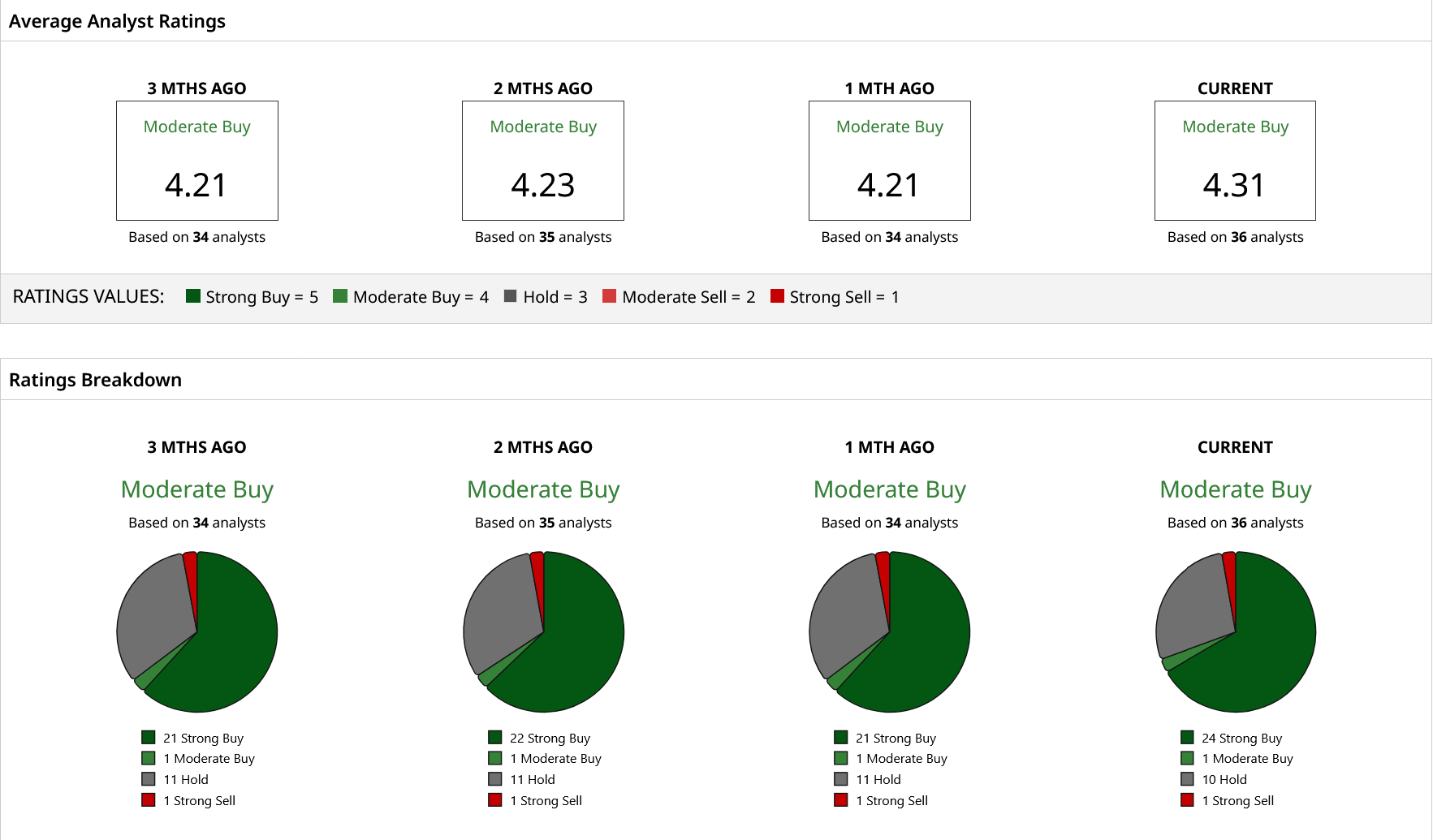
Based on 36 Wall Street analysts covering the stock, CRWV holds a consensus “Moderate Buy” rating. The stock’s mean price target of $134.77 reflects an impressive 115% upside from current levels. The high price target of $250 reflects analysts' optimism about the future prospects of the company.
On the date of publication, Jabran Kundi did not have (either directly or indirectly) positions in any of the securities mentioned in this article. All information and data in this article is solely for informational purposes. For more information please view the Barchart Disclosure Policy here.