


More than a decade ago, in 2014, Tesla (TSLA) CEO Elon Musk, in an interview with The Independent, had said, “Maybe we’ll make a flying car, just for fun. I’ve thought about it quite a lot. We could definitely make a flying car—but that’s not the hard part. The hard part is, how do you make a flying car that’s super safe and quiet? Because if it’s a howler, you’re going to make people very unhappy.”
Dismissed as another futuristic musing then, Musk has made this a reality in 2026 when he unveiled the new Roadster. A (kind of) flying one at that, just as he had envisioned in 2014. Apart from the excitement that was palpable and covered extensively by the media, on a broader scale, this bodes well for investors in both Tesla and SpaceX (SPCX). It shows that Musk can deliver (albeit the timeline may vary), and his ambitious projects around humanoid robots (Optimus) and data centers in space could become a reality sooner rather than later.
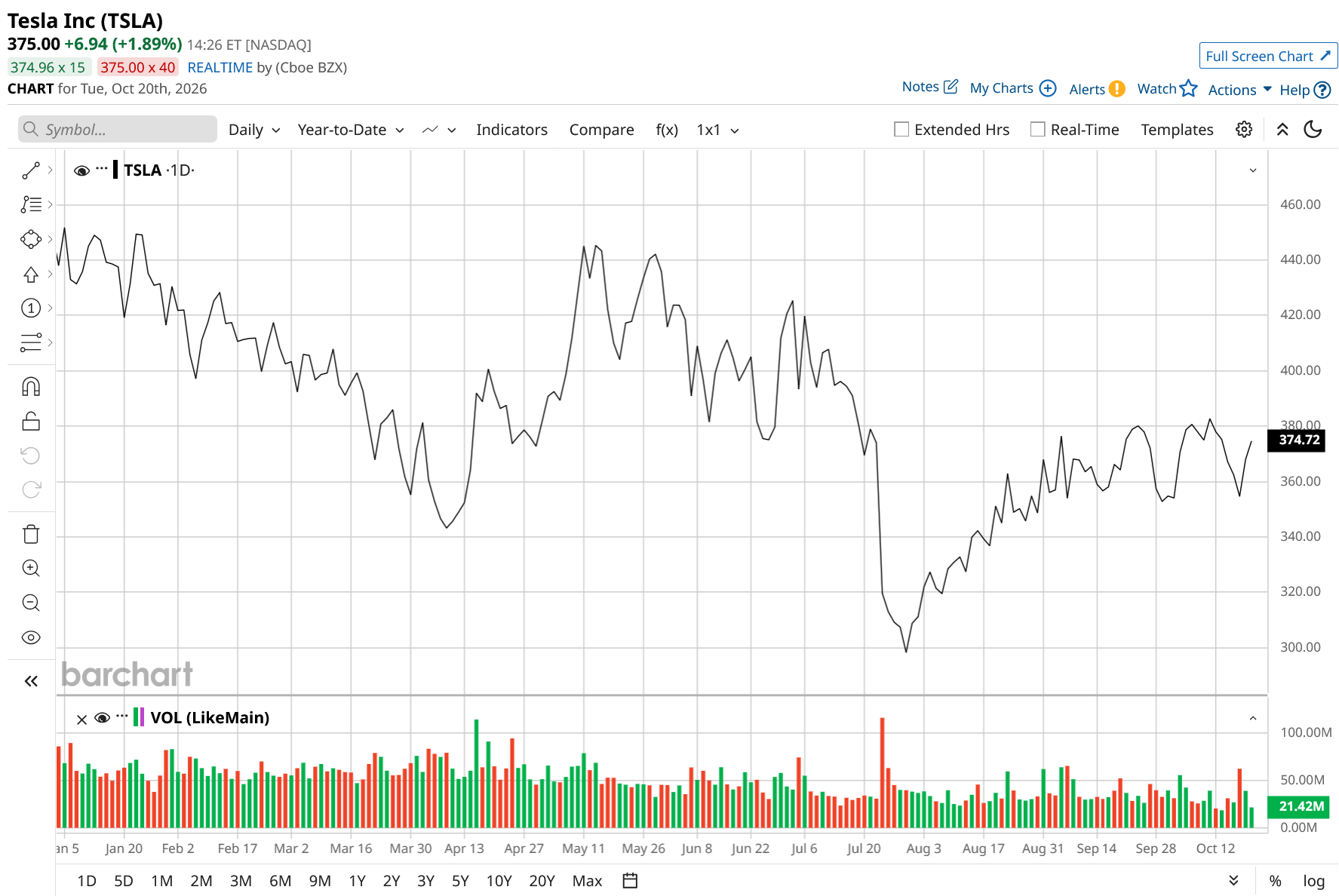
Amid all this, the company is set to report its Q3 earnings tomorrow, and a good print may shift the momentum for the stock, which has been under pressure this year, declining by 17% on a year-to-date (YTD) basis.
Expectations From Q3
For Q3, the Street is having muted expectations around Tesla, with a decline in both revenue and earnings. Revenues are expected to hover between $27.8 and $28.3 billion; earnings expectations are around $0.43-$0.45 per share. In Q3 2025, the same figures were $28.1 billion and $0.50 per share, respectively. Key automotive revenues are projected to decline to $20-$20.3 billion, while on the other hand, growth is expected for energy generation and storage and service revenues.
Free cash flow is expected to be negative and range between $4 and $4.5 billion as the company goes for heavy capex, with the company itself projecting a median figure of $8 billion.
Other than the numbers, keen focus will also be on the automotive gross margins and average selling prices, which have been under pressure, along with more color on the demarcation of capex between Robotaxi, AI training and inference, and Optimus humanoid robots.
Meanwhile, unveiling more aspects of the new Roadster will also be expected, particularly in the earnings call, concerning production timing, configurations, and pricing implications, coupled with the broader product roadmap. However, Musk remains more excited about Optimus and Cybercab, stating on X, “Optimus and Cybercab will be the vast majority of Tesla’s value. The only things that will scale to incredible size (K2 and beyond) economically are super intelligence, robots, solar power and mass to space. … But Roadster is super cool, so we’re doing it anyway.”
Finally, the market will also be expecting some hints about Tesla's merger with SpaceX and the possible timeline of the same.
How Was Tesla's Q2?
Tesla generated total revenue of $28.2 billion during the second quarter, reflecting a 26% rise from the year-earlier period and exceeding estimates by more than $2.5 billion. Automotive revenue, the largest segment, increased 23% to $20.5 billion. Services revenue expanded 50% to $4.6 billion, while the energy business advanced 13% to $3.1 billion.
Earnings per share (EPS) declined 18% to $0.33, falling short of the consensus forecast of $0.53. Gross margins edged lower to 16.8% from 17.2% in the prior year period. Operating expenses rose to $4.3 billion from $2.9 billion, driven mainly by a 50% year-over-year (YoY) increase in research and development spending that may support future growth.
Cash flow from operations reached $4.7 billion, an 85% improvement from the previous year. Free cash flow, however, turned negative at $1.1 billion, a point that stands out given Chief Financial Officer Vaibhav Taneja’s confirmation of capital expenditures exceeding $25 billion for 2026. The company ended the quarter with $43.5 billion in cash, significantly higher than its short-term debt of $1.4 billion.
Vehicle deliveries totaled 480126 units, up 25% YoY and ahead of the consensus estimate of 406000. Production increased 10% to 451,758 vehicles, while Full Self-Driving (FSD) subscriptions rose 56% to 1.48 million.
Energy storage deployment advanced to 13.5 gigawatt hours from 9.6 gigawatt hours in the second quarter of 2025. Supercharger stations and connectors, essential parts of the energy infrastructure, grew 18% and 17%, respectively, to 8,704 stations and 82,357 connectors.
Despite these operational achievements, TSLA shares continue to trade at elevated valuation levels. Its forward P/E, P/S, and P/CF at 203.41, 13.07, and 84.87 are all much above the sector medians of 15.40, 0.84, and 10.10, respectively.
Tesla is currently valued at a market cap of $1.4 trillion.
Analyst Opinion on TSLA Stock
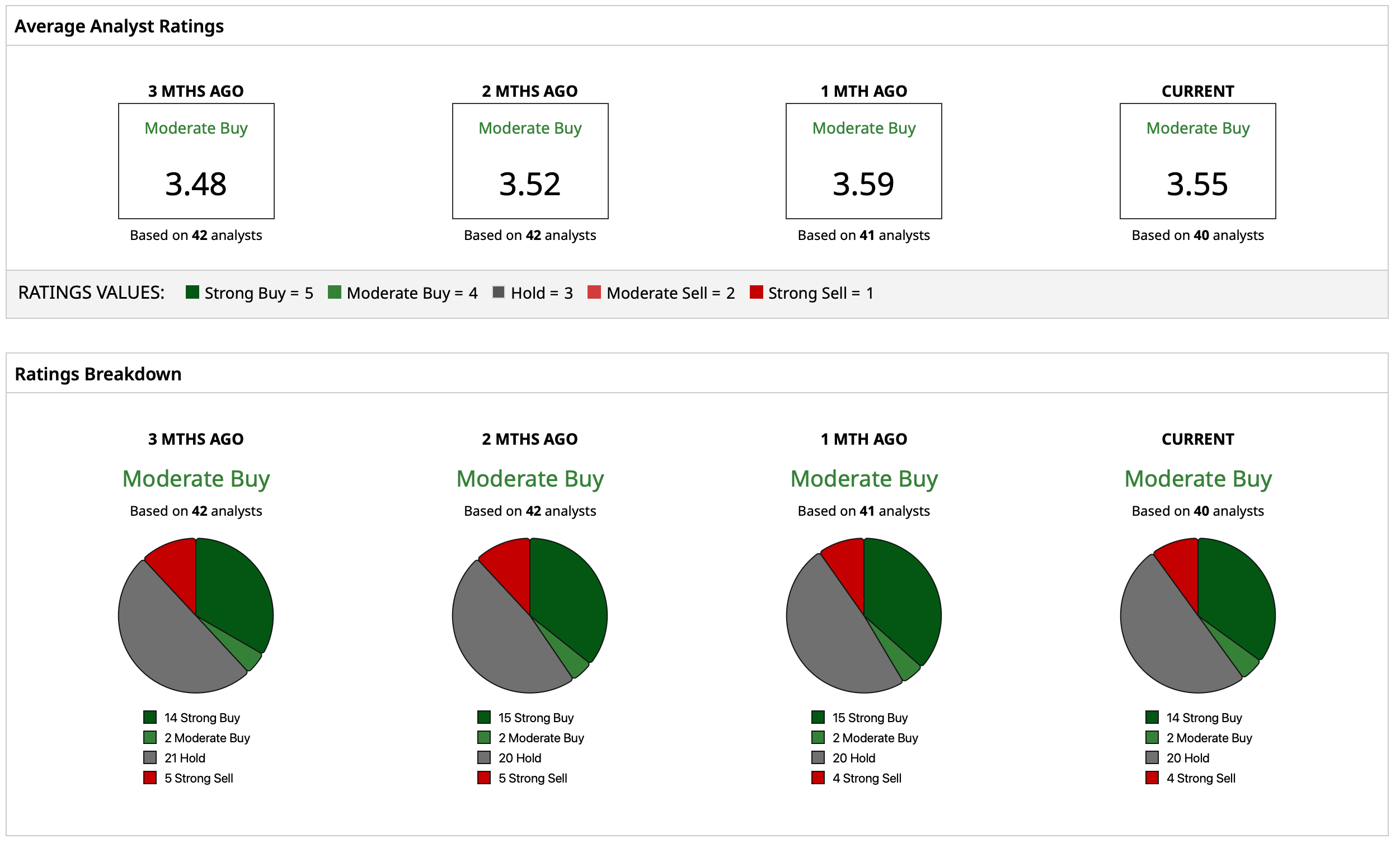
Overall, analysts have earmarked a consensus rating of “Moderate Buy” for TSLA stock, with a mean target price of $401.36, which implies a potential upside of about 9% from current levels. Out of 40 analysts covering the stock, 14 have a “Strong Buy” rating, two have a “Moderate Buy” rating, 20 have a “Hold” rating, and four have a “Strong Sell” rating.
On the date of publication, Pathikrit Bose did not have (either directly or indirectly) positions in any of the securities mentioned in this article. All information and data in this article is solely for informational purposes. For more information please view the Barchart Disclosure Policy here.