


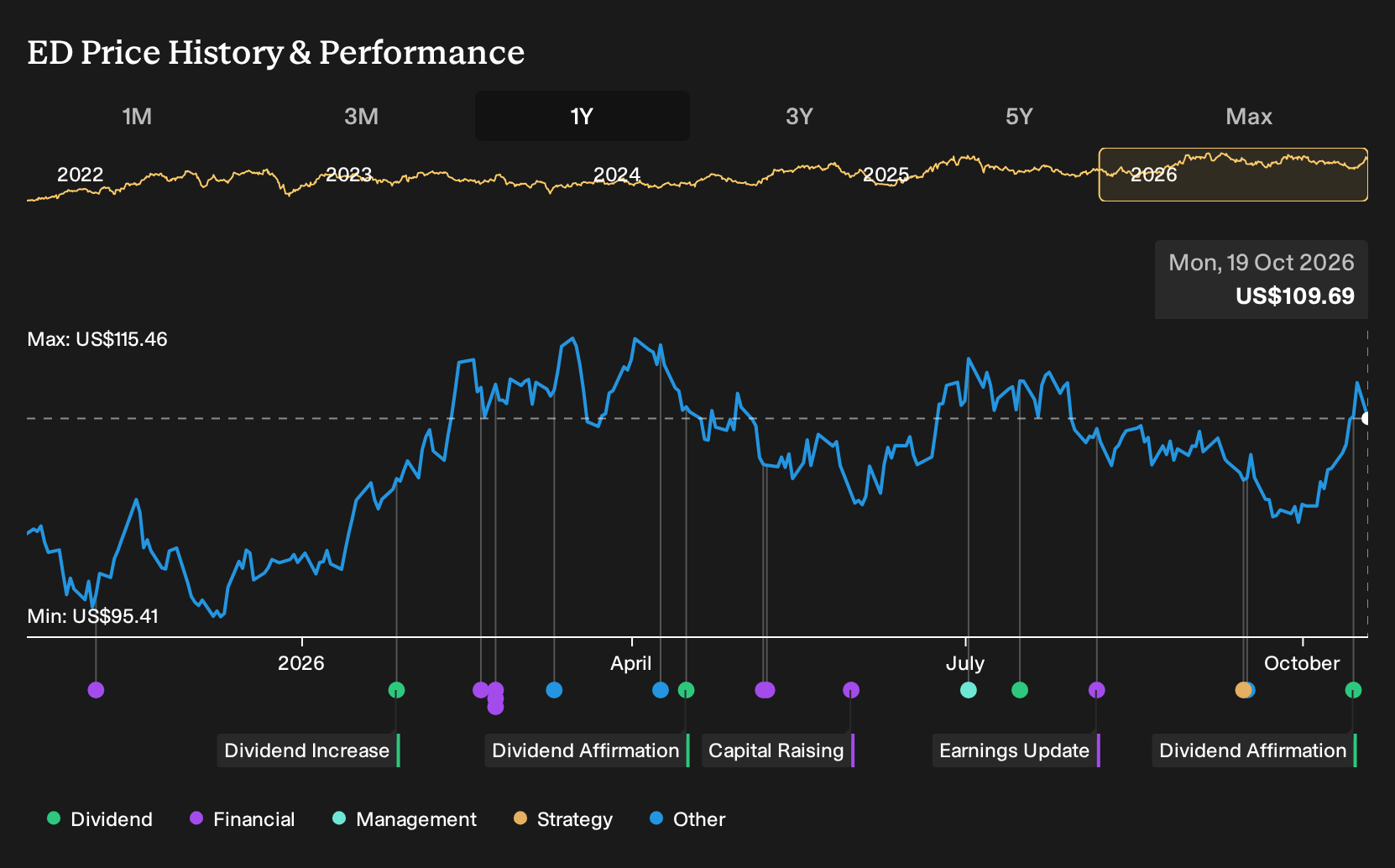
- Consolidated Edison affirmed a quarterly dividend of US$0.8875 per share and previously outlined approved New York rate increases, tied in part to higher property tax costs that contributed 21% of New York City customers' bills after a 45% rise in those taxes between 2019 and 2024.
- The move to clearly show how much of each electric bill goes to New York City property taxes places regulatory cost pressure and customer affordability at the center of Consolidated Edison’s operating story.
- We will look at how Consolidated Edison’s investment narrative is shaped by greater bill transparency around New York City property taxes.
Compare how Consolidated Edison’s regulated profile stacks up against other grid exposed utilities by scanning our hand picked 42 power grid technology and infrastructure stocks in one pass.
Consolidated Edison Investment Narrative Recap
For a shareholder in Consolidated Edison, the core belief is pretty simple. You need to think a heavily regulated, New York focused utility can keep winning approval for large grid and resilience projects while keeping bill pressure politically acceptable. The near term swing factor is how regulators balance higher property tax pass throughs with reliability and affordability concerns.
The biggest risk sits on that same axis. Tougher earnings sharing rules, longer rate cases or penalties tied to heat related reliability issues could tighten returns just as capital needs remain heavy. The latest property tax transparency move raises scrutiny but does not look like a clear break to the long term plan at this point.
The dividend affirmation at US$0.8875 per share keeps Consolidated Edison on its long running pattern of regular cash returns. For income focused holders, that matters, especially with the stock trading around a high teens P/E and analysts flagging that the payout is not well covered by free cash flow.
Where this links back to catalysts is capital intensity. Management is pursuing multi decade grid, electrification and resiliency programs while also carrying debt that analysts say is not well covered by operating cash flow. A steady dividend alongside rising bill visibility and large planned spend places execution risk on financing and regulatory outcomes rather than headline yield.
Analysts currently assume Consolidated Edison's revenues will reach about US$19.7b and earnings US$2.8b by 2029. This implies around 3.6% yearly revenue growth and an earnings increase of roughly US$0.6b from about US$2.2b today.
Discover why Consolidated Edison's fair value aligns with its current price.
Exploring Other Perspectives
Three fair value estimates from the Simply Wall St Community cluster tightly between about US$107.6 and US$109.7, so you are not looking at wild outliers. Those retail views do not yet reflect the latest dividend affirmation, property tax transparency move or planned US$38b plus of grid spending, which could reshape how you and other investors frame Consolidated Edison’s longer term resilience and risk. Explore several alternative viewpoints before leaning on any single fair value line.
Explore 2 other Consolidated Edison fair value estimates, including one estimate that suggests it could be worth as much as $109.66.
Decide For Yourself
Disagree with existing narratives? Extraordinary investment returns rarely come from following the herd, so go with your instincts.
- A great starting point for your Consolidated Edison research is our analysis highlighting 3 key rewards and 2 important warning signs that could impact your investment decision.
- See our latest analysis for Consolidated Edison. The report includes a comprehensive fundamental analysis summarized in a single visual, the Snowflake, making it easy to evaluate Consolidated Edison's overall financial health at a glance.
Looking For More Investment Ideas Beyond Consolidated Edison?
If you want to stress test your thinking on Consolidated Edison, it helps to line it up against a wider set of opportunities. The Simply Wall St Screener lets you quickly filter for different kinds of businesses so you can see how this regulated utility compares with other potential holdings on your radar.
- If you are hunting for resilience first and foremost, start with companies that screen as relatively steady by reviewing 32 resilient stocks with low risk scores that may better match a cautious risk profile.
- For investors who care most about quality at a reasonable price, compare Consolidated Edison to a hand picked group of attractively priced companies by scanning 35 high quality undervalued stocks for ideas that fit your return and risk expectations.
- If balance sheet strength is your priority, line up utilities and non utilities side by side using a curated list of solid balance sheet and fundamentals (25 results) to see which businesses combine financial flexibility with fundamentals you are comfortable owning.
Have feedback on this article? Concerned about the content? Get in touch with us directly. Alternatively, email editorial-team@simplywallst.com