The Zhitong Finance App learned that according to the Hong Kong Stock Exchange's disclosure on October 20, Ganzhou Hemei Pharmaceutical Co., Ltd. (abbreviation: Hemei Pharmaceutical) passed the Hong Kong Stock Exchange main board listing hearing, and SDIC Securities International is the sole sponsor.
According to the prospectus, Hemei Pharmaceutical is a biopharmaceutical company dedicated to the discovery and development of self-discovered and small-molecule drugs for autoimmune diseases and tumors. Currently, the company has the core product Mufemilast and five small molecule drug candidates. In September 2025, Mufemilast was approved by the NDA in China to treat moderate to severe plaque psoriasis.
Mufemilast is a self-discovered and self-developed small-molecule PDE4/PDE4b inhibitor that is also being reviewed for critical phase III trials for Behcet's disease (“BD”) and ulcerative colitis (“UC”). Phase II trials for atopic dermatitis (“AD”), psoriatic arthritis (“pSA”), Crohn's disease (“CD”), and chronic obstructive pulmonary disease (“COPD”) are ongoing or planned in China. This product has been certified as an orphan drug by the FDA for BD.
In addition, the company's clinical-stage drug candidates include: Hemay022, Hemay007, Hemay808, Hemay181, and Hemay5087.
In terms of R&D strategy, the company takes strict product portfolio management policies as the core, and prioritizes the core product Mufemilast and the key oncology assets Hemay022 and Hemay181.
Hemay022 is a class 1 small molecule inhibitor that targets EGFR and HER2 and is intended as second-line therapy for advanced ER+/HER2+ breast cancer, and the company has global rights to the drug. Currently, Hemay022 is undergoing phase III clinical trials in China to treat advanced ER+/HER2+ breast cancer in combination with an aromatase inhibitor (exemestane or letrozole). The company plans to submit an NDA application in China in December 2028.
According to market data, the market size of HER2-positive breast cancer drugs in China is estimated to grow from RMB 11.4 billion in 2021 to RMB 16.5 billion in 2025, with a CAGR of 9.7%. In the future, China's HER2-positive breast cancer drug market will further grow to RMB 23.3 billion in 2028 and RMB 37.7 billion in 2032, with a compound annual growth rate of 12.2% from 2025 to 2028 and 12.8% from 2028 to 2032.
Another developed product, Hemay181, is a beta-GU-targeting glycos-based drug conjugate, or SDC drug. It is the first clinical SDC drug in China that is activated by β-GU in the tumor microenvironment, and has anti-tumor potential. After administration, Hemay181 showed metabolic stability during systemic circulation. After reaching the tumor site, β-GU cleaves Hemay 181 and releases the cytotoxic drug SN38 (a topoisomerase I inhibitor that can interfere with DNA replication and transcription in tumor cells), which is then internalized by cancer cells and exerts toxic effects.
Phase I clinical trials of Hemay181 are being conducted in China to evaluate its safety, tolerability, pharmacokinetic characteristics, and initial anti-tumor efficacy. Currently, the company is conducting phase Ib clinical trials to evaluate the anti-tumor efficacy and safety of Hemay 181 in patients with advanced solid tumors.
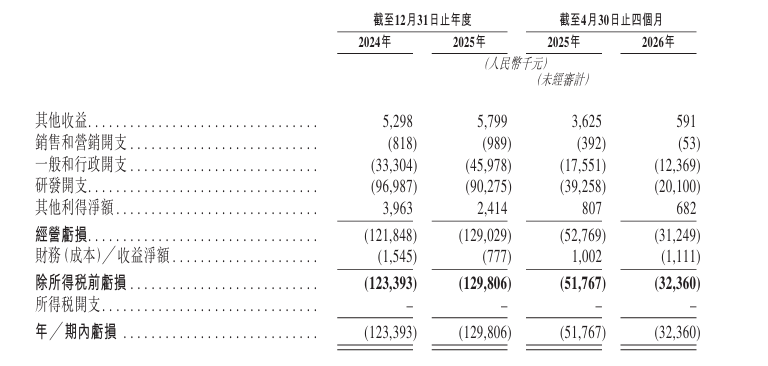
On the financial side, for the four months ending April 30 in 2024, 2025, and 2026, the company's other earnings were approximately RMB 5.298 million, RMB 579.9, and RMB 591,000, respectively; during the same period, the year/period losses were approximately RMB 123 million, RMB 130 million, and RMB 32.36 million, respectively.