


The Zhitong Finance App learned that due to strong global demand for artificial intelligence (AI) driving semiconductor shipments, South Korea's exports maintained strong growth in the first 20 days of October, highlighting that the Korean economy is still resilient as the Bank of Korea is about to announce interest rate decisions. According to data released by Korea Customs on Wednesday, exports increased 65.9% year-on-year in the first 20 days of October after adjusting for differences in working days. In comparison, the increase for the same period in September was 89.8%.
In the first 20 days of October, exports increased by 105.4%, imports increased by 42.8%, and the trade surplus reached 14.5 billion US dollars in the first 20 days of October. Total exports in the first 20 days of the month were US$61.6 billion; after exports reached US$71.4 billion in the same period in September, the growth momentum continued.
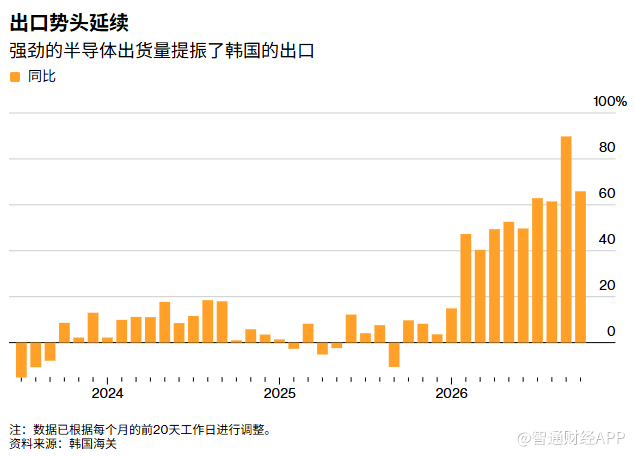
Since this year's Mid-Autumn Festival holiday was in September and last year was in October, the year-on-year data is biased. The workday-adjusted data better reflects potential trends.
The semiconductor industry remains the main engine of economic growth. Chip exports soared 222.5% from the same period last year to US$27.5 billion. Exports of petroleum products increased by 68.3%, while exports of automobiles increased by nearly 41%.
According to reports, exports of products such as semiconductors, automobiles, and batteries from South Korea occupy an important position in the global supply chain, and as a result, its export data is often regarded as a “canary” reflecting global trade trends and economic warmth.
These data further show that the boom in the semiconductor industry is supporting South Korea's economic growth while keeping inflation high. The data will also provide a key economic reference for the Bank of Korea's interest rate decision on Thursday. The market generally anticipates that the Bank of Korea will keep interest rates unchanged to weigh the impact of recent interest rate hikes.
The Bank of Korea raised the benchmark interest rate by 25 basis points to 3% in August, the second consecutive rate hike. Stronger than expected economic growth and continued high inflation prompted policymakers to take pre-emptive measures. Bank of Korea Governor Shin Hyun-song said that the central bank will maintain a tight monetary policy stance until it is convinced that the inflation rate will fall back to the target level of 2%.
South Korea's overall inflation rate in September fell back to 2.9% from 3.1% a month earlier, but it was still significantly higher than the central bank's target. Shin Hyun-song once said that the war in the Middle East and the AI boom are increasing inflationary pressure. Excluding volatile food and energy prices, the core inflation rate in September was 2.8%.
The strong performance of the Korean chip industry has boosted corporate profits and investment, but policymakers are still evaluating how widely these benefits can be transferred to household consumption and the broader domestic economy.
According to export destinations, South Korea's exports to China increased by 154.4% in the first 20 days of October, and exports to the US increased by 154.9%; exports to Malaysia and Singapore increased by 363.2% and 121.1%, respectively.