


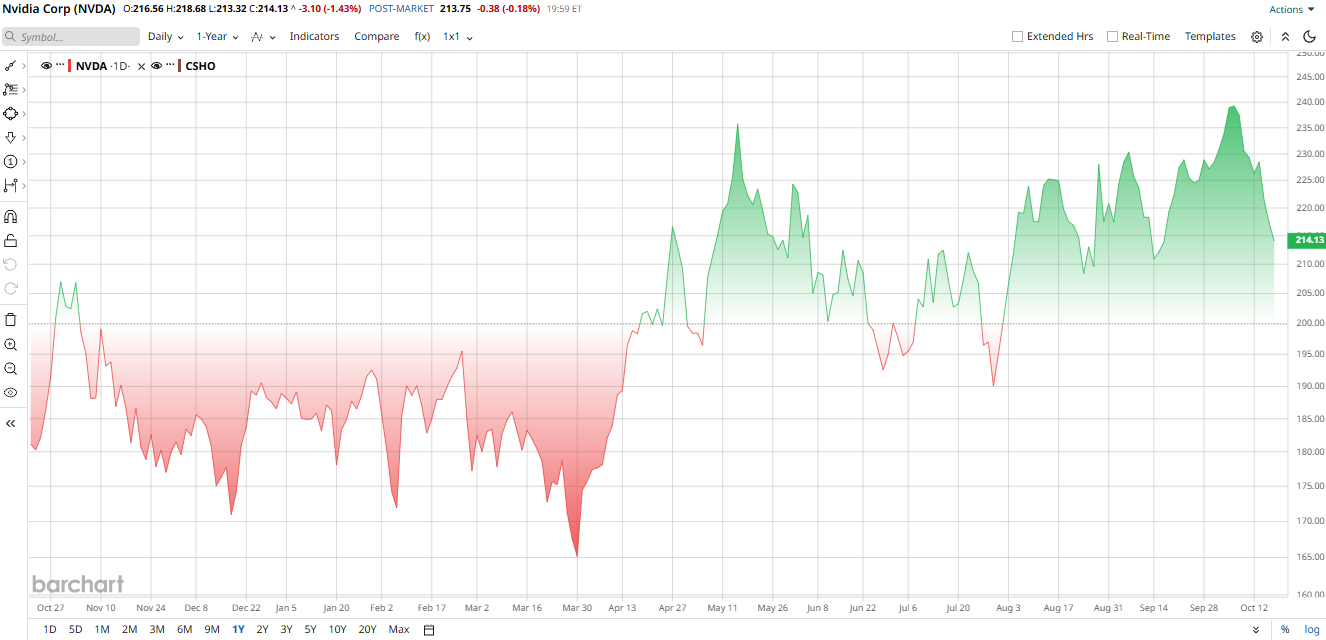
Nvidia (NVDA) stock just took a hit. The share price fell approximately 5% in two trading sessions in mid-October. Risk of AI debt and rising borrowing costs shook investor confidence in chips.
But Dan Ives is not rattled. The longtime tech analyst recently took a bullish stance on Nvidia, kept his ‘Outperform’ rating, and maintained his $300 price target. He called the selloff a buying opportunity. Ives says demand for Nvidia's AI chips still outruns supply. He points to a fiscal 2028 outlook of roughly 70% revenue growth. And he argues the Street still underestimates how far Nvidia's advantage runs beyond the GPU. That includes networking, full computing systems, and the CUDA software platform.
From my point of view, His logic is straightforward. This is not everything sold by others and funded on credit; a big part is sold on contracts and financed by cloud cash flow. So it's his take that it's a gift just for being down. But is he right? The numbers do tell a useful story.
A Rough October, but a Strong Year
Despite the recent selloff, Nvidia shares are still nearly 14% up year to date (YTD). However, there are only 3 months left till the end of the year, and these modest gains are not in line with the chip giant's usual track record. Nvidia finished 2025 with more than 39% gains, and 2024 with 170% higher.
But now the situation is different as an AI debt scare hits. CoreWeave (CRWV), a cloud provider Nvidia both supplies and backs, carries $50 billion in debt. Rising rates made investors nervous about the whole AI financing chain. Nvidia fell with the chip group.
It was notable, however, that the growth catalysts did not escape notice. For example, Morgan Stanley added Nvidia back to its list of top picks for semiconductors. Nvidia also increased its buyback up to $235 billion through fiscal 2028, following the raise of another $150 billion. The bad news is that the negatives are true, too. They're simply short-term looking.
Although Nvidia’s gains have slowed amid AI debt concerns, renewed analyst support and a massive buyback plan suggest the recent selloff may be creating an opportunity, particularly given its reasonable valuation relative to its own five-year average.
Nvidia trades at 28 times trailing earnings, compared with the industry's median of 24 times, but is giving a 47% discount from its own historical average. Its forward P/E of 22 also exceeds the sector median of 21. While the stock is not cheaper than its peers on these measures, its premium remains relatively modest. If Nvidia sustains strong earnings growth, that premium could be justified.
The stock seems reasonable to slightly undervalued, as the market prepares for rate cuts. But that's not the case according to Nvidia's own guidance.
The Quarter That Backs the Bull Case
Nvidia continues to benefit from the AI trend, and the company's second-quarter earnings highlight the lack of any signs of abating demand for artificial intelligence computing power.
Nvidia recorded $96.2 billion in revenue during the period, which is a 106% increase from the previous year's second quarter. The Data Center business continued to be its growth driver, with $89 billion coming from AI infrastructure, up 117%. The company's net income also skyrocketed, rising 126% from a year ago to $59.7 billion. Adjusted earnings per share grew 120% from a year ago to $2.22 from $1.01. Nvidia's free cash flow was $21.3 billion, and the company ended the quarter with $22.4 billion in cash and equivalents.
CEO Jensen Huang did not hold back. "AI has reached its inflection point," he said. "It's doing useful work. Its tokens are productive and profitable. Now, compute is revenue." Huang added that demand is accelerating. Vera Rubin is now in full production.
Management guided third-quarter revenue to $108.0 billion, plus or minus 2%. Nvidia expects revenue growth of approximately 70% for FY28, while fiscal 2027 revenue is projected to reach $411.7 billion, and earnings per share are expected to be nearly $9.31. Fiscal 2028 earnings per share are expected to be nearly $15.91, a 71% increase.
Wall Street Still Sees Big Upside
The Street is not backing away. Morgan Stanley keeps an Overweight rating and a $300 target. The firm points to Nvidia's new product cycle and growing demand from AI labs and agentic AI.
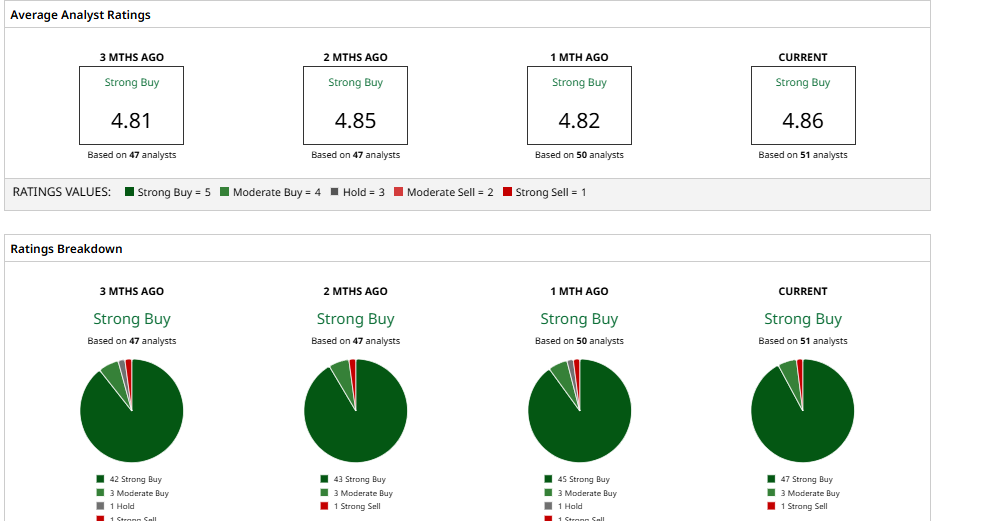
Similarly, Goldman Sachs also has a $300 target and a Buy rating. UBS sits at $300 as well. Cantor Fitzgerald is higher at $350, Raymond James lifted its target to $352, and BMO moved to $340. The consensus rating is “Strong Buy.” The average price target is $328. At that level, the stock could run more than 53% from today.
Basically, Ives crystallized the bull case. He noted Nvidia is still the cornerstone of the AI Revolution. The bear case is “customer concentration” and “AI debt”. Both matter, but not one of them has appeared on the scoreboard yet. Ives thinks that's not going to happen. The dip can be an opportunity to purchase a terrific company at an attractive price.
On the date of publication, Nauman Khan did not have (either directly or indirectly) positions in any of the securities mentioned in this article. All information and data in this article is solely for informational purposes. For more information please view the Barchart Disclosure Policy here.