


The Zhitong Finance App notes that due to the sell-off of US Treasury bonds and the rise in benchmark yields to decades-high levels, the US government is finding itself increasingly dependent on investors who “buy only if the price is right”.
The dominant composition of the world's largest bond market is evolving — over the past 20 years, driven by massive borrowing by the US federal government, the size of the market has increased sevenfold to $32 trillion.
Foreign governments, central banks, and pension funds have declined in importance compared to the past. These buyers respond less “conditionally” to prices, and have historically absorbed large amounts of risk-free securities in the traditional sense of the word. Although some of these institutions intend to reduce their holdings, they usually hold US debt for a long time. They can be called “slow money.”
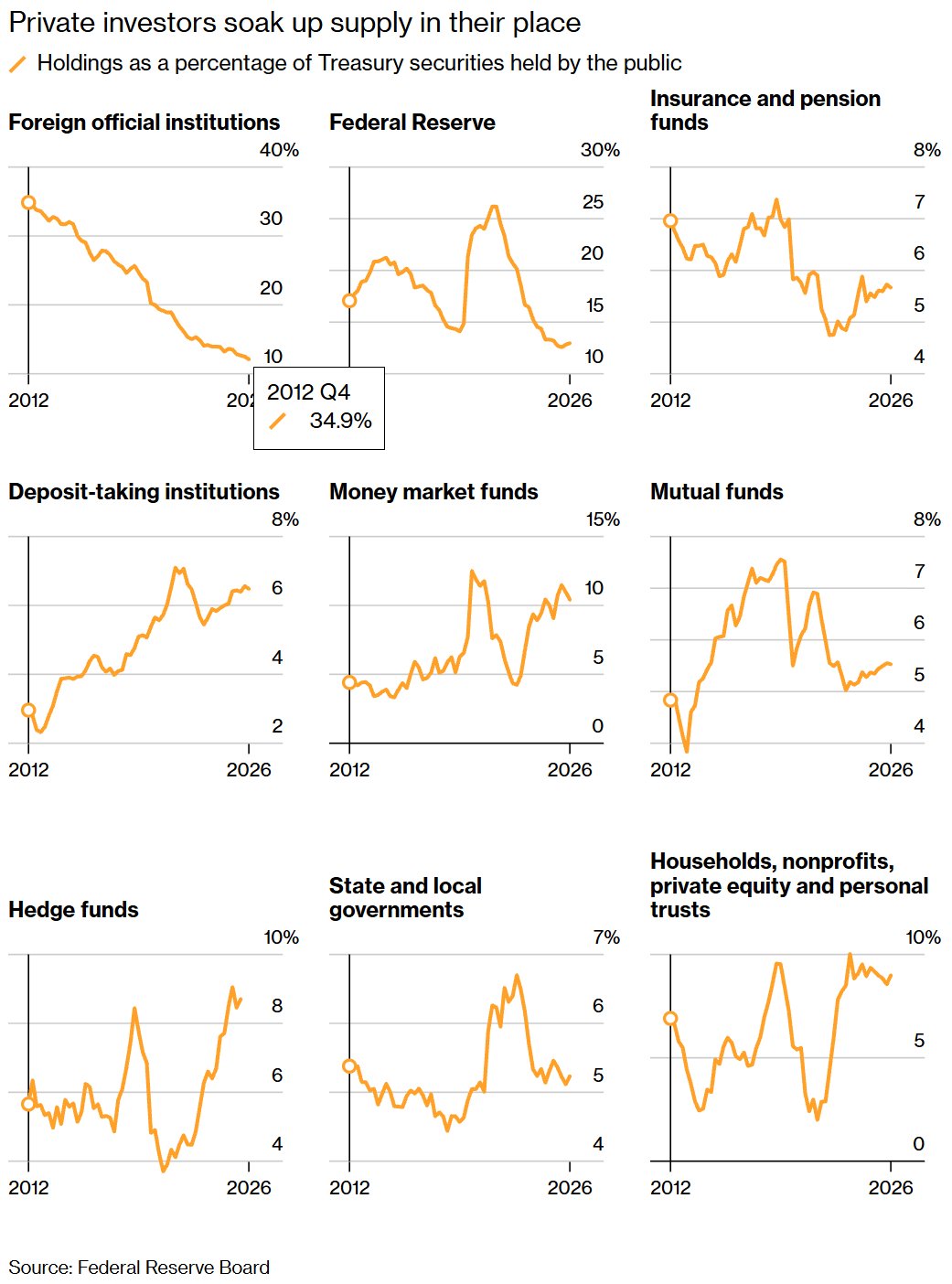
The central bank left room for more “fast money” buyers
Meanwhile, the footprints of private investors are expanding. They hold about 70% of federal debt, which is close to the highest level since 1990. Nearly one-tenth of the US bond market is a hedge fund — they also have other assets to choose from, and their use of leverage to extract market misalignment has drawn the attention of regulators to financial stability risks. In the process of chasing returns, this type of investor will turn away at the slightest whim. They are “quick money.”
For US Treasury Secretary Bessent, Federal Reserve Chairman Kevin Walsh, and others, the concern is that once these price-sensitive buyers suddenly panic about monetary policy, economic trends, the widening US deficit, or any presidential executive order, they will have more influence than ever before.
Admittedly, the US government can still find creditors to finance its expenses, but these investors are less reliable — and their capriciousness is driving higher yields.
According to Anshul Pradhan, head of US interest rate strategy at Barclays, this behavior reveals the true cost of US capital. “The investor base has become more critical.” “A market with a large number of price-insensitive buyers only requires relatively minor adjustments to absorb supply; a market that relies on private capital may require greater concessions.”
In the context of this year's bond market sell-off, this transformation is even more significant. Although this repricing is mainly driven by global factors, such as soaring oil prices and improved economic growth prospects, it has reignited concerns about US fiscal policy, while also driving up borrowing costs for businesses and individuals.
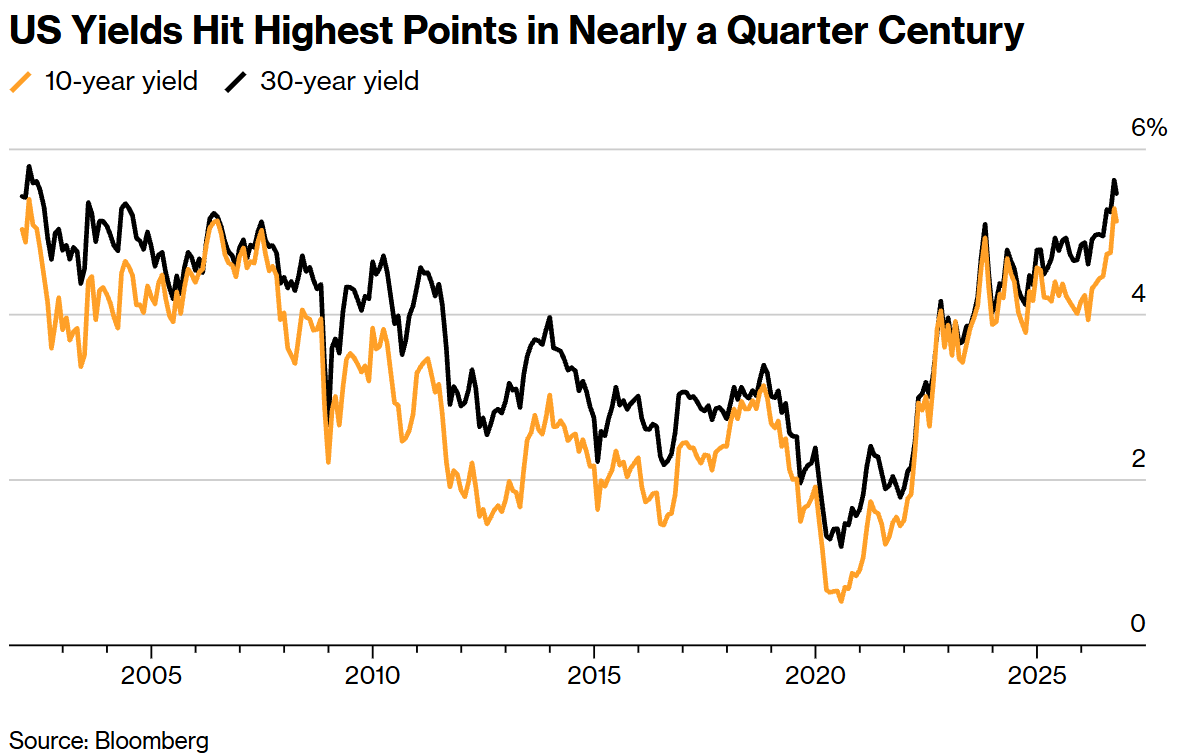
US Treasury yields hit a new high in nearly 25 years
An Australian state-level fund said last year that it is reducing its holdings of US debt due to concerns about US President Trump's tariff and tax plans. Meanwhile, in September of this year, Norges Bank of Norway Investment Management, a division of the Bank of Norway, proposed reducing its sovereign bond holdings, saying that other fixed income assets could bring better risk-adjusted returns.
At the same time, companies are issuing bonds on a record scale to finance the development of artificial intelligence and supporting infrastructure. This bet has fueled a frenzy in the stock market.
Unlike foreign central banks (which usually buy US bonds to manage national reserves and exchange rates), private investors prefer to sell US bonds and hold corporate bonds or stocks. Meanwhile, the Federal Reserve is no longer continuing to buy bonds as part of a quantitative easing program aimed at boosting the economy.
Paul Donovan, chief economist at UBS Global Wealth Management, said, “As investors, central bank officials are less volatile, partly because the range of assets they can buy is more limited,” and “the capricious, less constrained private sector has expanded its influence in the bond market.”
The exit of central banks — often viewed as one of the least price-sensitive buyers — made room for depository institutions, hedge funds, and other relatively price-sensitive investors.
Bloomberg Economic Research estimates that the decline in official positions of the Federal Reserve and foreign countries once added about 105 basis points to the term premium — the additional return required by investors due to the risk of holding 10-year US bonds (rather than holding short-term securities on a rolling basis) over the same period of time.
Another key source of demand for long-term bonds may be fading: corporate pension fund managers have enough money on hand to pay retirees, and are often closed to new members.
According to the Milliman 100 Pension Fund Adequacy Index, as of September, corporate pensions as a whole had about 114% of the required capital; in July 2020, these accounts had an adequate funding ratio of only 82%. As they profit from the stock market, they are motivated to limit risk by switching to bonds — the expected income from bonds can closely match their future liabilities to retirees.
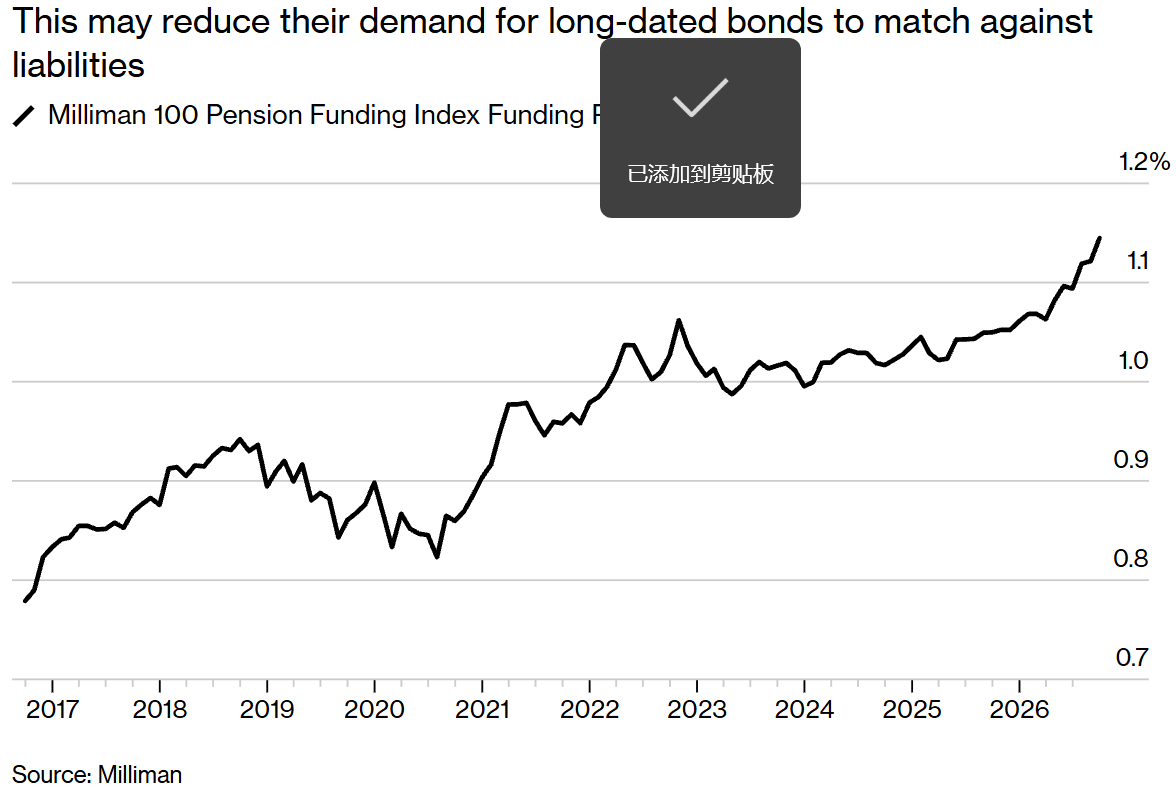
Many US pension funds are now well-funded
Citigroup interest rate strategist Jason Williams said that the weakening demand for pension funds may prompt the US Treasury to cut the issuance of long-term bonds and instead increase the issuance of short-term treasury notes.
Stephen Douglas, chief economist at NISA Investment Advisors, said, “The trend of corporate fixed income pensions has always been to freeze or close,” and “as a result, you are no longer accumulating new liabilities in the distant future.”
Federal Reserve researchers have noticed a rise in hedge funds' US bond holdings: between 2012 and 2025, these funds quadrupled their holdings, accounting for nearly one-fifth of their assets. They have absorbed US Treasury bonds faster than other US creditors. By the end of last year, hedge funds held about 8.5% (about 2.7 trillion US dollars) of outstanding US debt.
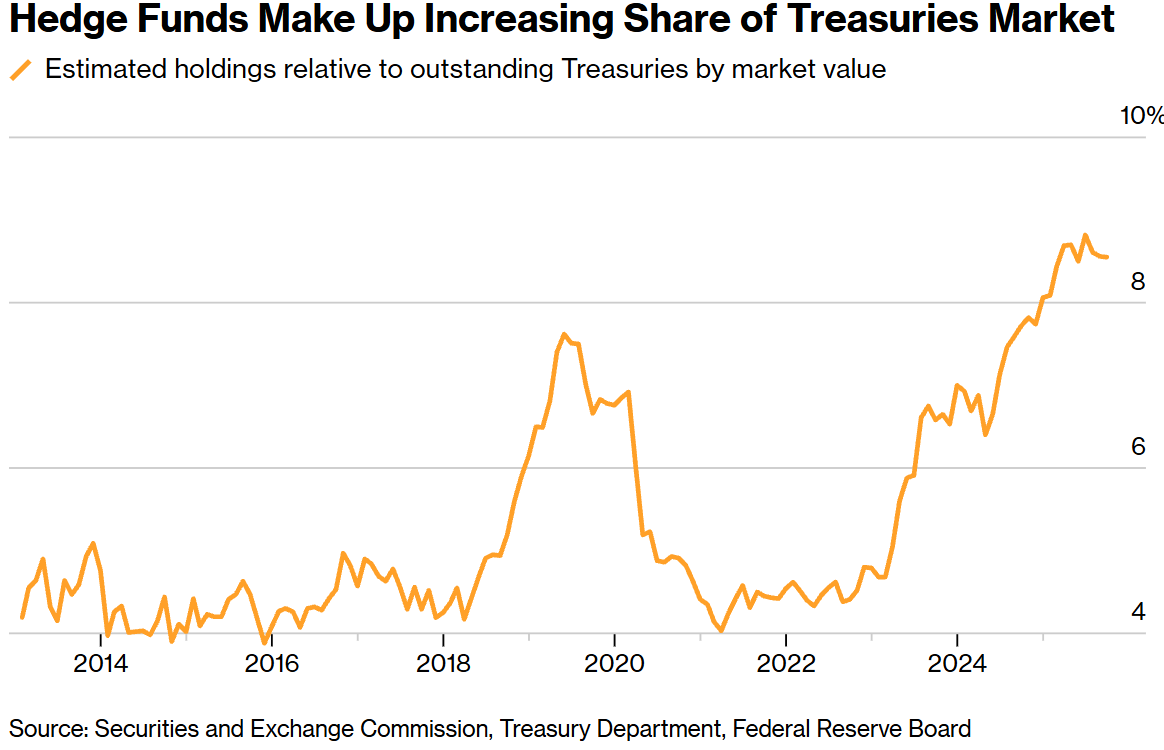
The share of hedge funds in the US bond market is increasing
This figure is particularly remarkable given the ability of hedge funds to act quickly, leverage their transactions, and be flexible in selling US bonds.
Some hedge fund transactions take advantage of the relative value of interest spreads between interest-rate ratios in the market. Typical examples include “base difference trading” and “swap spreads.” Macro hedge funds also bet on the direction of yield.
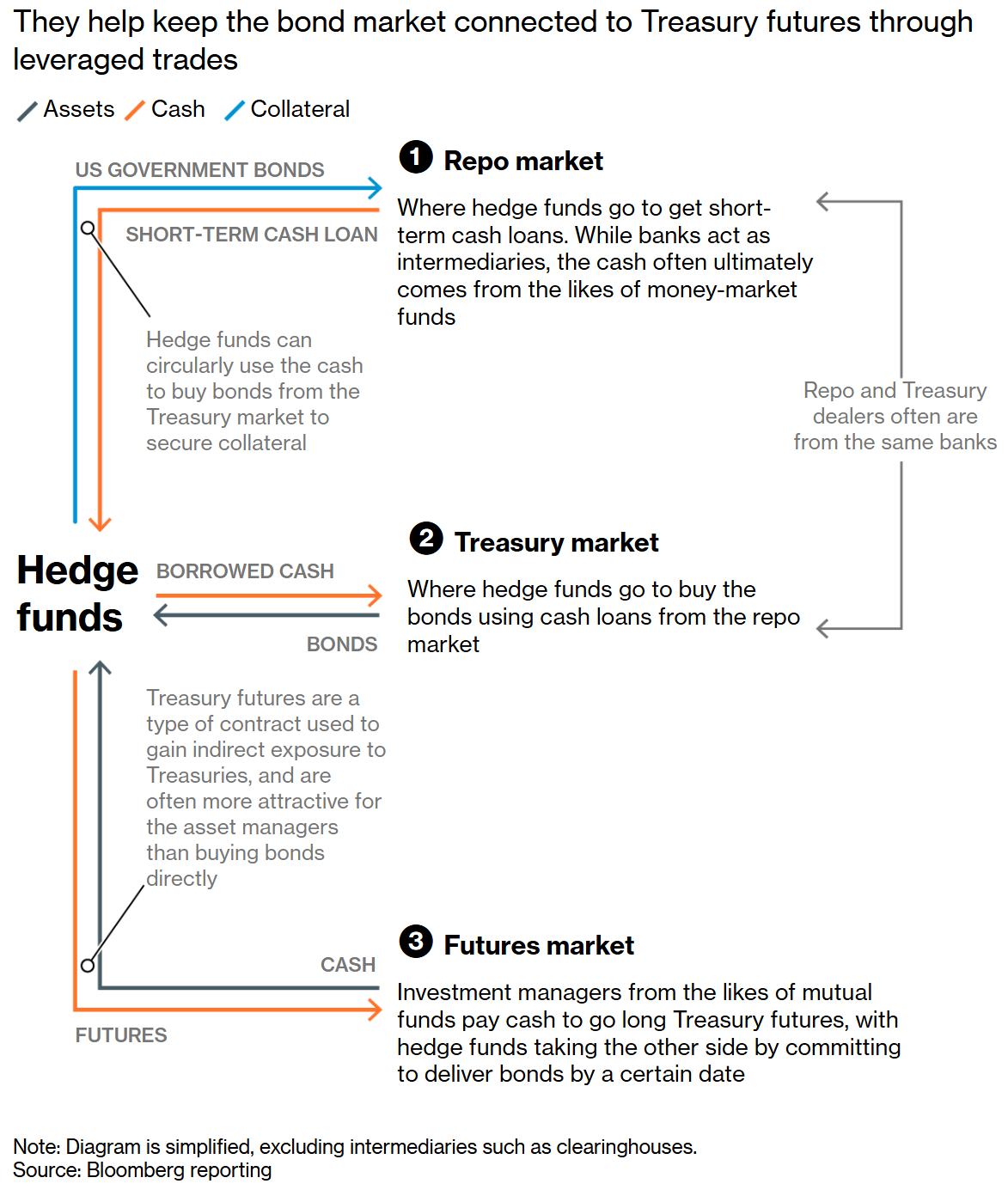
Hedge funds act as intermediaries in a complex treasury bond ecosystem
Steven Blitz, managing director of TS Lombard, said, “Leveraged buyers boosted demand and kept yields from rising too high,” referring to the funds' activities in swap spreads and base spreads. However, “once the repurchase rate jumps sharply, these positions will be liquidated, triggering a torrential sell-off of US bonds.”
To illustrate the potential threat to hedge fund holdings, market participants, regulators, and the Federal Reserve all mentioned March 2020 — when investors were selling bonds in exchange for cash on the eve of the pandemic lockdown. The sell-off impacted the hedge fund's spread trading positions and increased market volatility. However, the size of this deal has been shrinking in recent months, indicating that this leveraged strategy is currently not a concern.
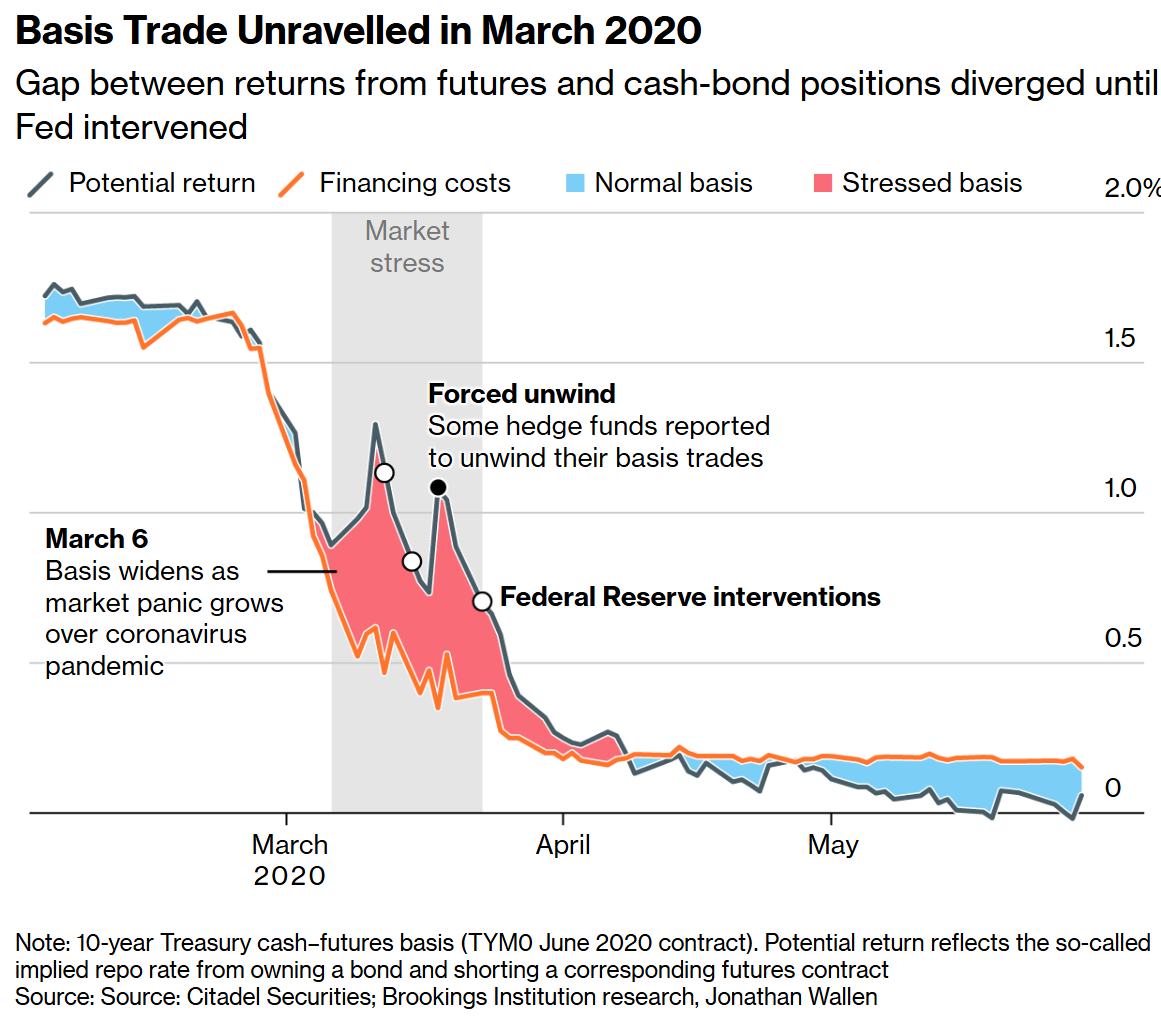
Spread trading collapsed in March 2020
Despite this, the deal highlights the field between “quick money” strategies and the strategies of major central banks such as the Federal Reserve — especially as price-sensitive investors increasingly occupy the market.
The TS Lombard team, headed by Alexandros Zenofontos, wrote, “The global bond market is adapting to a less tolerant group of buyers,” and “governments will still finance themselves, but increasingly at prices set by more self-determined investors.”