


Key Points
Apple remains a dominant force in consumer hardware and high-margin digital services.
Broadcom is leveraging significant demand for infrastructure software and artificial intelligence networking.
Which tech giant offers the best combination of growth and value for your portfolio?
As the technology landscape evolves, investors must decide between established consumer giants and the infrastructure providers powering the next era. Choosing between Apple (NASDAQ:AAPL) and Broadcom (NASDAQ:AVGO) depends on your specific goals.
Apple is defined by its integrated ecosystem of premium hardware and recurring service revenue. Broadcom focuses on the critical backend components that drive data centers and enterprise software. Both companies are central to the modern economy, but they serve very different niches for everyday investors.
The case for Apple
Apple operates a massive global business centered on its iconic hardware devices and growing suite of digital services. The company sells the iPhone, Mac, and iPad to a loyal global user base while expanding its reach through the App Store and Apple Pay. Its distribution model relies on a mix of direct retail sales and partnerships with cellular carriers that account for roughly 60% of its net sales.
In its latest annual report, filed for fiscal 2025, revenue reached nearly $416.2 billion, a 6.4% increase over the prior year. This growth was accompanied by robust net income of approximately $112 billion. The company maintained a net margin of 26.9%, showing its ability to convert a significant portion of its total sales into actual profit.
As of Apple's September 2025 balance sheet, the debt-to-equity ratio, which measures total debt divided by shareholder equity, was roughly 1.5. The current ratio, a measure of the ability to pay short-term bills with short-term assets, was approximately 0.9. Apple generated free cash flow, or cash from operations minus capital expenditures, of nearly $98.8 billion during the fiscal year.
The case for Broadcom
Broadcom has positioned itself as a titan among semiconductor stocks, providing essential networking and infrastructure software. The company reports high customer concentration, with its top five end customers accounting for approximately 40% of net revenue. Customer concentration like this adds a layer of risk to the business, as the loss of one major partner could significantly impact the bottom line.
In fiscal 2025, revenue reached approximately $63.9 billion, a substantial 23.9% increase from the previous fiscal year. This revenue jump led to net income of close to $23.1 billion for the period. Broadcom reported an impressive net margin of 36.2%, reflecting the high value of its proprietary semiconductor solutions and enterprise software contracts.
As of its November 2025 balance sheet, the company maintained a debt-to-equity ratio of roughly 0.8 and a current ratio of approximately 1.7. Free cash flow for the fiscal year was nearly $26.9 billion. Note that stock-based compensation accounted for roughly 27.5% of operating cash flow, inflating reported cash generation, since SBC is a non-cash expense added back in the cash flow statement.
Risk profile comparison
Apple faces significant macroeconomic and geopolitical risks, particularly regarding its reliance on global trade stability and manufacturing in regions like China. The company is also navigating intense antitrust scrutiny and litigation regarding its App Store and search licensing deals with Alphabet (NASDAQ:GOOGL) (NASDAQ:GOOG). Supply chain concentration remains a concern, as the company depends on limited sources for several critical hardware components.
Broadcom relies on a small number of distributors and end customers, making it vulnerable to any shift in demand from its largest partners. The company depends heavily on contract manufacturers, specifically Taiwan Semiconductor Manufacturing (NYSE:TSM), for the majority of its wafer production. Furthermore, legal disputes over software licensing with companies like AT&T (NYSE:T) and potential cyclicality in the artificial intelligence industry present ongoing challenges to its growth trajectory.
Valuation comparison
Broadcom appears more attractive based on future earnings estimates, while Apple offers a lower entry point when comparing its market price to its total sales volume.
| Metric | Apple | Broadcom |
|---|---|---|
| Forward P/E | 35.7 | 28.7 |
| P/S ratio | 10.7 | 17.9 |
Valuation metrics include sourcing from Financial Modeling Prep (FMP) and may differ from other data providers.
Which stock would I buy in 2026?
I'm a longtime Apple shareholder, so I'm a little biased here. (Just wanted to get that out of the way up front!)
That said, Broadcom has outperformed Apple in a major way over the past 10 years. Just because Apple was a good investment in my portfolio since I purchased it in 2012 (relative to my other stocks), doesn't mean it was the best investment.
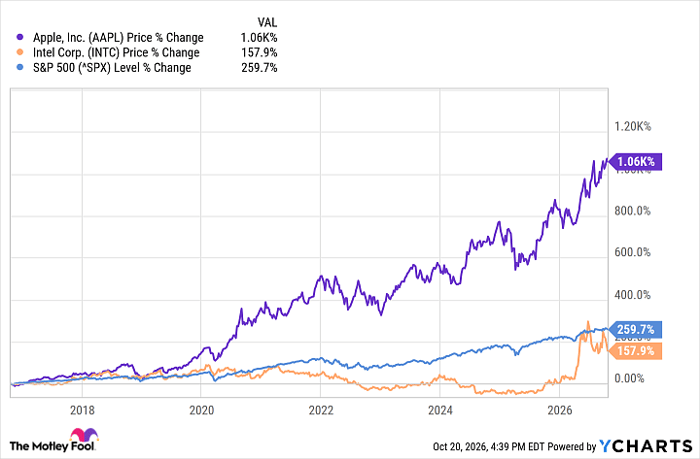
Of course, past performance is no indication of future results. Broadcom isn't guaranteed to continue posting impressive growth.
I think my main issue with Apple is that it's just so big, and it looks like it's closer to a potential ceiling than Broadcom. Both companies are valued in the trillions, but a $5 trillion market cap is kind of hard to wrap your head around. I wouldn't sell my Apple stock, but I don't think I would buy more at the moment (apart from the DRIP). I would prefer to buy shares of a company posting stronger growth, so Broadcom gets my vote here.
Erin Kennedy has positions in Apple and Taiwan Semiconductor Manufacturing. The Motley Fool has positions in and recommends Alphabet, Apple, Broadcom, and Taiwan Semiconductor Manufacturing. The Motley Fool has a disclosure policy.