


The Zhitong Finance App learned that the prospects for the strongest El Niño cycle in history are prompting more and more capital managers to compete to prepare their portfolios to deal with what they call the impending shock.
This climatic phenomenon, associated with the warming of seawater in the equatorial Pacific Ocean, is exacerbating droughts and floods that damage crops. Food commodity prices are rising, and economists are revising their forecasts for inflation and deficits. These effects are being transmitted to markets already pressured by high debt levels and rising borrowing costs.
Katie Self, portfolio manager at Pictet Asset Management (Pictet Asset Management), said that no corner of the global asset market is completely immune to the current El Niño cycle.
“This has almost become a definitive judgment: this will be the most extreme El Niño phenomenon in history,” Self said in an interview. Figuring out how to deal with the disturbances ahead is now “definitely” a priority.
Man Group (Man Group), the world's largest listed hedge fund, warned in July that everything from grid infrastructure to metals and fertilizers could be targets for El Niño. T. Rowe Price said it has moved to a custom model to protect its $165 billion portfolio of emerging market bonds and stocks from El Niño. Earlier reports said that as El Niño intensifies, many boutique hedge funds are constructing complete investment logic around this weather cycle.
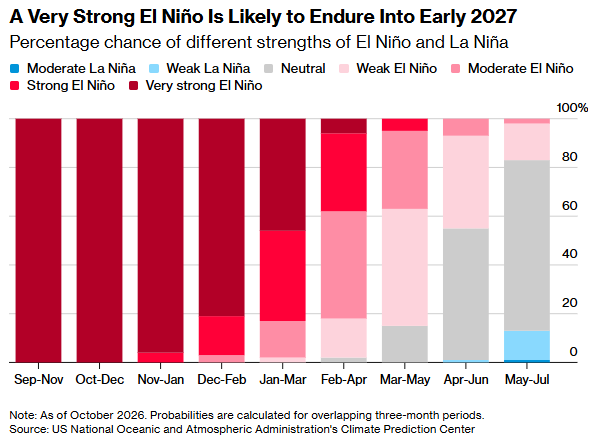
One major concern is that El Niño will impact a market already under multiple pressures, including increasing reliance on debt, rising interest rates, and sudden sell-offs from investors.
Kamesh Korangi and Rose Choy, analysts at the Anthropocene Fixed Income Institute (Anthropocene Fixed Income Institute), wrote in a report this week that compared to the previous El Niño phase, “the current macro background is different” and “higher interest rates, higher debt, and greater volatility.” The two identified Indonesia, Brazil, and Colombia as the most vulnerable sovereign states, and a “global spillover effect” is likely the end result.
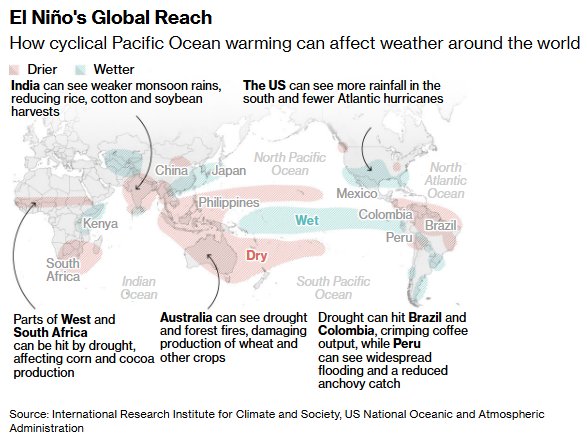
Although El Niño is associated with the Pacific, investors need to understand that “its ripple effect is completely global,” Self said. Together with her team, she manages the $5.1 billion Patek Global Environmental Opportunity Fund. “There's no place in the world that doesn't feel some kind of ripple effect from El Niño.”
Strategies to deal with forward shocks include betting on interest rates linked to El Niño's drive for higher inflation. The impact of this weather phenomenon on the energy market is also becoming a key deal in the coming months.
“Winter is the season when these forces — climate, geopolitics, and structure — are most likely to converge intensively,” Zulfiqar Ali, founder and chief investment officer of energy commodities trading hedge fund ZAMS Asset Management, said in an interview last month. This has created an “unusually rich alpha environment” for managers who “have analytical strengths and risk discipline to navigate it.”
At Patek, Self said she and her team are looking for companies that design technology to help cope with extreme weather patterns caused by El Niño. Examples include smart irrigation equipment suppliers, solutions to help plant roots prolong in arid conditions, and stormwater drainage and flood control systems.
“El Niño is a superimposed factor,” Self said. This weather cycle itself isn't new, but “it's happening now above a warmer benchmark.” These two forces “will interact and influence each other, making the situation significantly worse.”
The physical effects of El Niño are already making headlines. Southeast Asian countries have been dealing with extreme air pollution caused by forest fires. India experienced its weakest monsoon in more than a decade. People across South America are now facing severe flooding and water shortages at the same time, disrupting their farming capacity.
Self said the type of resilience or adaptation needed is “very broad.” “It's a truly comprehensive global phenomenon.”