


The Zhitong Finance App learned that with the boom in artificial intelligence (AI) infrastructure investment driving the rising demand for data center network equipment, Nokia (NOK.US)'s profit for the third quarter exceeded expectations. According to financial reports, Nokia's Q3 revenue increased 10% year over year to 5.154 billion euros; adjusted operating profit increased 35% year over year to 605 million euros, far exceeding analysts' general expectations of 454 million euros.
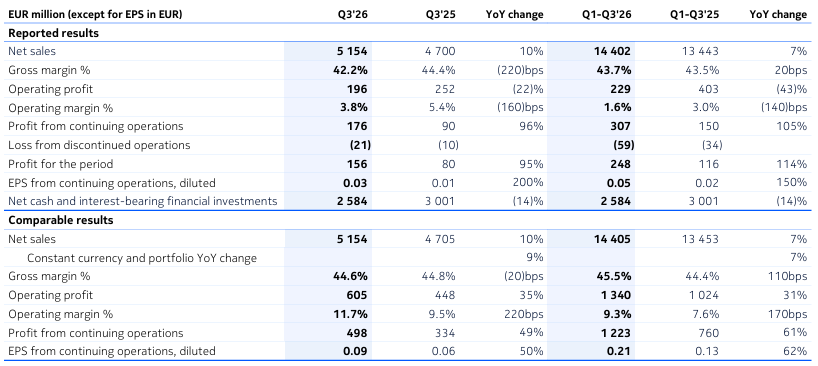
This increase in performance was due to the delivery of part of the backlog of data center equipment orders. Demand from traditional telecom customers is expected to continue to be sluggish due to the slowdown in 5G network construction, and CEO Justin Hotard is focusing on building the data center into Nokia's new growth pillar. Last year, he launched a development strategy based on the AI infrastructure boom and simultaneously initiated restructuring. Since then, Nokia has divested many businesses. Nokia said these adjustments are expected to drive double-digit growth in operating profits over the next few years.
According to the data, Q3 sales of the network infrastructure division, which covers the AI data center connectivity business, increased 15% year over year to 1,829 billion euros. Among them, sales of the optical network business increased 18% year over year to 933 million euros; sales of the IP network business increased 43% year over year to 3.839 billion euros. The mobile infrastructure segment, which covers traditional mobile device businesses, saw a 5% year-on-year increase in sales to 2,902 billion euros.
However, the rapid expansion of AI infrastructure has also brought challenges to device manufacturers. The supply of components such as memory chips has been limited, and prices have risen accordingly. Competitor Ericsson (ERIC.US) said the company has mitigated this impact, thanks in part to customers purchasing ahead of time during contract negotiations to cope with anticipated price increases.
The core of Nokia's counterattack is that it has stepped on the cusp of an explosion in the optical communications industry. As humans move into the AI era, AI models, autonomous driving, and physical intelligence place higher demands on the speed, capacity, and stability of data transmission, and traditional electrical signal transmission methods have reached the physical limit. However, optical communication uses optical signals to transmit information, which can be transmitted with high bandwidth and low latency. It can also reduce energy consumption in long-distance, high-capacity transmission, and become a “highway” for transporting AI computing power.
This giant, which once dominated the mobile phone market, is fighting back as a leading telecommunications and AI infrastructure leader after leaving the mobile phone business for more than ten years. Nokia has now transformed into the world's second-largest telecommunications equipment provider, and occupies a central position in the fields of 5G patents, optical communications, and computing power networks. The company holds a large number of 5G core patents; the share of optical communication equipment ranks among the highest in the world, providing network infrastructure for more than 130 countries around the world, and mainstream cloud service providers in North America mostly use their optical transmission solutions.
Nokia completed its transformation into AI and cloud infrastructure through a series of acquisitions. In 2016, Nokia acquired Alcatel-Lucent for 15.6 billion euros and obtained a core patent from Bell Labs, making it the second largest supplier of optical network equipment in the world; in 2024, it “whales” the optical network equipment manufacturer Infinera with 2.3 billion US dollars, thus forming a full chain layout from DCN to DCI to optical transmission.
Furthermore, in October of last year, Nokia received a strategic investment of 1 billion US dollars from Nvidia (NVDA.US). The two sides cooperated with AI-RAN smart base stations to upgrade the communication network to edge computing power scheduling nodes, which directly opened up space for Nokia's growth in the AI era. The mobile network device jointly developed by the two sides uses advanced chips from this American chip manufacturer, rather than relying entirely on special chips that have been used in traditional telecommunication networks for a long time. The partnership is part of Justin Hotard's broader strategy to prepare Nokia for the future — when AI computing will no longer be limited to data centers, but further extended to communications networks. With optical modules, data center connectivity, and 5G-A/6G technology layout, Nokia is becoming a key builder of the “highway” of computing power in the AI era.