


The Zhitong Finance App learned that with the accelerated penetration of emerging technologies such as artificial intelligence, big data, and embodied intelligence, the competitive paradigm in the manufacturing industry is undergoing a structural shift.
For a long time in the past, the core competitiveness of manufacturing companies focused on low-cost labor, supply chain efficiency, and large-scale production. Essentially, the growth logic of “exchanging costs for orders”. But as the demographic structure changes, supply chain restructuring, and global competition intensifies, the marginal benefits of this logic are diminishing — there is less and less room to gain an advantage by simply reducing costs, and the focus of competition is shifting towards production yield, response speed, and quality control. Looking further, new intelligent, digital, and flexible production lines are changing from “optional” to “mandatory”, becoming the core carrier of the new manufacturing paradigm.
Behind this shift is a change in the demand structure. Consumer fragmentation and accelerated product iteration have made it more and more difficult for factories to rely on a rigid production line to get through all orders; at the same time, the complexity of products such as new energy vehicles, semiconductors, optoelectronics, and high-end equipment continues to rise, the process chain is longer, and there is less room for fault tolerance. Any batch quality accident can cause huge loss of profit.
Because of this, when AI enters a factory, the key is not how ambitious the concept is, but whether data and algorithms can be embedded into specific production processes to make the production line more flexible and intelligent.
Recently, Weiyi Intelligent Manufacturing (03275) has opened a stock offering between October 20 and October 23. The sale price range is HK$16.63 to HK$21.46 per share. It is expected to be listed on the main board of the Stock Exchange on October 28. Unlike many embodied smart companies that are stuck at the conceptual level, Weiyi Intelligent Manufacturing has adopted a more pragmatic approach: the product form is determined by the environment and task. In the industrial scenario, whatever is efficient and can be calculated, it uses whatever form.
This outcome-oriented approach makes it easier for companies to capture the most realistic demands of the manufacturing industry. More importantly, in addition to solving individual pain points, the company also uses a “physical AI brain” technology system to turn single pain points into replicable products, thus forming a growth path from 1 to N.
Intelligent inspection and polishing robot: accurate recognition+real-time feedback, multi-process collaboration to improve production line efficiency
The product capabilities of Weiyi Intelligent Manufacturing can be thoroughly observed from their specific applications.
In the automotive manufacturing process, process upgrades have also brought about new quality control issues. The front cabin, rear floor, battery tray, and subframe, which used to be assembled and welded from multiple parts, can now be die-cast in one go. This not only brings the advantages of weight reduction and structural strength, but also makes quality standards more stringent: in the past, when quality problems were detected, only partial parts could be replaced, but now entire large die-castings have to be scrapped.
Weiyi Intelligent Manufacturing's industrial intelligent inspection and polishing robot now combines the two processes of inspection and polishing to significantly improve the output efficiency of the production line and meet the needs of one-stop flexible manufacturing. In the inspection process, the robot integrates sensing, decision-making and execution: planning the optimal motion trajectory in real time, accurately controlling the rapid movement of the end, and capturing defects in high definition in a flying state, achieving all-round and accurate detection of minor problems such as burrs, cracks, and oil stains.
The system uses self-developed algorithms to restore defects on 2D images to physical space coordinates in real time. The robot then independently planned the path, completed flexible polishing and secondary re-inspection, and achieved a closed loop throughout the entire process from inspection to repair.
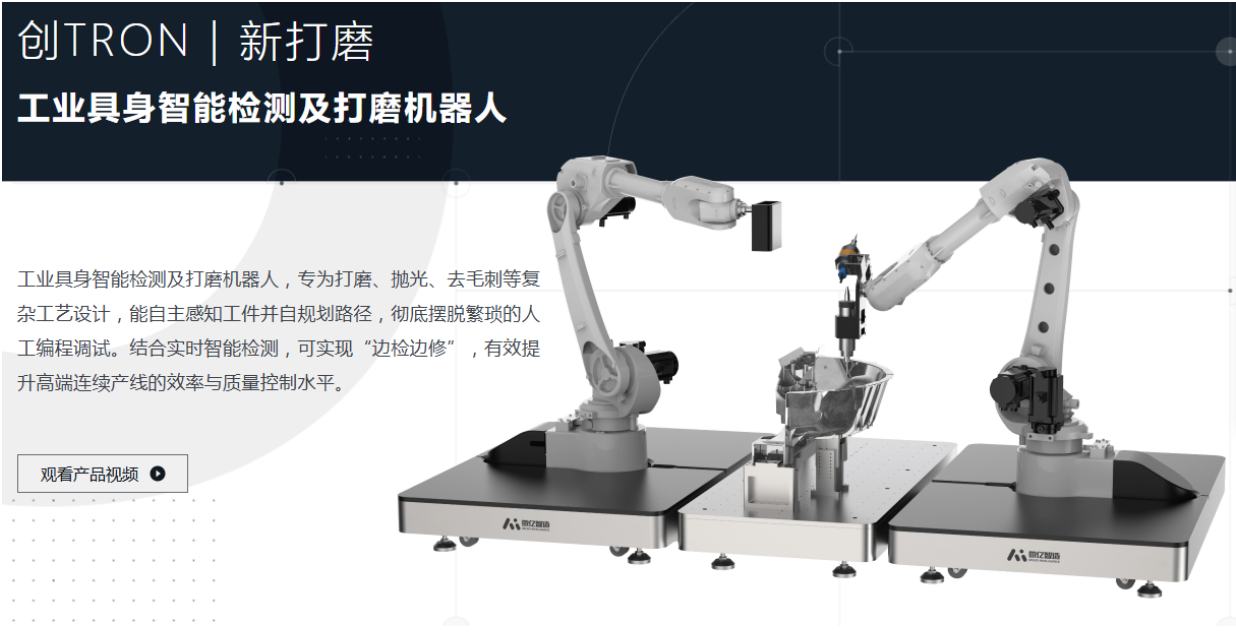
(Industrial self-contained intelligent inspection and polishing robot, source: the company's official website)
Furthermore, its ability to sense and understand can independently identify the shape of the workpiece and the area to be processed, reduce the product introduction and debugging time to a few minutes, and adapt to the rapid switching of various types of workpieces. For car companies and manufacturers, this means that model changes no longer rely entirely on repeated teachings from engineers, and equipment is no longer left idle because a product is discontinued.
As industry evolves intelligently, the evolution from single-process products to multi-process collaboration will become an industry trend. The traditional separation model makes it difficult for factories to achieve overall scheduling, and can only rely on manual transmission of judgment in the middle. However, as industrial intelligent robots achieve multi-process collaboration, data can also be fed back in real time in different production processes to achieve “inspection and repair”, so that quality control can be intercepted and moved to process intervention after being carried out, thereby reducing rhythm, reducing rework and scrapping, and reducing replacement and commissioning costs.
As Weiyi Intelligent Manufacturing integrates distributed processes into a one-stop solution that can be replicated and iterated, it can not only increase the value of individual projects, but also promote the gradual transformation of the company's delivery logic from a project system to a platform type.
Smart and flexible production line: flexible to meet diverse order requirements
Looking forward to the future, from rigid production to flexible intelligent manufacturing, it is the next threshold for the manufacturing industry. The value of traditional automation is to reduce the efficiency and cost of a single product to the extreme, but the shortcomings are also obvious. “One machine, one solution, one person, one program” makes every project have to redesign the mechanical structure, electrical architecture, and control procedures, and engineers spend a lot of time on repeated adaptation.
The significance of flexible manufacturing is to drastically reduce conversion costs on the premise of retaining automation efficiency, so that production lines can quickly adapt to order fluctuations. As demand for multi-variety, small-batch, and rapid iteration manufacturing increases in the market, flexible manufacturing can be dynamically adjusted according to orders, and process modules can be combined like assembling LEGO, greatly improving the factory's ability to accept different orders. In the context of order fragmentation becoming the norm, flexibility is not only a technical upgrade at the production line level, but also a prerequisite for manufacturing enterprises to enter the market and expand customers.
The “MicroFlex” intelligent flexible production line recently released by Weiyi Intelligent Manufacturing is designed around this kind of demand. “MicroFlex” uses an AI brain to simultaneously dispatch multiple industrial intelligent robots to complete multi-task collaboration such as loading and unloading, quality inspection, polishing, rewelding, and gluing. Each robot relies on AI to independently drive perception, decision making and execution. It can not only switch between stand-alone multi-tasks as needed, but also support continuous mixed production of multiple categories, providing an efficient and highly reliable one-stop flexible manufacturing solution.
This collaborative architecture has a higher fault tolerance rate when dealing with production line disturbances, order insertion, and equipment abnormalities. It is also closer to the operating state of frequent changes in orders and continuous fluctuations in operating conditions in actual factories.
As the core carrier of the “smart micro factory” paradigm, the “MicroFlex” intelligent flexible production line satisfies developed economies' demands for a new type of manufacturing with high efficiency and high space utilization, and is expected to be quickly replicated and promoted to overseas regions such as Europe, Singapore, and Japan.
A set of “physical AI brains” to achieve “1 to N” cross-scene reuse
From defect detection to polishing and repair, to applications such as flexible production lines, etc., each type of application scenario may seem different, but behind it is the same set of underlying capabilities to achieve cross-scene reuse.
Weiyi's “physical AI brain” combines AI models, industrial know-how, and real scene data, and introduces “fast and slow thinking” and “humans in the loop” mechanisms.
In everyday work scenarios, “quick thinking” is used for immediate, real-time action. Through the cloud-based human-computer interaction system, human expert process knowledge is quickly injected to solve the “cold start” problem, so that EIIR products can be put into operation within a few days after installation.
“Slow thinking” is geared towards long-term evolution. Human experts organize, clean, and label the data generated during the “quick thinking” phase, transform it into high-quality training data, continuously feed back the cloud model iteration, and promote the evolution of the system to higher autonomy.
The “end-edge-cloud” integrated architecture enables robots to sense, learn, make decisions, and execute: the cloud provides an intelligent engine that continues to evolve, the edge makes fully autonomous intelligent decisions, and the end side achieves accurate physical execution.
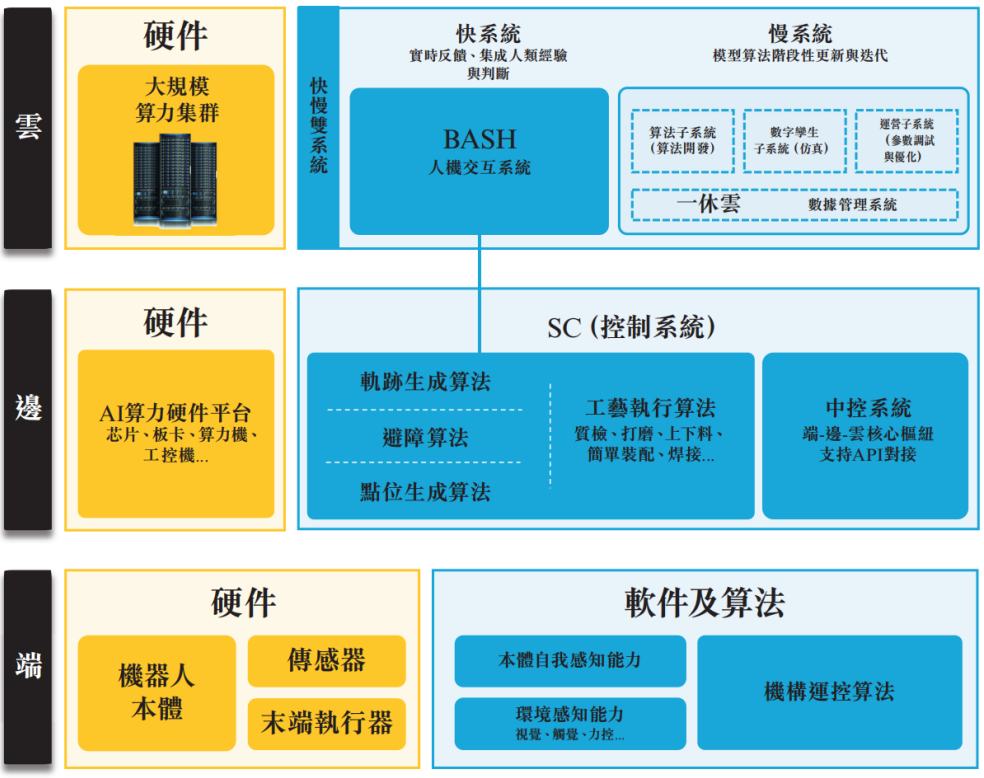
(Cloud, edge, and terminal architecture, source: post-hearing data collection)
Up to now, the company has accumulated the largest unstructured precision standard industrial database in the industry, with more than 23 TB of data and more than 1.6 billion precision data records, far exceeding the data scale of less than 5 TB for most similar companies, providing a foundation for model reuse and cross-industry adaptation.
The more robots work, the more high-quality data they obtain, the faster they learn and evolve, and the stronger their intelligence and autonomy. They form a forward flywheel of “data - model - product - redeployment”, and move physical intelligence from “single point of use” to “replicable, iterable, and scalable.”
In the future, industrial embodied intelligence will not be deployed simultaneously in all scenarios, but will take the lead in breaking through high-value single links and gradually promoting multiple sites and multiple factories in a single factory. Judging from Weiyi Intelligent Manufacturing's financial data, the company's revenue continued to grow from 434 million yuan to 796 million yuan from 2023 to 2025. In the past, the revenue structure, which mainly focused on single-process EIIR products, was skewed towards multi-process EIIR products that integrated testing, polishing, and sorting, which also reflected this development trend.
Summarize
Overall, the advantages of Weiyi Intelligent Manufacturing can be summed up in one sentence: using outcome-oriented product ideas to cut into real industrial pain points, and then using the underlying capabilities of the “physical AI brain” to transform a single breakthrough into a replicable growth curve.
The large-scale problems industrial AI has faced for a long time are that scenarios are highly scattered, demand is highly non-standard, and single-point delivery makes it difficult to dilute R&D costs. Meanwhile, Weiyi Intelligent Manufacturing chose to use a physical AI brain as the base, analyze multi-modal information using an industrial VLA model, settle the process using a vertical expert model, and then solve the problems of cold start and continuous iteration through “fast and slow thinking+humans in the loop” and “cloud-edge-end” architectures, drastically reducing the traditional delivery process that took several months. The accumulation of over 23 TB and 1.6 billion pieces of precision standard data is the foundation for forming a positive “data-model-deployment” cycle. As models continue to be iteratively optimized and the ability to migrate and reuse across scenarios increases, the cost of entering new scenarios will decrease accordingly.
As far as the smart industry is concerned, what really determines the speed of popularization is not the popularity of the concept, but whether the technology can actually be transformed into production line productivity that can be tested, repurchased, and scaled up. In this sense, what Weiyi Intelligent Manufacturing has verified is not only a company's growth path, but also a possible solution for industrial embodied intelligence to move from “single point of use” to “large-scale implementation.”