


- Black Hills Corp. reported that its Arkansas natural gas utility subsidiary previously secured Arkansas Public Service Commission approval for new rates, supporting recovery of about $147 million of system investments and funding operating costs to serve more than 189,000 customers, with roughly $17.9 million in additional annual revenue authorized on a 9.8% allowed return on equity.
- The approved rate structure, with a 47.5% equity and 52.5% debt capitalization mix, provides investors with a clearer view of how Black Hills plans to fund its Arkansas gas infrastructure and recoup those capital outlays over time.
- Attention now centers on how Black Hills' broader investment narrative incorporates this Arkansas rate approval, including the roughly $17.9 million increase in regulated revenue.
What Is Black Hills' Investment Narrative?
To own Black Hills, you need to be comfortable with a regulated utility that leans on steady, approved returns while carrying meaningful capital needs. The Arkansas rate decision fits that script. It gives clarity on recovering about $147 million of gas infrastructure spending and sets a 9.8% allowed return on equity with a 47.5% equity and 52.5% debt mix. That supports the short term story of predictable cash inflows from regulated assets, even as the utility side of the business remains capital intensive and dependent on regulators to keep projects economically sensible.
The bigger picture extends beyond one state filing. Black Hills is a combined electric and gas utility with more than 1.1 million gas customers, 1,386 megawatts of generation and thousands of miles of wires and pipes that all require ongoing investment. Forecasts point to revenue growth of 20.3% a year and earnings growth of 26.5% a year, which makes execution on projects and cost control the real swing factors. At the same time, interest costs are not well covered by earnings and the 3.58% dividend is not well supported by free cash flow. As a result, the balance between funding growth, servicing debt and paying shareholders remains tight.
Yet there is a less comfortable side to the Black Hills story that only really shows up when you look at ...
There's only one way to know the right time to buy, sell or hold Black Hills. Head to Simply Wall St's company report for the latest analysis of Black Hills's Fair Value.
Exploring Other Perspectives
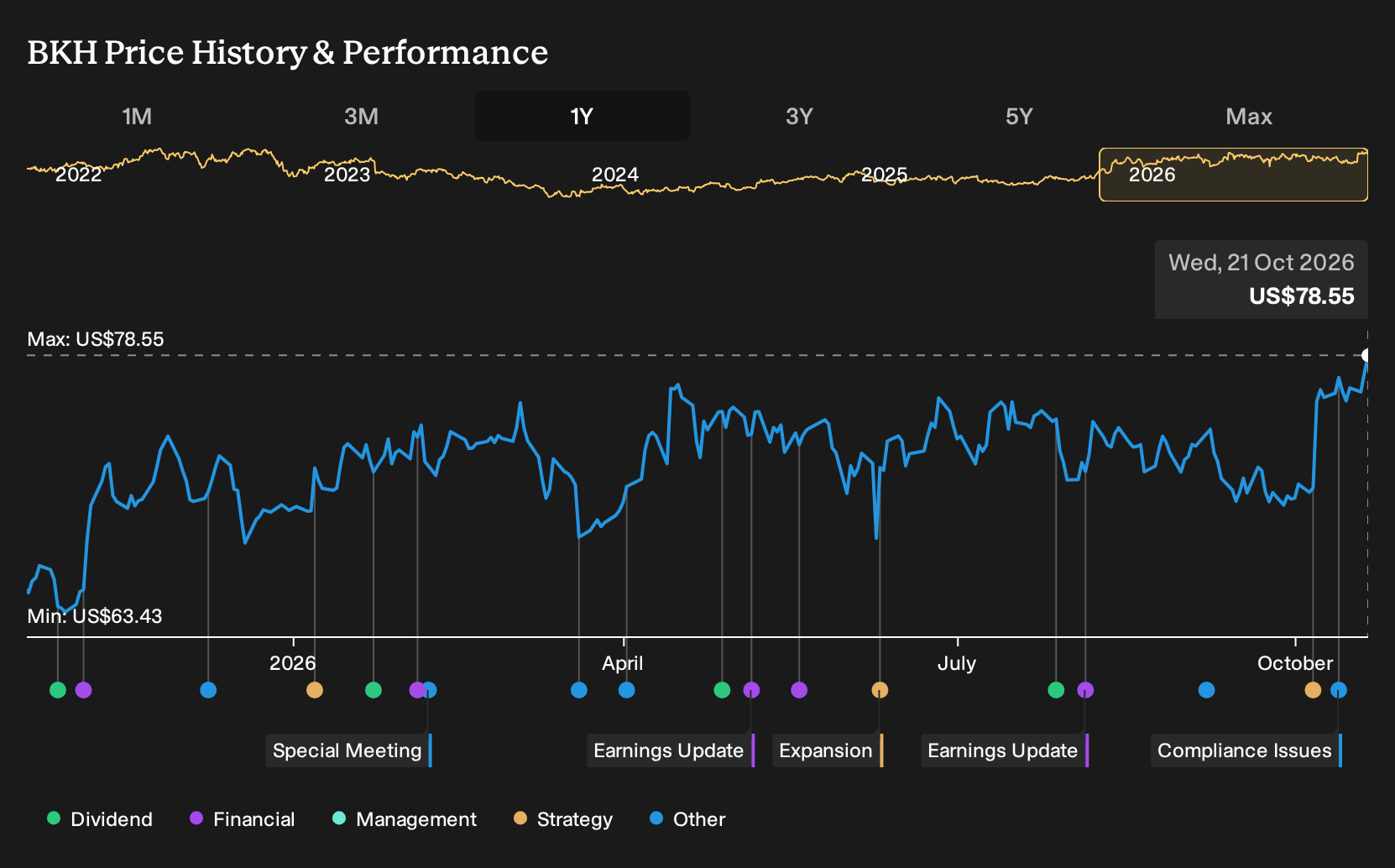
Two fair value estimates from the Simply Wall St Community cluster between about US$66.88 and US$86.64 per share, which already shows how far opinions on Black Hills can stretch. Those views were set before the Arkansas rate approval, so you are weighing fresh regulated revenue clarity against existing models. Other retail investors may see that trade off differently and use it as a cue to compare several alternative viewpoints.
Explore another Black Hills fair value estimate, including one that suggests up to 10% upside from the current price.
Reach Your Own Conclusion
Don't just follow the ticker. Dig into the data and build a conviction that's truly your own.
- A great starting point for your Black Hills research is our analysis highlighting 3 key rewards and 2 important warning signs that could impact your investment decision.
- See our latest analysis for Black Hills. The report includes a comprehensive fundamental analysis summarized in a single visual, the Snowflake, making it easy to evaluate Black Hills' overall financial health at a glance.
Looking For More Investment Ideas Beyond Black Hills?
Once you understand where Black Hills fits in your portfolio, it can help to compare it with other companies that target different mixes of quality, yield and risk. The Simply Wall St Screener lets you line those options up side by side so you can focus on the traits that matter most to you.
- If capital preservation is your priority, start with a 31 resilient stocks with low risk scores that aim to keep business volatility and financial strain relatively contained.
- If income is front of mind, weigh Black Hills against a set of 7 dividend fortresses that focus on higher yields supported by regulated or recurring cash flows.
- If you are hunting for opportunities that the wider market may not be watching closely, scan a 21 high quality undiscovered gems that pair strong fundamentals with lower visibility.
Have feedback on this article? Concerned about the content? Get in touch with us directly. Alternatively, email editorial-team@simplywallst.com