


The Zhitong Finance App noticed that the oil market was suddenly driven by a divergence between futures prices and spot prices. This divergence is reflected in two versions of Brent crude oil that have received much attention.
Over the past few weeks, Brent futures, with multi-billion dollar contracts changing hands every day, have risen by about $10 per barrel, hitting a five-month high of nearly $112. The driving factor behind this wave of gains is that traders are trying to determine whether the US will escalate the war against Iran after the general election, while Saudi Arabia was attacked by the Houthis because the Yemeni armed group, the Houthis, once closed the country's key western export pipeline.
However, spot Brent (Immediate Brent) experienced a sharp drop — a quotation benchmark used to assess the physical value of crude oil in the real world and is critical for global spot commodity traders. It is currently close to $120 and has dropped around $15 in less than two weeks. Similar benchmark prices in the Middle East have also declined.
Despite falling from extremely high levels, there are quite a few factors that are dragging down these spot supply market prices. Traffic volume in the Strait of Hormuz currently remains close to pre-war levels, and some cargo tracking agencies have even observed traffic above this level, even though Iran's attacks on this critical waterway have become more frequent and destructive.
The cost of renting tankers has also cooled down, making the cost of transporting crude oil around the world lower than at the beginning of this month. Since this year, transportation costs have remained high, causing more oil to stay close to where it is produced. Asian buyers have shied away from US crude oil, which in turn will push up Europe's available supply in the next few weeks, putting pressure on prices in the region.
If supply is maintained and freight rates continue to fall, oil market futures may face the risk of falling in the next few weeks.
However, some traders said that it is quite bold to bet that there will be no new supply disruptions. In particular, since this year, major oil producers in the Middle East have been attacked one after another, inventories have plummeted, and there has been an unprecedented shortage of oil tankers.
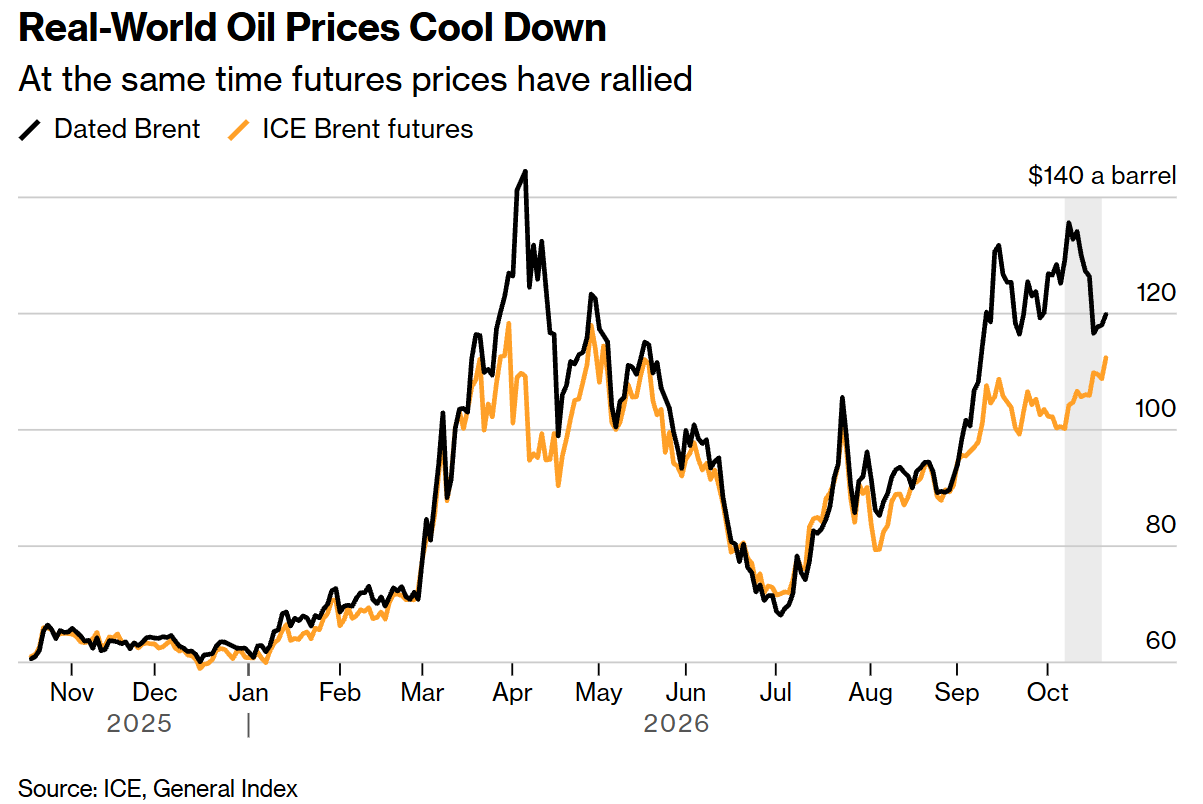
Spot oil prices are cooling
Ryan Fitzmaurice, senior commodity analyst at Marex, said, “There are still plenty of headline risks at play. Oil stocks are quite low, and it is difficult to see inventory reconstruction under current developments.” “At the same time, the market also has ways to find a way out: transportation in the Strait of Hormuz is strong, and El Niño may curb heating demand this winter.”
The price of spot Brent is different from futures because they reflect pricing over different time periods. Traders use the price difference between the two to measure the overall strength or weakness of the oil market. Although the premium for spot Brent has narrowed drastically recently, it is still far above the normal level compared to futures.
Transportation prospects
Traders have every reason to be wary of whether the surge in Middle East traffic will continue. For example, after the US and Iran reached an interim peace agreement at the end of June to allow ships to leave the Strait of Hormuz, the volume of shipments jumped for a while.
This additional supply impacted the global market, causing prices to plummet and plunging the regional Dubai market into a bearish futures rise structure — a sign of oversupply. But within a few weeks, hostilities broke out again, and transportation on this critical waterway was further disrupted.
Since then, the volume of traffic in the Strait of Hormuz has risen again. Although various estimates vary, most tracking agencies believe that crude oil shipments are close to or above pre-war levels. This rebound, combined with falling shipping costs, has put pressure on Middle Eastern crude oil prices in recent weeks.
Price differentials for various crude oil grades, from Oman to Iraq, are narrowing. Crude oil shipped to Asia was recently traded at a premium of more than 10 US dollars/barrel above the Dubai benchmark. According to familiar traders, although it is still high, this premium has fallen sharply from the level of about $35 last month; these traders requested anonymity because they were not authorized to speak to the media.
Derivatives linked to the Dubai benchmark in the Middle East also weakened along with spot crude oil prices in the region. Traders and brokers said that this week's oil spot spread (that is, the difference between this month's contract and next month's contract) has narrowed to less than 1 US dollar per barrel of spot volume, compared to about 15 US dollars a month ago.
Ed Hayden Briffett, a research analyst at The Officials, a research institution under Onyx Capital Group, said, “Middle Eastern oil producers have sold a large amount of crude oil shipped in the fall through tenders.” In contrast, benchmark Brent crude oil futures “are more likely to be affected by headline noise, and prices are naturally more likely to rise and fall.”
options market
The differences between long and short are also reflected in the options market.
In recent days, hundreds of thousands of put options have changed hands — once Brent crude falls below $100, these put options will profit — driving a record number of options trading.
However, relevant people in the options market said they have also seen interest in buying bullish options in recent weeks. They said this split in trading activity reflects a mixed set of positions: some expect the war in Iran to escalate again in the next few weeks, while others expect oil prices to fall.
Much will also depend on the direction of the freight market. Tanker earnings hit a record high this year, with average earnings increasing more than tenfold over the same period last year. This has eroded refining profits, reshaped global oil flows — including more US supply to Europe — and exacerbated the drop in immediate Brent prices.
Currently, most traders expect the Middle East to remain the biggest driver of oil prices, and are worried about whether the situation in Iran will escalate after the midterm elections. Crude oil futures rose again on Thursday after the attack on Saudi Arabia's Shaybah (Shaybah) oil field (which did not affect operations) and the US ordered some personnel to leave the country.
ING analysts, including Warren Paterson, wrote, “This will worry the market, indicate that tension in the Middle East has hardly improved and may escalate further.” “The large risk premium currently included in the price is unlikely to subside until clear signs of easing appear and investors are convinced that regional supply will not be interrupted.”