


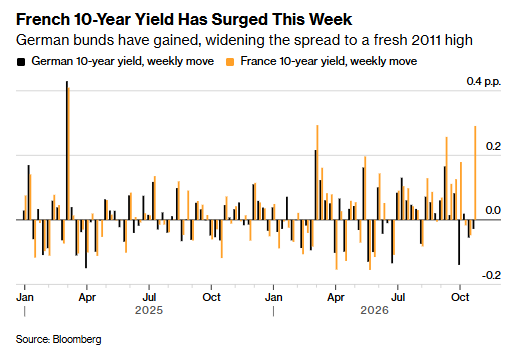
The Zhitong Finance App learned that as widespread risk aversion swept through the global market, capital flocked to German treasury bonds and US treasury bonds to seek refuge, and the pressure on French bonds further intensified.
The premium of French 10-year treasury bonds over German treasury bonds increased by 15 basis points to 174 basis points, the highest level since 2011. Italian bonds were also under pressure, and their yield difference with German treasury bonds widened by 11 basis points to 127 basis points.
This month, France has been on the cusp of anxiety in the bond market. The market is worried that lawmakers will find it difficult to cope with the country's heavy debt burden when protesters clash with the police over the cost of living. Paris police banned demonstrations in parts of the city on Thursday, citing the risk of violence.
Although the current interest rate spread in France has risen to a level similar to that of the European debt crisis, there are still many key differences between the current situation and that year. First, many investors believe that the current market has not fallen into disorderly turmoil, and the conditions for introducing emergency bailout measures have not yet been met. Mario Draghi, the former president of the European Central Bank, recently expressed similar views, saying that policymakers are unlikely to intervene in the short term.
Guinness Global Investors' portfolio manager Craig Visey said that Europe currently has a stronger backup guarantee mechanism than in 2011, and France did not experience the banking pressure that swept through Greece and other countries back then.
However, Weixi still maintains a bearish judgment on the European bond market, believing that there is still room for a sharp rise in yield. In his view, even German bonds are at risk of being drawn into a wider wave of sell-offs in Europe, especially if the market starts to expect Germany to help more heavily indebted countries.
“Germany may have to subsidize other governments in the future, and it may need to issue more debt as a result — I think this concern is beginning to accumulate in the minds of investors,” he said. “The market may think this will become a reality at some point.”
Visi was in charge of Sanlam Investments' fixed income business during the European debt crisis. Currently, he has cut his exposure to Italian and German bonds and increased his holdings in British Treasury bonds and US Treasury bonds.
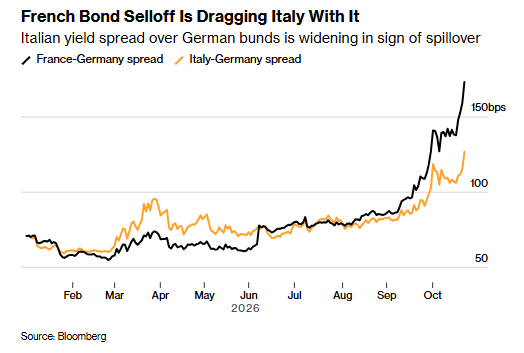
On Thursday, concerns about investment in artificial intelligence (AI) and rising oil prices triggered a widespread safe-haven market around the world. The yield on French 10-year treasury bonds jumped 12 basis points to 5.13%, the highest level since 2002.
Allspring Global Investments believes that there are currently few obvious triggers that can restore market confidence.
“The current yield level is worth watching. 5% will obviously attract attention,” Allspring's chief operating officer of fixed income Henrietta Parkmon said in an interview. “But we are still facing the obstacle of next year's election, and there are still a few months until the general election.”