


As the US midterm elections approach, the AI trading theme linked to the AI computing infrastructure frenzy is experiencing repeated tension between rebound and risk reassessment. On October 19, the Philadelphia Semiconductor Index rose 1.61%, ending eight consecutive trading days of decline; on October 21, it further rose about 2% to close at 11,505.6 points, and the Nasdaq 100 index rose 1.13% to close at 29,822.52 points.
However, the Philadelphia Semiconductor Index has accumulated a cumulative decline of about 8.89% since October, falling more than 20% from its all-time high. It is still hovering in a technical bear market. The short-term recovery has not yet repaired the previous decline; moreover, under the impetus of expectations that Middle Eastern geopolitics seem to be about to deteriorate, NASDAQ 100 stock index futures fell about 2% before the US stock market opened on Thursday, which also means that AI computing power and even the wider semiconductor stock market may once again fluctuate sharply.
Among AI computing power topics in global stock markets, the repetition of the memory chip industry chain is particularly evident: Micron and SanDisk rose 1.96% and 0.94% respectively on October 21, and rebounded 2.97% and 5.53% respectively on the 19th; the KOSPI benchmark index for the Korean stock market fell 3.52% on the 22nd after rising 3.29% on the 21st to close at 5,533.77 points. The stock prices of the world's largest memory chip giants, Samsung Electronics and SK Hynix, fell sharply by 4.03% and 5.49% respectively on the 22nd. The cumulative decline since October reached 20.11% and 31.14%. The short-term rebound and sharp fluctuations in US chip stocks and the renewed pressure on the stock prices of South Korean memory chip giants coexist, indicating that AI computing power and the recovery of risk appetite in the semiconductor industry chain are still unstable.
The Zhitong Finance App learned that as the midterm elections approach, Wall Street still approves the profit expansion brought about by AI, but there is already a clear disagreement about when to add positions and the concentration of allocations. Bank of America Wealth Management CIO said in an October 13 report that strong profits and AI-driven productivity growth may continue to support the stock market until 2027; Citi's own strategist Scott Chronert maintained the S&P 500 target of 8,100 points, while stressing that achieving the goal requires continued strong AI-related profit growth, easing of hawkish concerns about inflation and the Federal Reserve, and the participation of traditional industries in the rise.
The strategy team led by Mike Wilson, chief stock market strategist at Morgan Stanley, believes that if the large benchmark index of the stock market further reflects the pressure of the previous general adjustment of individual stocks, there will be opportunities to increase the allocation of high-quality stocks; the Bank of America derivatives trading strategy team tends to wait for the Federal Reserve meeting and the midterm elections before increasing risk assets. Jefferies (Jefferies) strategists recently proposed diversification of investments beyond AI. Although their GREED & fear portfolio still holds TSMC, Samsung, and SK Hynix, the relevant configuration falls below the regional benchmark weight. Being optimistic about AI's profit growth prospects in the long term, and controlling valuations, policies, and high-leverage technology position risks in the short term are simultaneously becoming the basis for Wall Street institutions to trade during the midterm elections.
Nvidia (NVDA.US), the absolute leader in the global AI computing power theme and market capitalization leader — the “AI chip superpower” with a market capitalization of more than 5 trillion US dollars, is still an important positive pricing anchor for Wall Street strategists under this division.
Based on its closing price of $221.97 on October 21, and assuming that the total share capital of about 24.15 billion shares remains unchanged: Citi maintained a “purchase” on October 22 and had a target price of $315, corresponding to an increase of about 41.91% and an implied market value of about $7.61 trillion; its bullish logic includes incremental computing requirements brought about by continuous operation of the smart body, multiple rounds of model calls, and tool execution. Morgan Stanley resumed Nvidia's “first choice” stock position in the semiconductor sector in early October, maintaining an “increase in holdings” and a target price of 300 US dollars, corresponding to an increase of about 35.15% and an implied market value of about 7.25 trillion US dollars, focusing on the expansion of Vera CPU and network services other than GPUs.
Furthermore, on August 18, Bank of America reiterated its “purchase” and target price as high as 350 US dollars, believing that Nvidia's strong free cash flow can support its investment in the AI ecosystem, rising about 57.68% in response to the above benchmark, with an implied market value of about 8.45 trillion US dollars; Jefferies maintained a “purchase” on August 27, with a target price of 300 US dollars, based on financial reports and business prospects that continued to exceed expectations. The average price target of 62 analysts compiled by S&P Global is $328.72, corresponding to an increase of about 48.09% and an implied market value of about $7.94 trillion. Whether these valuation expectations can be fulfilled will ultimately still depend on whether demand for computing power can continue to be converted into delivery, revenue, and cash flow, and the midterm elections are adding policy variables to this transformation process.
Supreme Court Reshapes Election Campaign: How US Congressional Control Enters AI Asset Pricing
Before the November 3 midterm elections, the Supreme Court intervened in election-related cases with an unusual intensity, and its ruling generally improved the Republican Party's competitive conditions. The Democratic Party needs a net increase of four seats each in the House of Representatives and Senate to gain control; the loss of either House of Representatives could block Trump's legislative agenda and open up space for Democrat-led congressional investigations. For the market, this means that the election results will change the ability to promote policies, the intensity of supervision, and the priority of regulatory issues. As a result, AI infrastructure construction has entered the field of political risk pricing.
The Supreme Court currently has a 6-3 conservative majority. In April of this year, the court weakened one of the key provisions of the Voting Rights Act, making it more difficult for ethnic minorities to challenge the electoral district map on the grounds of racial discrimination. Some Republican-dominated southern states immediately reclassified the House of Representatives constituencies with a high concentration of black voters. Meanwhile, in the middle of the 10-year census cycle promoted by Trump last year, the two parties competed for seats in the House of Representatives; the Supreme Court allowed Texas to implement a new version of the map favorable to the Republican Party.
According to information, the 2019 ruling found that the federal court was not competent to handle electoral district manipulation for partisan interests, and also provided an institutional background for this trend. Liberal Justice Ka Genzhou criticized it for increasing political polarization. In terms of campaign funding, the court lifted the federal ceiling on coordinated spending between political parties and candidates in June. In October, political parties were also allowed to enjoy preferential prices for TV and radio advertisements originally aimed mainly at candidates. The Republican Committee made more active use of the relaxed spending space.
But the Republican Party's judicial advantage coexists with the Democratic Party's electoral advantage. In September, the court blocked Missouri from using a new version of the Republican-biased electoral district map, and also allowed California to implement the Democrat-biased map and rule that the Republican Party did not support on mail-in voting rules and grace periods.
Preliminary polls quoted by some media show that the Democratic Party is still expected to win the House of Representatives; as of the release of the report, Kalshi and Polymarket Exchange reported that the most likely situation was for the Democratic Party to win both houses at the same time. Senior American legal scholar Ilya Somin predicts that more lawsuits are likely to occur after the election, but it is still difficult to determine whether they can enter the Supreme Court. What the market currently needs to continuously digest is a change in the ownership of the National Assembly and the ability to implement policies. It should be noted that the legal victory itself in terms of electoral districts and campaign funding does not lock in the final election results.
From ballots and electricity bills to AI chip orders, trillion-dollar AI computing power investments have met rising bill numbers for ordinary Americans
The reason why this kind of political uncertainty has market weight is that AI has become an important profit pillar in this round of the US stock bull market. According to predictions quoted by Reuters, data center and other AI infrastructure spending will exceed 1 trillion US dollars in 2027, and capital expenses closely related to global AI computing power infrastructure construction are even expected to rise to the 3 trillion US dollar super mark around 2030.
Christopher Gannatti, a senior analyst from WisdomTree, pointed out that since the launch of ChatGPT in November 2022, one of the signals that the market is most concerned about is how much capital five or six large technology companies have invested to accelerate the construction of AI data centers around the world. According to the AI capital expenditure forecast and outlook of the J.P. Morgan strategist team, hyperscale cloud vendors will spend about 950 billion US dollars in 2026, 1.4 trillion US dollars in 2027, and 3 trillion US dollars in 2030.
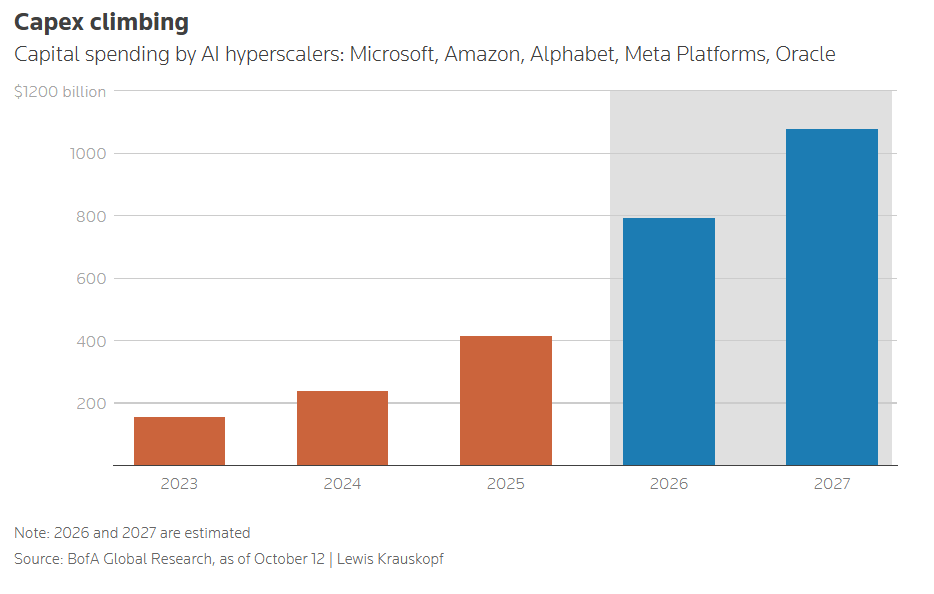
As facilities expand, energy bills, environmental pressures, and concerns about AI itself are turning capital market growth narratives into political issues that community residents can directly feel. According to this month's Reuters/Ipsos poll, 69% of registered Democratic voters and 43% of registered Republican voters support restrictions on data center construction, and opposition has a cross-party basis.
Market participants interviewed regard the Democratic Party's simultaneous control of both houses as the situation with the greatest pressure on AI transactions in potential election results, but it is widely believed that nationwide legislation that completely hinders data center expansion is still difficult to implement. Matt Gertken, a strategist from BCA Research, judged that Trump is likely to block such legislation, and is more likely to accept legislation to strengthen AI regulations without “putting the brakes on” capital expenditure and construction. The importance of data centers for economic growth, as well as concerns about falling behind China, may also restrain some Democratic lawmakers. The more immediate impact on the market comes from increased surveillance: Brian Gardner, portfolio manager from Stifel, predicts that after the Democratic Party takes control of Congress, hearings, investigations, and negative news may increase, thereby amplifying AI asset fluctuations.
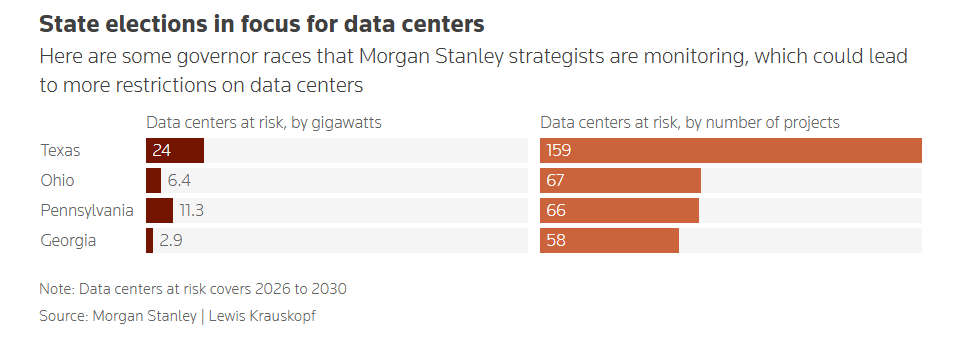
The political power that really affects the implementation of the project is also distributed at the state and local levels. Ownership of governor, state legislature, and utility supervisory positions may change the rules, restrictions, and construction conditions faced by data centers. Morgan Stanley is watching the gubernatorial elections in the seven states of Texas, Ohio, Pennsylvania, Georgia, Nevada, Wisconsin, and Michigan; Beacon Policy Advisors emphasized that investments are highly concentrated in specific regions, so the importance of these local elections is particularly prominent. Trump proposed on October 21 that data center development companies should pay “dividends” to the community to seek support. It also indicates how construction proceeds are distributed between enterprises and residents; however, Trump's statement is currently an initiative.
Derived from the economic nature of the project, policy risk first affects the commissioning time, cost burden, and return on investment. Delays in construction or power delivery may push back some server deployment, equipment acceptance, and billing of computing power services; if enterprises need to bear more grid expansion, community compensation, or compliance costs, project returns will also be under pressure.
For new cloud businesses that rely on external financing, the mismatch between delayed revenue and continued financing expenses is more sensitive. Recent debt concerns surrounding CoreWeave have shown that investors are beginning to strictly examine the funding sources and cash recovery capabilities of AI expansion; new policy friction may further affect its credit spreads and equity valuations.
The investment analysis of the AI industry chain needs to further focus on the power supply guarantee, construction license, customer contract and financing capacity of downstream data center projects, as well as the computing power utilization rate and revenue fulfillment progress after commissioning, that is, who has implemented power supply and underlying energy security, obtained permission to accelerate the construction of AI data centers, who has reliable customers, high utilization rates and sufficient financing capacity, and when these conditions are converted into revenue.
The accelerated expansion of AI smart applications led by Meta Muse and OpenAI Astra still provides long-term demand support for Nvidia and storage vendors, but progress at the AI data center construction and operation level of different customers, regions, and large-scale infrastructure projects may change the pace of equipment procurement, delivery, and revenue recognition. The latest judgment from BNY Wealth portfolio manager Kevin Shea reveals this risk: policy uncertainty may not drive the AI investment theme off track, but it may delay project implementation and raise construction and operating costs. Therefore, the substantial impact of the midterm elections on AI transactions mainly focuses on whether policy changes prevent huge capital expenditure from being converted into operational computing power on schedule, and further generate continuous revenue and cash returns.
Three potential outcomes of the US midterm elections will influence the next pricing trajectory of the global stock market
The US midterm elections are shifting the pricing focus of the AI bull market from the record scale of AI capital expenditure surrounding the AI computing infrastructure frenzy to policy restrictions, production progress, and financing costs.
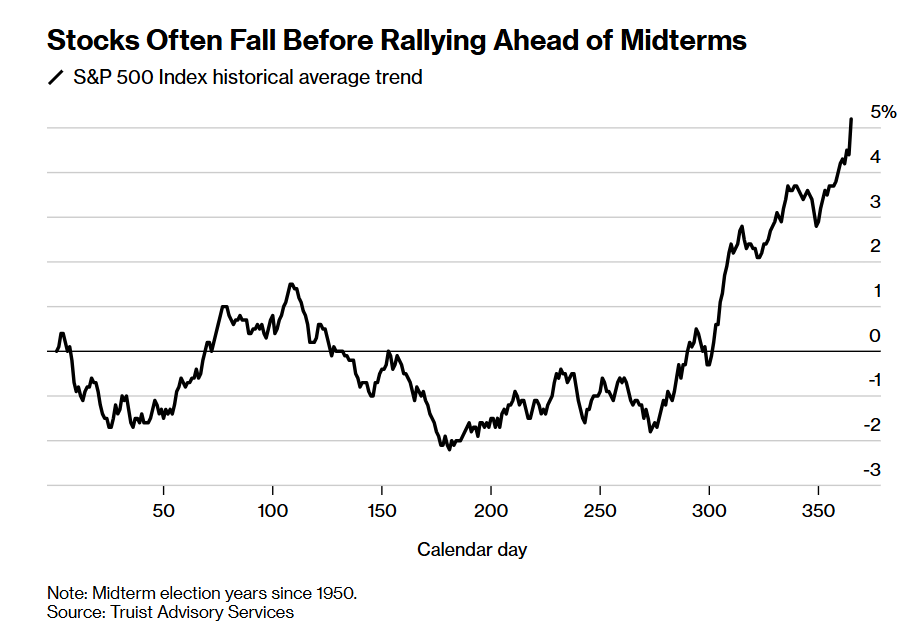
The Supreme Court's ruling changed the terms of election competition, and congressional ownership would affect the legislative, investigative, and regulatory agendas. Some media quoted Wells Fargo statistics as saying that in the 12 months after every midterm election after World War II, the S&P 500 index recorded an increase; however, up to this point this year, S&P has accumulated a cumulative increase of 13%, and has not experienced a typical pre-election decline or pre-election bear market trend. Therefore, whether the market can continue after the election requires support for corporate profits, economic growth in 2027, and consumer resilience. The cross-party opposition to data center construction has given special weight to AI transactions in this round of elections.
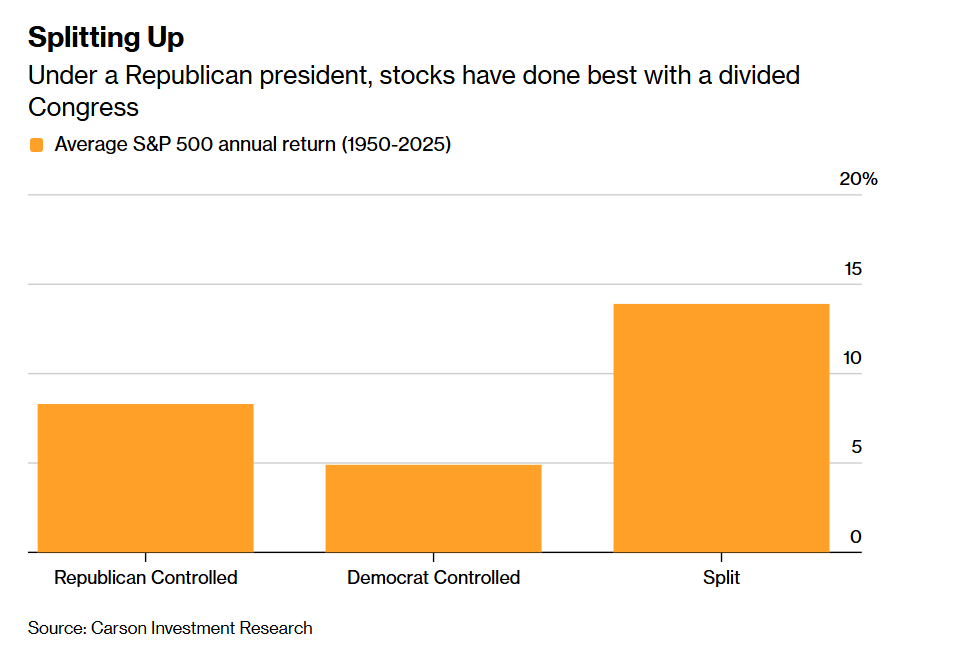
The division of Congress is a situation that Stuart Kaiser, a senior Citigroup strategist, believes is most beneficial to the current stock market situation. If the Democratic Party takes back only one house, the differences between the two houses combined with Trump's veto power will reduce the possibility of major tax and regulatory policy adjustments and make investors more focused on profit and economic growth. According to Carson statistics, since 1950, during the Republican presidential administration, the average annual increase in US stocks corresponding to congressional divisions was 13.7%, higher than the 8.3% and 4.9% increase when the Republican Party and the Democratic Party controlled the two houses respectively. Limited room for fiscal expansion may also reduce pressure on new deficits and treasury bond supply, support bond prices, and improve corporate investment returns through lower financing costs. However, Trump can still influence the market through tariffs and foreign policies, and the congressional impasse does not mean that fluctuations in administrative policy will disappear simultaneously.
If the Democratic Party takes back both houses at the same time, it may first impact the valuation and risk appetite of AI assets, and only then depends on whether the policy can actually influence operations. Stricter data center construction rules or model supervision may delay the procurement of chips, servers and supporting equipment, and delay the realization of AI service revenue. However, Trump is inclined to support AI, and it is extremely difficult for the Democratic Party to obtain the supermajority needed to overthrow the presidential veto. Therefore, nationwide legislation that severely limits AI expansion still faces a high threshold. More realistic pressure comes from hearings, investigations, and investors' rejudgment of future policy direction; combined with previous Reuters reports, licensing, power supply, and community coordination at the state and local levels is an important channel for changes in construction time and costs. For leaders such as Nvidia and Microsoft, what needs to be paid attention to is how these changes are transmitted to customer production and order fulfillment.
The Democratic Party's sweep of both houses may also push for repricing between industry and assets: if it uses political influence to mitigate Medicaid spending cuts, some health-care companies may benefit; stricter military spending reviews may suppress defense contractors' expectations. The direction of bonds and the US dollar depends more on the subsequent policy mix: if Trump shifts to more aggressive tariffs or foreign action, rising inflation and risk premiums may put pressure on bonds; if AI investment slows down US growth expectations, it may drag down the dollar, but high energy prices and expectations of the Federal Reserve's interest rate hike may also be supported. Therefore, this is why the same election results can simultaneously have different effects on finance, inflation, and growth, and cannot be directly equated with a single conclusion of the rise and fall of equity and debt.
The Republican Party's retention of both houses may continue the policy environment conducive to the expansion of AI and drive growth expectations in economically sensitive sectors such as finance and industry. However, if subsequent fiscal stimulus boosts demand, deficits, and bond yields, corporate financing costs and stock discount rates may also rise, offsetting some of the growth benefits. From this perspective, the core investment judgment corresponding to the three election results is whether AI capital expenditure can successfully complete approval, construction, and electricity transmission under an affordable capital cost, and be converted into orders, revenue, and cash flow. Large-scale AI infrastructure projects with clear power supply arrangements, reliable customer contracts, and steady financing capabilities will be more likely to reflect value in policy differentiation.