


As of the first half of 2026, a total of 94 companies have passed Chapter 18A listing, and 93 are still listed; in the first half of the year, 11 unprofitable biotech companies raised about HK$12.5 billion in IPOs, and their financing activity picked up. However, Hong Kong stock healthcare IPOs slowed significantly in the third quarter. Only 2 non-18A medical companies went public and both broke on the first day, and the issuance window narrowed. During the same period, the Hang Seng Biotech Index rose 17.4% in the first three quarters and rose 31.7% in the third quarter, outperforming the Hang Seng Index. The second-tier valuation repair contrasted with the cooling of first-level issuance, highlighting the scarcity of already commercialized 18A companies. Market evaluation standards shifted to clinical data quality, differentiation mechanisms and commercialization execution.
In this context, Ganzhou Hemei Pharmaceutical Co., Ltd. (“Hemei Pharmaceutical” for short) successfully passed the Hong Kong Stock Exchange main board listing hearing and plans to be listed in accordance with Chapter 18A of the “Listing Rules”. The sole sponsor is SDIC Securities International. This innovative pharmaceutical company, which has been deeply involved in the field of autoimmune diseases and oncology for more than 20 years and has commercialized its first core product, is using the international platform of the Hong Kong capital market to enter a new stage of development driven by a two-wheel drive between R&D and commercialization.
So, at a time when the differentiation of the 18A sector is intensifying and commercialization capabilities are the core valuation anchor, what kind of product pipeline and financial infrastructure does Hemei Pharmaceutical actually rely on to stand out from many biotech companies? Can the differentiated advantages and multi-indication expansion potential of its core product Mufemilast support the market's long-term expectations for this new 18A company?
Prospects for the industry are promising
The Zhitong Finance App learned that autoimmune diseases and tumors are the two major treatment areas with the greatest potential for growth in the global pharmaceutical market. According to Frost & Sullivan's report, the global autoimmune disease drug market has grown from US$101.69 billion in 2019 to US$154.9 billion in 2025, and is expected to rise further to US$247.7 billion in 2032. The growth rate of the Chinese market is even more remarkable, from US$2.4 billion in 2019 to US$5.3 billion in 2025, with a compound annual growth rate of 14.5%, and is expected to reach US$26.5 billion in 2032.
In the field of oncology, the global oncology drug market has reached 278.2 billion US dollars in 2025, of which targeted treatments account for about 60%. The Chinese oncology drug market is also dominated by targeted drugs, accounting for 50.3% of the total market in 2025. Among them, in terms of psoriasis, a key indication in the field of autoimmunity, China's medium to severe plaque psoriasis drug market will reach 8.6 billion yuan (RMB, same below) in 2025, and is expected to increase to 16.5 billion yuan in 2028 and 27.2 billion yuan in 2032, with a compound annual growth rate of 24.5% from 2025 to 2028.
At the same time, there is still a large unmet clinical need for indications such as Behcet's disease and ulcerative colitis in China. Up to now, there are no targeted drugs approved to treat Behcet's disease in China, and traditional treatments face pain points such as low mucosal healing rate and poor long-term safety in the treatment of ulcerative colitis. This market pattern provides a broad market space for innovative small molecule drugs with differentiated mechanisms of action and good safety characteristics, and also creates a favorable growth environment for enterprises such as Hemei Pharmaceutical with independent discovery and independent development as their core capabilities.
Core products have been approved for commercialization
According to the prospectus, Hemei Pharmaceutical was founded in 2002 and is a biopharmaceutical company dedicated to the discovery and development of independent discovery and small molecule drugs for autoimmune diseases and tumors. Up to now, the company has built a product pipeline including an approved drug, Mufemilast, and five small molecule drug candidates, covering psoriasis, Behcet's disease, ulcerative colitis, atopic dermatitis, chronic obstructive pulmonary disease, Crohn's disease, psoriatic arthritis, and advanced breast cancer. Three drug candidates have entered phase II or phase III clinical trials, covering a total of nine indications.
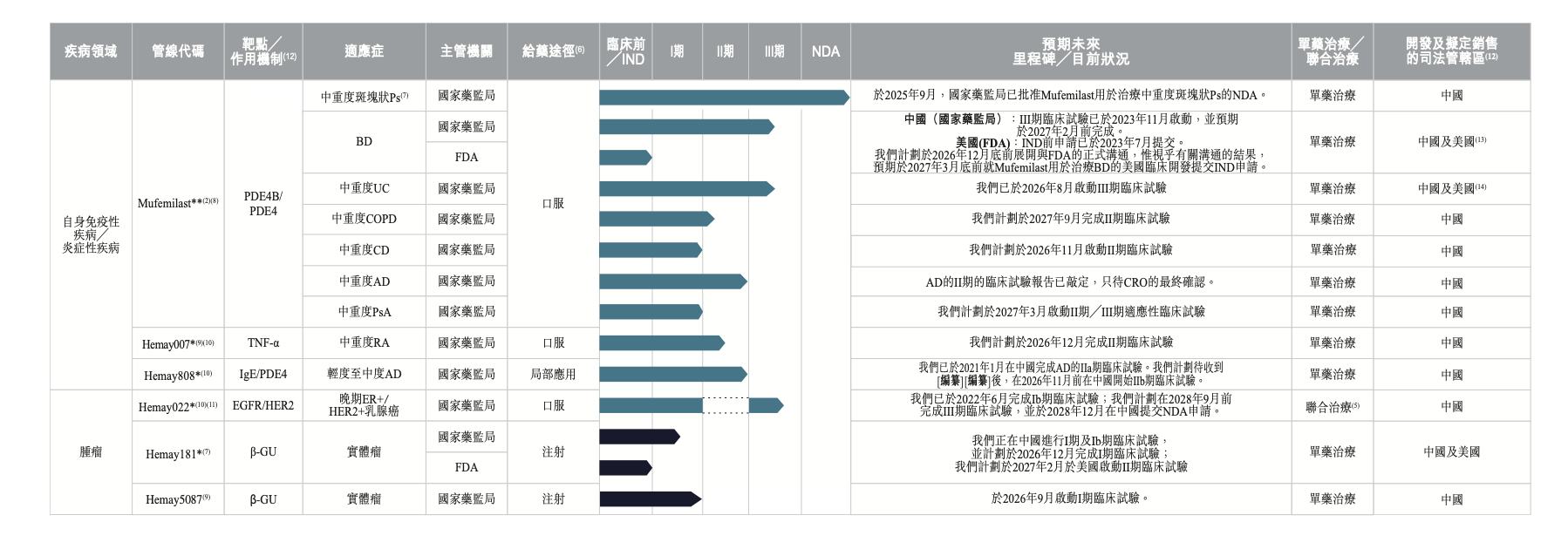
Among them, the core product Mufemilast is a strategic pillar of the company. This drug is a novel small-molecule phosphodiesterase 4B (PDE4B) protein expression blocker and PDE4 inhibitor, which has the potential to treat a wide range of autoimmune diseases. It does not cause vasculitis and does not easily cross the blood-brain barrier, thereby reducing central nervous system side effects such as depression and suicidal tendencies. In September 2025, Mufemilast received NDA approval from the National Drug Administration to treat moderate to severe plaque psoriasis, becoming the company's first commercialized product.
Mufemilast's clinical data showed significant differentiating advantages. In its critical phase III clinical trial, the PASI-75 response rate at week 16 reached 53.6%, significantly superior to 16.0% of the placebo group, the PASI-90 response rate reached 32.5%, and the spGa improvement rate of 31.3%. More importantly, the drug showed good safety characteristics. No deaths or cases of drug-related depression were reported in clinical trials. Most adverse reactions were grade 1 or 2, and mainly occurred during the first week of administration. It is particularly noteworthy that among 105 psoriatic patients positive for latent tuberculosis infection, no active cases of tuberculosis were observed after 52 weeks of treatment, making MuFemilast currently the only drug that can be directly used in psoriatic patients infected with latent tuberculosis and whose safety is supported by phase III clinical data. It has outstanding clinical value in the Chinese market where the burden of tuberculosis is heavy.
With the exception of psoriasis, Mufemilast's multi-indication expansion is progressing steadily. Key phase III clinical trials for Behcet's disease and ulcerative colitis are ongoing, phase II clinical trials for chronic obstructive pulmonary disease have been initiated, phase II clinical trial reports for atopic dermatitis have been finalized, and phase II/III adaptive clinical trials for psoriatic arthritis and phase II clinical trials for Crohn's disease are also being prepared. The company has obtained the FDA's orphan drug qualification for Mufemilast for the treatment of Behcet's disease, and plans to officially communicate with the FDA by the end of December 2026 to discuss the feasibility of directly carrying out phase III clinical trials in the US.
The key product Hemay022 is an EGFR/HER2 dual-target small molecule irreversible inhibitor intended for second-line therapy for advanced ER+/HER2+ breast cancer. The phase Ib clinical trial showed that among 55 evaluable patients, the objective remission rate was 29.1%, the clinical benefit rate was 56.4%, and the median progression-free survival was 9.0 months. The drug is currently undergoing phase III combination therapy clinical trials in China, and the company plans to submit an NDA application in December 2028. The key product, Hemay181, is a beta-GU-targeting SDC drug. It is the first SDC drug in China to be activated by β-GU in the tumor microenvironment and is in the clinical stage. It is currently undergoing phase I clinical trials in China, and has been approved by the FDA to conduct phase I clinical trials in the US.
In terms of commercialization, the company uses a model combining internal commercial teams, third-party distributors, and contract sales organizations. As Ganzhou production facilities and Xiajiang production facilities passed GMP compliance inspections in March 2026 and April 2026 respectively, the company began commercial sales of Mufemilast in July 2026. Up to now, the company has supplied a total of 2,000 boxes of Mufemilast to nine distributors, covering Shaanxi, Jiangxi, Beijing, Shandong, Sichuan, Henan, Ningxia and Guangdong. The company's internal sales team consists of eight members, and has signed agreements with 11 dealers and eight contract sales organizations to initially establish a commercial network covering many provinces.
The first year of commercialization began
However, it should be noted that as an 18A biotechnology company in the early stages of commercialization, Hemei Pharmaceutical, which does not yet have a stable source of revenue, is already moving forward with a “heavy burden.”
According to the Zhitong Finance App, in 2024, 2025, and the four months ending April 30, 2026, the company has not yet generated revenue from product sales revenue, mainly because Mufemilast was approved by the NDA in September 2025, and commercial sales only began in July 2026. The company's losses before tax for the first four months of 2024, 2025 and 2026 were $123 million, $130 million and $32.4 million respectively. The losses mainly came from R&D expenses and general and administrative expenses, which is in line with the general characteristics of 18A Biotech Company in the early stages of product commercialization. It is worth noting that losses for the first four months of 2026 were significantly narrower than in the same period of 2025, mainly due to phased optimization of R&D expenses and effective control of administrative expenses.
In order to continuously advance research and development, Hemei Pharmaceutical has also spent a lot of financial and material resources in recent years. In 2024, 2025, and the first four months of 2026, the company's R&D expenses were 96.987 million yuan, 90.275 million yuan and 2010 million yuan respectively, accounting for 74.0%, 65.8% and 61.8% of operating expenses for the same period, respectively. In response, the company admits that it must continue to invest significant human and capital resources to develop or obtain technology to enhance the scope and quality of clinical trials. If it fails to successfully develop, enhance or adapt to new technologies and obtain sufficient intellectual property protection and regulatory approval for related technologies, it may face the risk of technology becoming obsolete, thereby harming its business and prospects. This is probably the company's intention to actively go to the Hong Kong IPO. The company expects to gradually generate operating cash inflows as commercialization of Mufemilast progresses and pipeline products are approved one after another.
Taken together, as an 18A biotechnology company with independent discovery capabilities, commercialization of core products, and the potential to expand multiple indications, Hemei Pharmaceutical is establishing a unique competitive advantage in the field of autoimmune disease treatment with Mufemilast's differentiated dual action mechanism, solid clinical data, good safety features, and clear multi-indication development strategies. As the Hong Kong stock listing process progresses, the company is expected to use the power of the capital market to accelerate the commercialization and global layout of products, bring more innovative treatment options to patients around the world, and create long-term value for investors.