


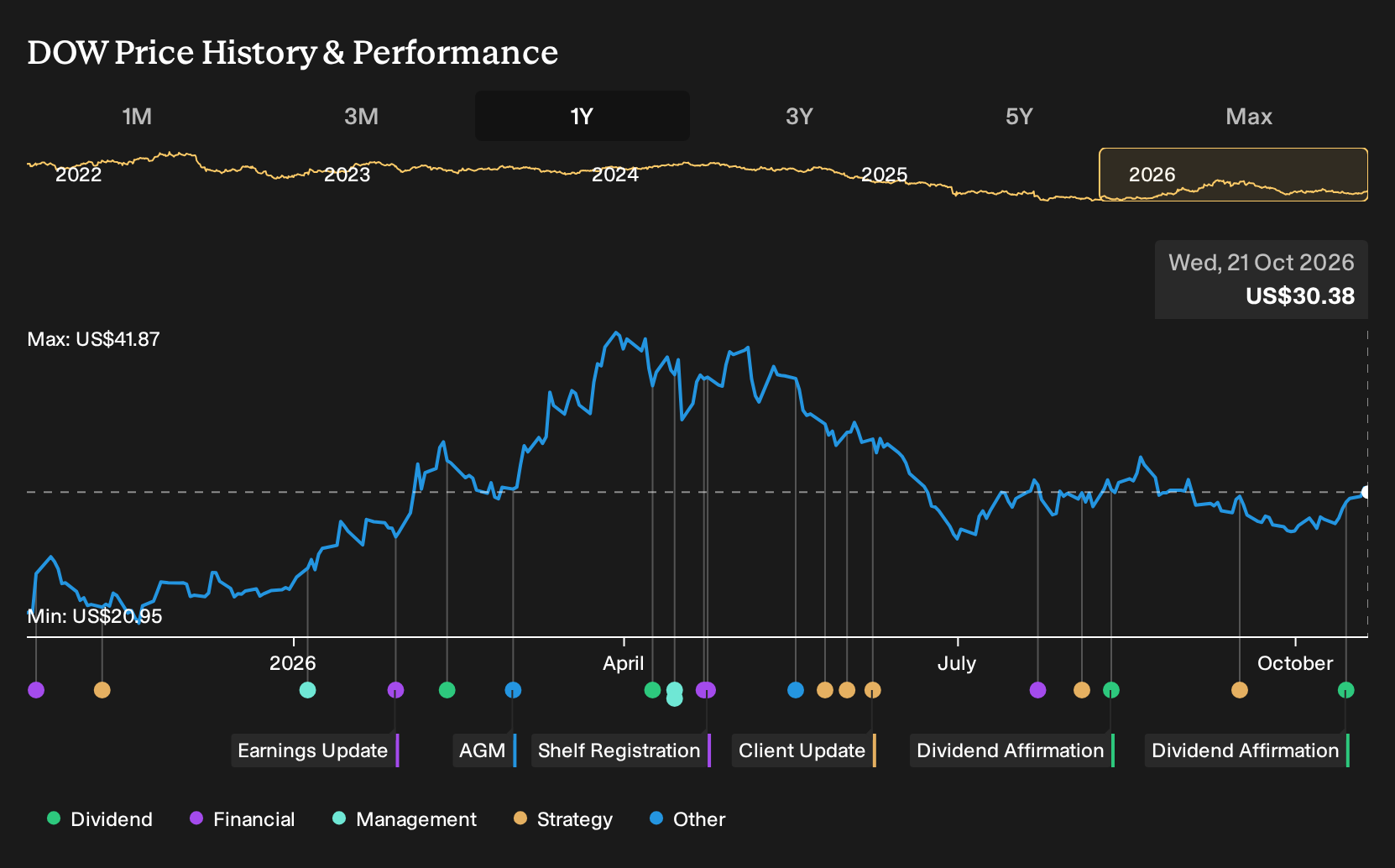
If you had bought Dow on 21 October 2025 and simply held through a year of supply shocks, layoffs, nuclear power plans and a CEO handover, the outcome on your account would look very different from the anxiety in those headlines. For Dow shareholders, the return over the past year was 46.9%, including dividends. If that decision were in front of you again, which mattered more at the time: the cost cuts or the decarbonization risks?
The useful thing about a Narrative is that the reasoning is checkable: the assumptions sit beside the argument, and together they imply an estimated Fair Value you can disagree with.
Dow has already moved. See which of 33 high quality undervalued stocks still trade below our estimates.
What Dow Investors Were Really Arguing About
The shares cost US$21.75 at the start, and Dow sat between two very different stories that both sounded reasonable at the time.
On the bullish side, one camp saw Fair Value at US$28.24, based on revenue growing 0.8% a year with profit margins reaching 4.1% and a future P/E of 15.7x over three years.
The bearish view put Fair Value closer to US$20, expecting revenue to decline 1.0% annually even as margins moved up to 3.8% and the future P/E reached 12.6x.
What The Results Changed For Dow
Dow’s Q2 2026 numbers did the heavy lifting in this debate. Revenue moved from US$10,104m in Q2 2025 to US$12,092m, while net income shifted from a loss of US$839m to a profit of US$715m. Net margin moved from -8.3% to 5.9%. That swing pointed toward the bullish cash flow and margin story, although one period does not settle it.
The useful test here was simple. The optimistic case leaned on margin repair more than headline growth. For the next stock you assess, track whether net income and net margin move in the direction and rough size implied by the original thesis, not just whether revenue or the share price change.
What Dow’s Current Price Already Assumes
Today Dow trades at US$30.38. The selected Narrative argues that Fair Value sits above that level, anchored in execution on self help plans, asset tweaks and cash now available from earlier legal settlements.
In that view, a buyer at today’s price is effectively assuming Dow’s advantaged feedstock footprint and energy projects will not reshape long run earnings mix as much as the thesis implies.
"Dow's receipt of about US$1.3b of litigation proceeds earlier in 2026 gives the company extra capacity to fund the next wave of high return self help and portfolio projects beyond what consensus models typically assume, which can influence future earnings and free cash flow."
One Narrative has put a figure on that disagreement. → See the Narrative with its higher Fair Value, assumptions and all
Find Your Own Contrarian Opportunity
What if your next investment idea came before the headlines? Go straight to the companies whose prices and our estimates still disagree. Three places to start, with the names waiting behind the link.
- Company 1 - 33% below our estimate - convert subsea project demand into higher margin, long duration services contracts.
- Company 2 - 40% below our estimate - tackle complex technical and regulatory challenges, including multi disciplinary AI related assignments.
- Company 3 - 22% below our estimate - embed AI tools into cloud, productivity, developer and security workflows in one ecosystem.
Those are three of them. See all 25 companies with the balance sheet to back it up →
Have feedback on this article? Concerned about the content? Get in touch with us directly. Alternatively, email editorial-team@simplywallst.com